
An electric vehicle may hold enough stored energy to keep important home systems running through an outage. But using that energy safely is not as simple as plugging your car into a wall outlet or connecting an extension cord to the electrical panel.
Vehicle-to-home charging, often shortened to V2H, is a coordinated home-energy setup. It needs a compatible EV, approved bidirectional charging hardware, and electrical equipment that disconnects your home from the utility grid before vehicle power can reach household circuits.
For homeowners considering an EV partly as an alternative or supplement to a generator, the practical questions are compatibility, installation design, and loads. A well-planned system may support selected essentials for an extended outage. A poorly matched one may not run the appliances you expect—or may not be permitted to operate at all.
What Is Vehicle-to-Home Charging?
Vehicle-to-home charging lets a compatible EV battery send electricity back into a home. Instead of electricity flowing only from the grid to the car, the system can reverse that flow during an outage or, in some setups, during planned energy-management events.
The U.S. Department of Energy groups this capability under bidirectional charging. When electricity is sent to a building, it is commonly called vehicle-to-building (V2B). V2H is the residential use case: the vehicle supports a house rather than a commercial building. DOE’s overview of bidirectional EV charging also distinguishes this from vehicle-to-grid, or V2G, where electricity is exported to the utility grid under a utility-approved arrangement.
V2H also differs from vehicle-to-load, or V2L. V2L uses outlets built into an EV or a vehicle-specific adapter to run individual devices, such as a refrigerator, power tools, lights, or a camping appliance. It can be useful during an outage, but it does not normally energize your home’s wiring. V2H is designed to supply household circuits through properly installed electrical equipment.
How an EV Powers a House During an Outage
A V2H system works more like a stationary battery backup system than a conventional EV charger. The exact hardware varies by automaker, but the basic sequence is similar:
- The system detects a utility outage.
- A gateway, backup switch, home integration system, or similar device isolates the home from the grid.
- The compatible EV begins discharging through approved bidirectional charging equipment.
- That equipment supplies power to selected circuits or, in some installations, the entire home.
- When grid power returns, the system transitions back according to its configuration.
Grid isolation is an essential safety requirement. Your home cannot feed electricity onto utility lines during an outage, where it could endanger utility crews and damage equipment. This is why a standard EV charging cable, a regular outlet, or an improvised panel connection is not a substitute for a V2H installation.
The home integration equipment handles the transition and prevents unintended backfeed. Depending on the system, it may also measure household demand, communicate with the EV, and manage circuits that use more power than the vehicle can provide at one time.
What You Need for Vehicle-to-Home Charging
Before treating an EV as EV home backup power, confirm that all parts of the system are compatible. In most cases, you need these three pieces.
A V2H-capable EV
Not every EV can discharge power to a residence. Bidirectional capability depends on the vehicle’s hardware, software, battery configuration, connector, and the manufacturer’s approved home-energy equipment.
Do not assume a vehicle with V2L capability also supports home backup. Likewise, do not assume every trim, model year, or battery size of a nameplate will work. Check the automaker’s current documentation for your exact vehicle before buying charging or integration hardware.
Approved bidirectional charging equipment

A bidirectional EV charging system must move energy in both directions: into the vehicle for normal charging and out of the vehicle when it is powering the home. The equipment may be described as a bidirectional charger, charging station, inverter system, or a manufacturer-specific home-energy package.
Manufacturer approval matters. A V2H charger that works with one brand’s EV may not work with another, even when the connectors appear similar. Use the equipment specified for your vehicle and market rather than trying to combine components from unrelated systems.
Home integration and transfer equipment
Your home needs equipment that can safely separate it from the utility and distribute EV power to the intended circuits. Depending on the manufacturer and installation plan, this can include a gateway, backup switch, home hub, transfer equipment, energy meter, load controller, or a dedicated essential-loads panel.
An electrician may also need to assess your main service panel, service capacity, grounding, wiring routes, and the location of the EV charger. Older homes or homes with full panels may need additional electrical work before a system can be installed.
Permits and utility coordination
Local building departments and utilities set requirements that can affect the design and timeline. Permits, inspections, interconnection applications, export restrictions, and rate-program rules vary by location. DOE recommends reviewing your serving utility’s requirements, particularly when a bidirectional system could send electricity beyond the home. Its guidance on managed and bidirectional charging notes that grid-service programs and interconnection arrangements remain location-dependent.
Whole-Home Backup vs. Essential-Loads Backup
One of the most important decisions is whether the EV should power the whole home or only selected circuits. Neither approach is automatically better. The right choice depends on the vehicle’s output, your panel and wiring, your daily electricity use, and which appliances matter most during an outage.
An essential-loads design commonly prioritizes refrigeration, internet equipment, lights, garage-door access, selected outlets, a furnace blower, and some medical or sump-pump circuits. By limiting demand, it can stretch the available battery energy and reduce the risk that large appliances overload the system.
Whole-home backup can be more convenient, but it requires careful planning. A home may contain several high-demand loads that are unlikely to run well together from an EV: central air conditioning, electric resistance heat, electric water heating, clothes dryers, ovens, well pumps, pool equipment, and EV charging itself.
Keep two ratings separate when comparing systems:
- Kilowatts (kW) indicate how much power the system can deliver at one time. This affects which appliances can run simultaneously.
- Kilowatt-hours (kWh) indicate stored energy. This affects how long the battery can support the home.
Startup loads matter, too. Motors in air conditioners, pumps, refrigerators, and some HVAC equipment can briefly demand more power when starting than when running. Load management, soft-start equipment, or an essential-loads plan may be needed even if the EV’s battery is large.
If you are evaluating broader load control for EVs, heat pumps, and batteries, our related guide, Smart Electrical Panels for Home Energy Management, is a useful next read.
How Long Can an EV Run Your Home?

There is no single answer because backup time is a math problem shaped by your household behavior. The starting battery charge, usable battery capacity, weather, appliance use, and supported circuits all affect results.
A simple planning estimate is:
Usable EV battery energy ÷ average home load = approximate backup duration.
For example, reducing a home’s load by turning off air conditioning, electric cooking, laundry equipment, and other large loads can materially extend runtime. A household using power sparingly may get through a multi-day outage, while a home running several large electric appliances may drain the same vehicle much faster.
Ford and Tesla publish multi-day backup examples based on household consumption of roughly 30 kWh per day. Those figures are useful illustrations of why household load matters, not guarantees for every home, outage, or vehicle battery. Reserve energy is another personal decision: some owners may want to preserve enough charge for evacuation, commuting, or access to a public charger after the outage.
Before installation, look at your utility bills or an energy monitor to identify your normal daily consumption and major loads. Our guide to the best home energy monitors for tracking electricity use can help you understand the consumption data that makes backup planning more realistic.
Examples of V2H Systems Available in the U.S.
Current U.S. offerings show why it is important to buy a complete, approved system rather than treating bidirectional EV charging as a universal feature.
Ford F-150 Lightning Intelligent Backup Power
Ford’s Intelligent Backup Power system for the F-150 Lightning uses the Ford Charge Station Pro and a Home Integration System. Ford describes the setup as one that can detect an outage and provide backup power to the home when properly installed. Compatibility and installation details should be confirmed for the specific truck and home before purchase.
GM Energy V2H system
GM Energy’s approach uses a properly equipped eligible GM EV along with the GM Energy PowerShift Charger and V2H Enablement Kit. GM notes that the home must be suitable for the installation and that grid interconnection requirements can apply. Confirm the current eligible vehicle list, software requirements, and local availability directly with GM Energy and an approved installer.
Tesla Cybertruck Powershare Home Backup
Tesla’s Powershare Home Backup is designed for the Tesla Cybertruck and uses a Tesla Universal Wall Connector with a Powershare Gateway. Tesla describes both whole-home and partial-home configurations, with final capability dependent on the installation and household loads. See Tesla’s current Powershare Home Backup documentation for its equipment requirements and supported configurations.
These are examples, not a universal compatibility list. EV availability, supported model years, software versions, equipment packages, and installer coverage can change.
Can Solar Panels Recharge an EV During an Outage?
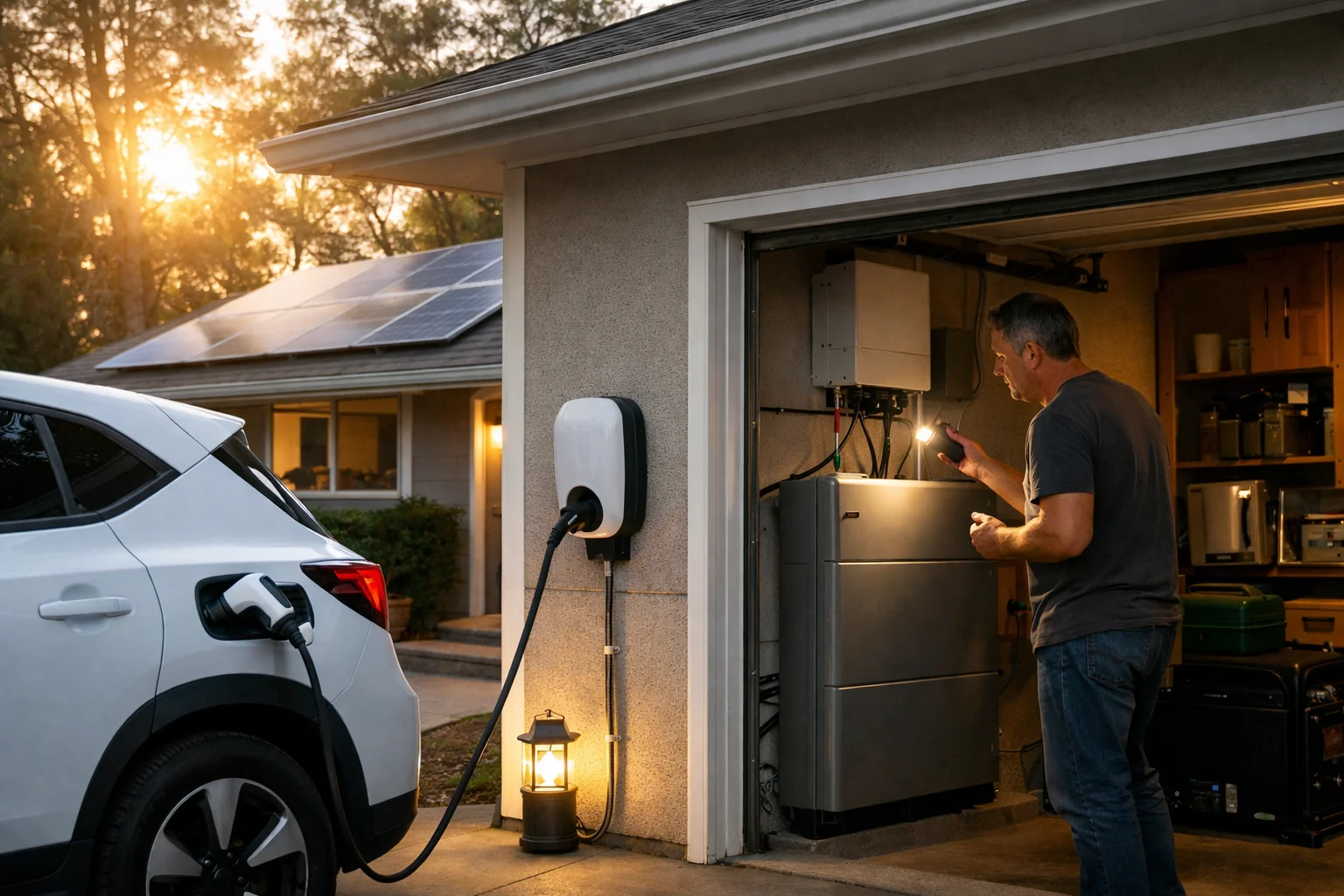
Possibly, but do not assume it will happen automatically. A typical grid-tied solar system shuts down during an outage unless it has equipment designed to form and manage an isolated backup system.
For solar to recharge an EV while the grid is down, the solar inverter, battery system if present, gateway or transfer equipment, and bidirectional EV system must be designed to work together in islanded operation. The system also needs to balance solar production, household demand, and charging limits.
Ask the installer and manufacturers for written confirmation that your specific solar equipment can support outage-time EV charging. If you already have solar plus a home battery, verify the proposed architecture before assuming the EV will simply become another battery on the system.
V2H vs. Vehicle-to-Grid Charging
Vehicle-to-home charging is focused on supplying your own home, especially during an outage. Vehicle-to-grid charging sends electricity from the EV to the utility grid, usually under an enrollment program, rate structure, and interconnection agreement.
V2G may eventually provide opportunities to earn credits or support grid reliability, but it is not the same as home backup and is not broadly available in every utility territory. If grid export is important to you, ask both the automaker and your utility whether an approved program exists for your vehicle and address.
Limitations and Safety Checks Before Buying
V2H can be compelling, but it is not a drop-in replacement for every generator or stationary battery system. Consider these checks before committing:
- Confirm exact vehicle compatibility. Verify your EV’s model year, trim, battery, software status, and approved hardware.
- Make a backup-load list. Decide whether you need selected circuits or practical whole-home coverage, then account for large and motor-driven appliances.
- Plan for vehicle availability. Your backup battery may be away from home when an outage begins, and using it for backup reduces driving range.
- Get a site assessment. An electrician should evaluate panel capacity, wiring, charger location, service upgrades, and required safety equipment.
- Check utility and permitting rules. Ask whether interconnection paperwork, export limits, inspections, or special equipment are required.
- Verify solar integration. Existing solar and storage systems may require specific compatible controls to operate during an outage.
- Request an itemized installation quote. Equipment, labor, panel work, trenching, permits, and utility-related work can all affect installed cost.
The Bottom Line
Vehicle-to-home charging can make an EV a valuable emergency energy resource, but only as part of a properly matched system. The vehicle, bidirectional equipment, home integration hardware, electrical design, and local utility rules all have to line up.
Start with the loads you need to protect, then verify your exact EV’s eligibility and ask a qualified installer how the system would isolate your home from the grid. That approach will tell you whether V2H is a practical backup solution for your household—or whether a smaller essential-loads setup, portable V2L option, stationary battery, or generator better fits your needs.
Useful references: Bidirectional Charging and Electric Vehicles for Mobile Storage · Managed and Bidirectional Charging