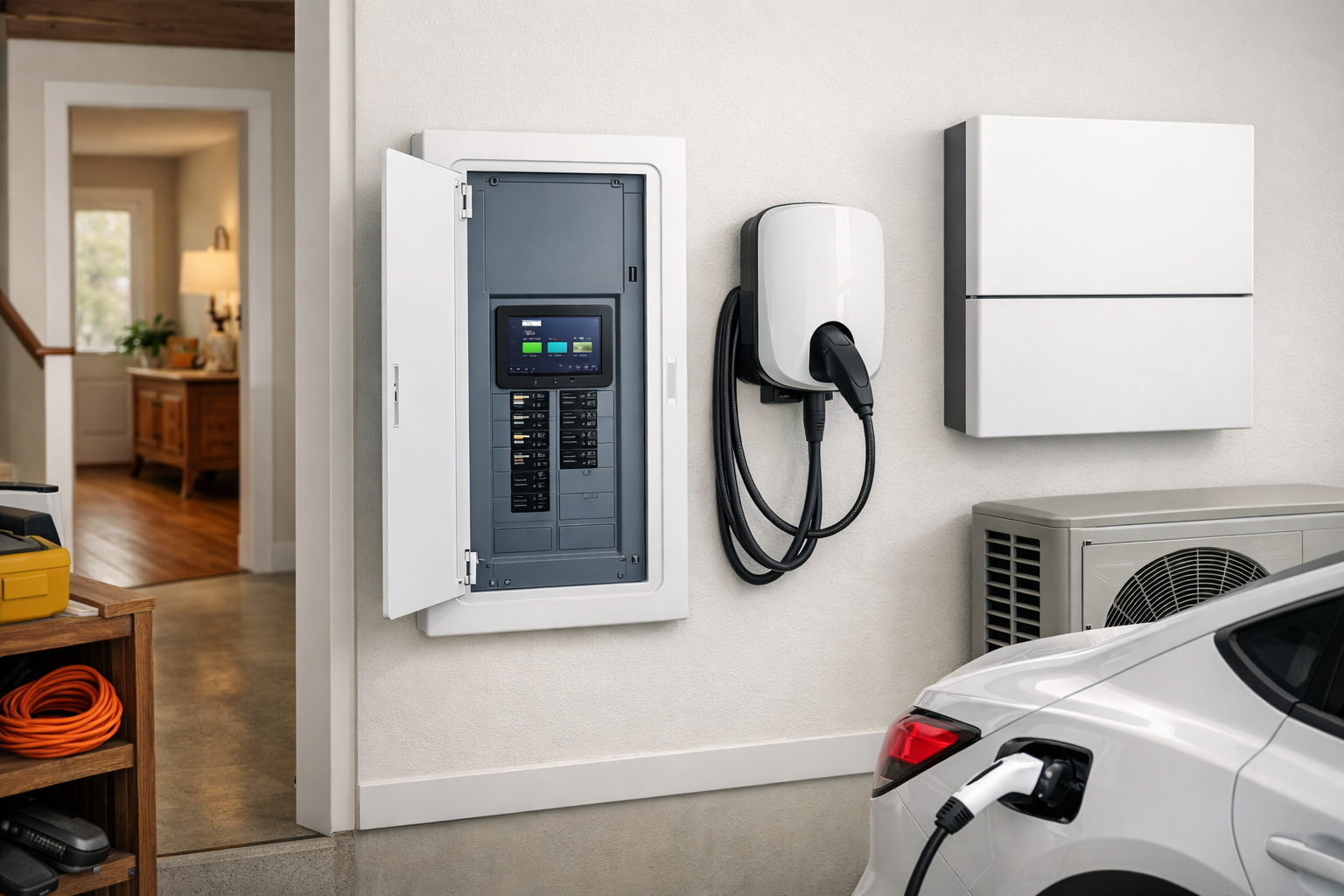
Electrifying a home can put new pressure on an older electrical service. A Level 2 EV charger, heat pump, electric water heater, induction range, solar inverter, and home battery can all be worthwhile upgrades, but they do not necessarily fit comfortably on a 100-amp or 150-amp service when several run at once.
That is where smart electrical panels for home energy management enter the conversation. These systems can monitor household demand and control selected loads so the home stays within defined electrical limits. In the right design, that may help a homeowner add equipment without immediately upgrading utility service.
But a smart panel is not a source of extra electrical capacity. It cannot increase the amp rating of your service conductors, meter equipment, main panel busbar, or utility connection. Whether it can be part of an alternative to a service upgrade depends on a professional load calculation, the equipment involved, the product listing, and approval from the local authority having jurisdiction (AHJ).
What Is a Smart Electrical Panel?
A smart electrical panel combines electrical distribution hardware with sensors, connected controls, and software. Depending on the system, it may measure electricity use at the service and circuit level, display that information in an app, and turn selected circuits on or off when demand reaches a configured limit.
Some systems use smart breakers. Others use a conventional panel alongside control equipment, contactors, load-management modules, compatible appliances, or a connected EV charger. The details matter because not every system has the same ability to measure, switch, prioritize, or modulate loads.
The U.S. Department of Energy describes smart-panel-based home energy management as a way to use circuit-level measurements to coordinate household loads and behind-the-meter resources such as solar and batteries. Its research work includes goals such as cost optimization, peak-demand management, emissions reduction, and improved resilience. Those outcomes are possible use cases, not guaranteed results for every household. Read the DOE overview of a smart electrical panel-based home energy management system for more background on this approach.
A smart panel is not just an energy monitor
A circuit-level energy monitor can show which circuits are using power. That visibility can be useful, but monitoring alone does not stop two large loads from operating at the same time.
A smart panel or related control system may add active control. For example, it might reduce EV charging current when electric heat is running, temporarily disconnect a lower-priority circuit during a peak event, or preserve battery output for essential loads during an outage.
There is also an important distinction between an energy-management system and a power control system. An energy-management system may focus on scheduling, optimization, and utility-rate strategies. A power control system is intended to manage loads within defined electrical limits. UL Solutions explains why this distinction and the applicable equipment listing can matter when a system is used for overload mitigation rather than simple monitoring or scheduling.
Smart electrical panels for home energy management vs. more capacity
The biggest misunderstanding is assuming that load management changes the size of your electrical service. It does not.
If your home has a 100-amp service, a smart panel cannot turn it into a 200-amp service. It can only help ensure that certain loads do not operate simultaneously in a way that exceeds the limits established for the installation.
Think of it as traffic control rather than road construction. The system can tell one vehicle to wait while another passes, but it does not create additional lanes.
This can be particularly useful where loads are flexible. An EV usually does not need to charge at its maximum rate every minute of the night. A water heater may have some usable thermal storage. Some HVAC strategies may allow setpoint adjustments or limited load reduction under particular conditions. These options can give a properly designed system room to manage demand.
Other loads are less flexible. Medical equipment, refrigeration, sump pumps, well pumps, cooking equipment, and heating during severe weather may be poor candidates for routine shedding. Your priorities should drive the design, especially in a home that uses electric resistance backup heat or relies on a battery during outages.
How smart panels handle EV chargers
EV charging is one of the clearest applications for dynamic load management because charging current can often be adjusted instead of simply interrupted.
With a compatible charger and control setup, the system monitors overall home demand. If the home approaches its configured service or feeder limit, it can reduce the charger’s available current. When household demand falls, charging can increase again. The vehicle may charge more slowly during high-demand periods, but it can continue charging without asking the electrical system to carry every major load at full power at once.
SPAN describes this behavior for SPAN Drive, which can adjust charging based on real-time home load monitoring when paired with its ecosystem. That is one example, not evidence that every smart panel works with every EV charger.
Before assuming EV charger load management will work in your home, verify:
- Whether the charger supports adjustable current or a supported load-management integration.
- Whether the system modulates charging current, pauses charging, or controls a dedicated circuit.
- How the installation handles continuous-load requirements and the charger’s configured current.
- Whether charging priorities and minimum charging rates can be set for your driving needs.
- Whether your electrician and AHJ accept the proposed design under locally adopted requirements.
An EV charger may be a strong candidate to defer during a short peak. It is not a good idea to treat dynamic charging as a substitute for electrical design work.
How they work with heat pumps and electric heating
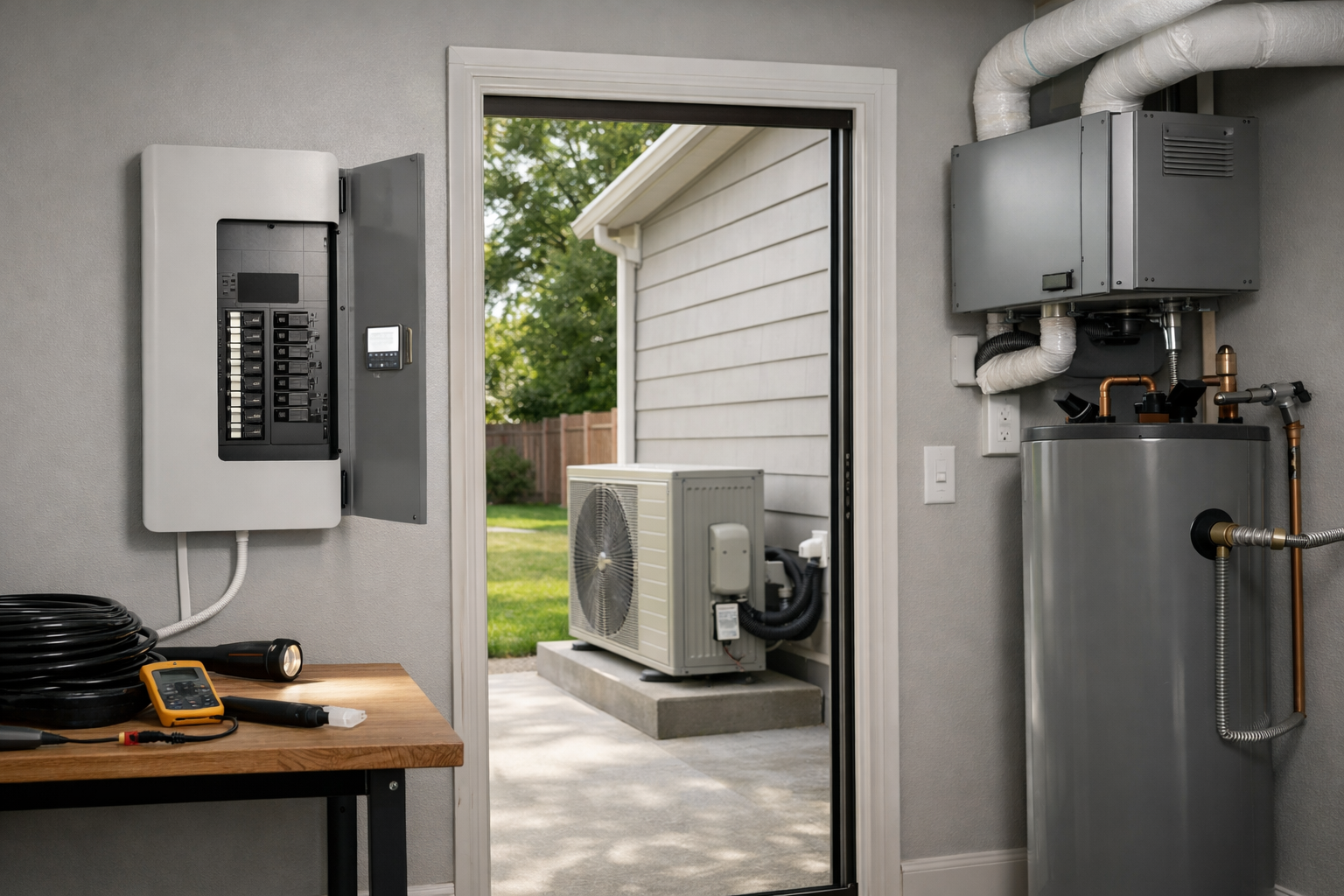
Heat pumps may add substantial electrical demand—particularly when auxiliary electric resistance heat operates. That makes heat-pump planning more complex than simply adding a controllable EV charger.
A smart system may manage HVAC loads in several ways. In a basic design, it may shed a whole circuit based on a priority list. In a more integrated setup, it may communicate with compatible HVAC controls to adjust setpoints or coordinate equipment operation. DOE and NREL research has explored coordinated control of HVAC, water-heater setpoints, solar, and battery operation in both normal and resilience-focused modes.
The control method matters. Cutting power to an HVAC circuit is not the same as asking a compatible thermostat or heat-pump controller to make a measured adjustment. Circuit interruption may be unsuitable for certain equipment, comfort needs, or operating conditions.
Ask an installer to identify the heat pump’s electrical loads separately, including the outdoor unit, air handler, electric strip heat, and any supplemental equipment. Auxiliary heat can materially change the load calculation and may be the component that determines whether a service upgrade is still necessary.
Using a smart panel with solar and home batteries
Solar and batteries add another layer of control because the system must consider both stored energy and instantaneous power. A battery may have enough energy to run essential loads for hours, yet still be unable to start or support every high-demand circuit at the same time.
During a grid outage, a smart panel can help prioritize circuits. A homeowner might choose refrigeration, lighting, internet equipment, selected outlets, and a sump pump as higher-priority loads while assigning lower priority to an EV charger, electric dryer, pool equipment, or some HVAC loads.
Some systems can automatically shed or throttle loads if total backup demand approaches the battery system’s output limit. This type of backup overload protection is intended to help avoid overloading the battery or inverter. Tesla also documents load-shedding capability for selected loads in its Tesla Powerwall 3 backup ecosystem.
Whole-home backup does not necessarily mean every circuit can run at once. Review the battery’s available power, surge capability, backup gateway configuration, and the priority assigned to each circuit. A large electric heating load may need special planning even if the home has solar and substantial battery storage.
What smart panels can—and cannot—do
What they can do
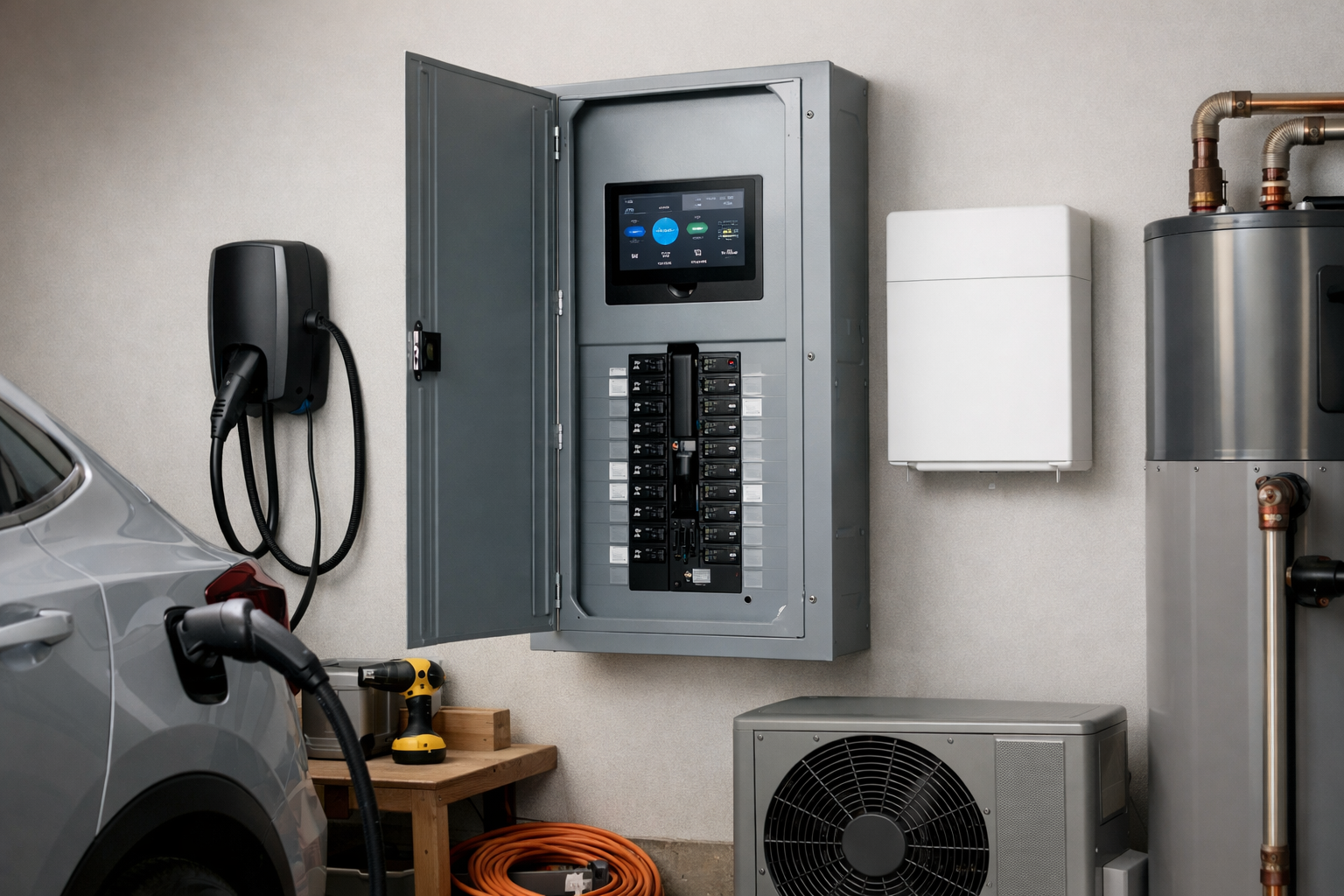
- Provide circuit-level visibility, depending on the system configuration.
- Prioritize selected circuits during an outage or high-demand event.
- Reduce or pause compatible EV charging as household demand changes.
- Coordinate certain loads with solar production, battery state, or time-of-use rates.
- Support a load-management design that may make better use of existing capacity.
What they cannot do
- Increase the ampacity of the utility service, conductors, panel busbar, or meter equipment.
- Guarantee that a 100-amp or 150-amp service will support every electrification project.
- Make incompatible appliances, chargers, batteries, or HVAC equipment communicate with one another.
- Guarantee electricity-bill savings without considering the utility rate plan, household habits, equipment, and local programs.
- Replace a qualified electrician’s load calculation, permit process, or local inspection.
Smart electrical panels for home energy management can support time-of-use scheduling and peak reduction, but savings are highly household-specific. The value may be convenience, resilience, capacity management, usage visibility, or a combination of these—not necessarily a predictable monthly bill reduction.
Installation checklist for homeowners
Before committing to a panel replacement or a load-control system, ask for a written design discussion that covers the following items.
- Confirm your existing service. Verify the service rating, main breaker, panel rating, busbar rating, available breaker spaces, feeder sizes, and the condition of existing equipment.
- Request a formal load calculation. Do not rely only on the number of open breaker spaces. Ask how existing loads, planned EV charging, HVAC, water heating, cooking, solar, and battery equipment are being accounted for.
- Identify the actual limiting point. The constraint might be the service, a feeder, a subpanel, a busbar, battery output, or a particular circuit—not always the same component.
- List every load that may be controlled. Clarify which circuits can be shed, which can be throttled, which must remain powered, and what happens when communication is unavailable.
- Verify product listing and control function. If the system is being used for overload mitigation, ask the installer how its listing and configuration apply to the proposed power-control function. UL identifies UL 3141 as a relevant framework for certain power control systems.
- Check equipment compatibility. Confirm the exact EV charger, heat pump, thermostat, water heater, inverter, battery, and gateway models supported by the design. Do not assume brand compatibility means system compatibility.
- Understand outage behavior. Review the essential-load list, battery power limit, startup behavior, and which circuits may be automatically shed during backup operation.
- Confirm permits and approval. Local code adoption, utility requirements, and AHJ interpretation control the final installation. A load-management proposal that works in one jurisdiction may require a different approach elsewhere.
For many homes, the right answer will still be a service upgrade. The Department of Energy notes that electrification projects such as heat pumps may require evaluating panel capacity and, in some cases, upgrading equipment. A smart panel should be evaluated as one design option rather than a universal workaround.
Who should consider a smart panel—and who should skip?
- Consider a smart panel or listed load-control design when you are already replacing an aging panel, adding EV charging, solar, batteries, or major electrification, and need circuit-level visibility plus active coordination—not just charts.
- Also consider it when backup prioritization or shedding during outages is part of the plan and your battery/inverter ecosystem supports that architecture.
- Skip or pause if you are a renter, only want usage visibility, expect guaranteed bill payback, or have a modern panel with no electrification roadmap—a whole-home energy monitor may be enough.
- Reconsider when permit, electrician, and utility costs dominate the project, or when every major load must run at full power concurrently without a service upgrade.
Smart panel vs energy monitor vs smart breaker add-on
A whole-home or circuit-level energy monitor measures use and may help you find waste—it does not by itself keep two large loads from running together. A smart electrical panel or listed power-control system may add shedding, throttling, or prioritization within engineered limits. A smart breaker or load-control module may retrofit selected circuits in compatible panel ecosystems but is not a full-panel replacement by itself.
Monitoring does not equal load control; load control does not equal battery backup—the inverter and battery provide stored energy; the panel helps decide which circuits receive it.
Full panel replacement vs retrofit monitoring/control
Replacement may align with an already planned service upgrade, obsolete equipment, or a design that needs integrated smart breakers and coordinated control across many circuits.
Retrofit may suffice when the existing panel is sound, you mainly need visibility, or add-on modules and a compatible EV charger can meet a narrower load-management goal—confirm listing, AHJ acceptance, and equipment compatibility before assuming retrofit is cheaper or sufficient.
Backup, outages, and app/cloud access
During utility outages, smart panels may help prioritize or shed circuits when backup power is limited—as described for battery-backed designs such as Tesla’s Powerwall 3 load-shedding documentation. That is not whole-home backup at full demand on every circuit.
Remote app features often depend on internet and vendor cloud services; physical breaker behavior and locally configured priorities may differ when communication is down. Verify outage behavior with your installer rather than assuming full remote control during a blackout.
Local control vs cloud features
Distinguish what happens at the breaker or contactor locally, what automations run on-site, and what requires the vendor app or cloud. Firmware updates and account dependence vary by platform—ask what still works if Wi-Fi or ISP service is unavailable.
Electrician, permits, and cost expectations
Panel and service work is professional electrical work. Permits, inspections, utility coordination, and load calculations are normal parts of the project—not optional DIY steps. Total cost is often dominated by installation and service upgrades, not the panel hardware alone. Value may come from capacity coordination, backup prioritization, and electrification planning; direct energy-bill savings are not guaranteed.
Common buying and planning mistakes
- Buying a smart panel when an energy monitor would answer the question.
- Assuming monitoring automatically lowers usage or bills.
- Expecting every circuit to be remotely controllable.
- Treating load management as a universal substitute for service upgrades.
- Ignoring compatibility among EV charger, inverter, battery, and HVAC models.
- Assuming app control works the same during internet outages.
- Underestimating ecosystem lock-in for breakers and future parts.
- Equating backup load control with unlimited whole-home power on a battery.
- Changing multiple electrification projects at once without a coordinated load calculation.
Smart panel platform decision table
Editorial summary from this guide—confirm current models, listings, and AHJ requirements with a licensed electrician before purchase.
| Product / platform | Best for | Replacement or retrofit | Monitoring | Load control | Solar / battery integration | Main trade-off |
|---|---|---|---|---|---|---|
| SPAN ecosystem (panel + Drive / PowerUp per SPAN docs) | EV charging coordination with SPAN load monitoring | Integrated panel/control ecosystem—installer-defined | Service and circuit visibility when configured | Adjustable EV charging; load coordination cited in article | Designed for broader home energy coordination | Not universal for every EV charger or home layout |
| Tesla Powerwall 3 backup ecosystem | Backup load shedding with Tesla gateway/battery | Within Tesla backup architecture—not a generic panel for all brands | Via Tesla energy system context | Load shedding for selected circuits per Tesla documentation | Native to Tesla solar/battery installs | Does not make every circuit run at once on backup power |
| Listed smart panel / power-control design (UL 3141 context) | Active overload mitigation within service limits | Often major panel work or engineered retrofit | Circuit- or service-level where supported | Shed/throttle per product listing and design | May coordinate with solar, batteries, and rates in design | Requires qualified design, permits, and compatibility checks |
| Circuit-level energy monitor (alternative path) | Usage visibility and analytics only | Typically retrofit clamp/sensor installs | Yes | No switching—per monitor vs panel distinction above | Insight only; no automatic shedding | Lower scope; cannot replace power-control listing needs |
HomeTechSignal Recommendation
- Best for full smart-panel replacement: A listed smart-panel or power-control design when the panel is due for replacement and electrification/backhaul planning is underway—start with a load calculation.
- Best for existing-panel retrofit: Add-on monitoring or compatible load-control modules only when an electrician confirms listing, spaces, and goals; otherwise plan service/panel upgrades.
- Best for solar + battery households: Coordinate panel/load priorities with your inverter and battery gateway (Tesla example cited in this article)—verify shedding limits and essential-load lists.
- Best for EV / load-management projects: SPAN Drive–style adjustable charging when the charger and ecosystem match; still not a substitute for electrical design work.
- Best if you only need monitoring: A conventional panel plus a home energy monitor.
- Best if you should keep a conventional panel: Modern equipment, no electrification roadmap, or when monitoring alone is enough—see also home battery backup systems for outage strategy separate from panel shopping.
Is a smart electrical panel worth considering?
Smart electrical panels for home energy management are most compelling when a home has several large electrical loads that do not need maximum power at the same time. EV charging, electric water heating, flexible HVAC controls, solar, and batteries can create useful opportunities for coordination.
They are less compelling when the home needs every major load to operate concurrently, the service equipment is already undersized or in poor condition, or the proposed system cannot safely control the specific devices involved.
Start with a load calculation and a plan for your future equipment, not just the next appliance purchase. If an EV charger is arriving this year and a heat pump, battery, or electric water heater may follow, designing for those loads together can prevent an expensive mismatch later.
Useful references: Smart Electrical Panel-Based Home Energy Management System · What is SPAN PowerUp?
Related Home Tech Signal guides: Best Home Energy Monitors for Tracking Electricity Use, Best Home Battery Backup Systems, Best Smart Thermostats for Multi-Zone Homes