
Disclosure: As an Amazon Associate I earn from qualifying purchases.
Shopping for a robot vacuum in a pet household is not only about suction. A machine that cleans up fur but drives through a dog accident, drags a charging cable, or gets stuck on a sock can create more work than it saves.
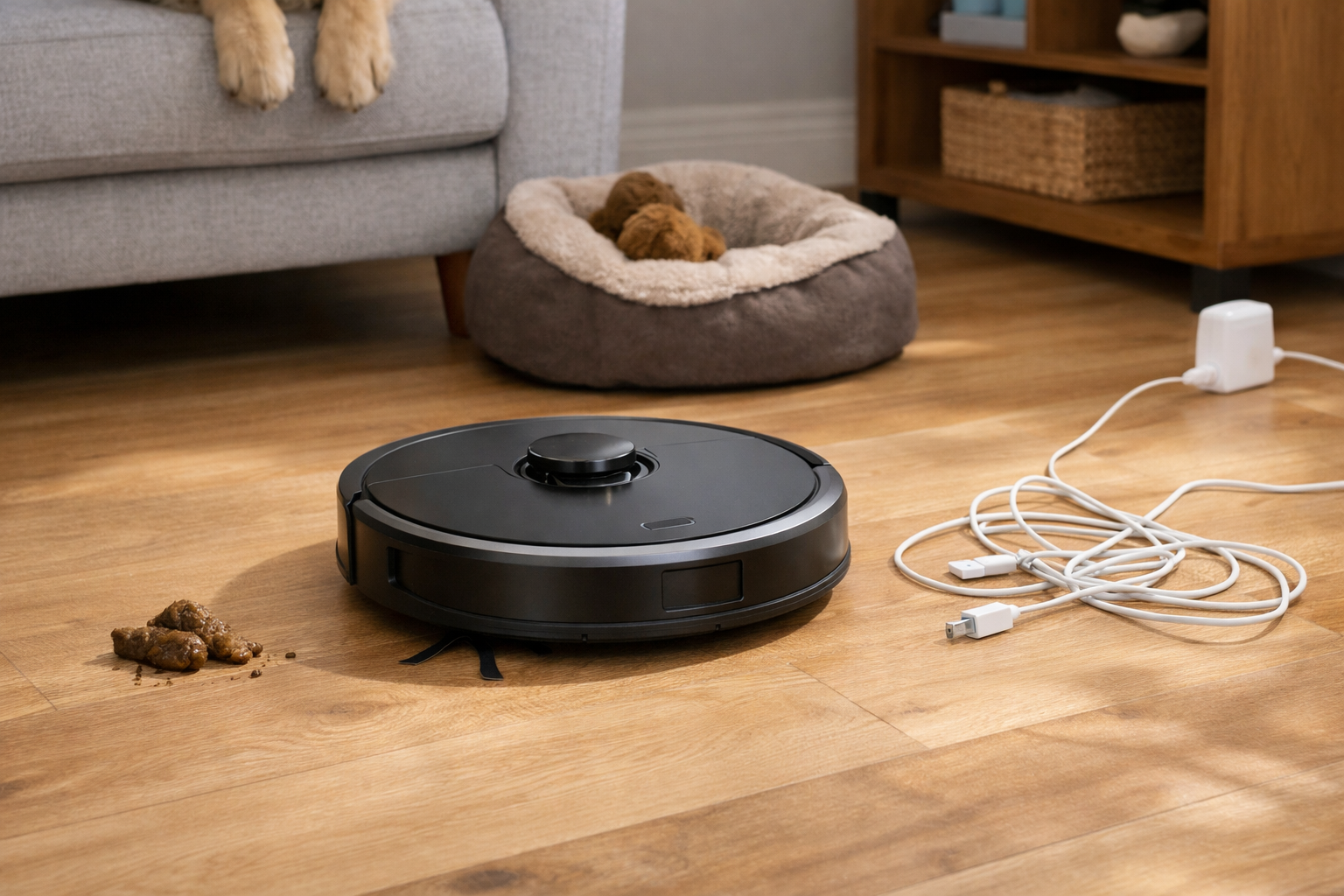
The best robot vacuums that avoid pet waste and cables combine object-recognition cameras or 3D vision with LiDAR-based navigation. That combination gives a robot a better chance of identifying obstacles before it reaches them while still mapping rooms efficiently. It is not a guarantee that every mess, cord, toy, or litter clump will be avoided.
For buyers who want the clearest manufacturer claim covering both cords and pet waste, the Roomba Max 705 Vac is the strongest starting point. Premium alternatives from Dreame, Roborock, and Narwal add advanced automation and obstacle-recognition claims, while Ecovacs and Eufy are worth considering for pet-hair performance and value.
Quick picks
- Best overall for explicit pet-waste and cable avoidance: iRobot Roomba Max 705 Vac Robot + AutoEmpty Dock
- Best premium alternative: Dreame X60 Max Ultra Complete
- Best value for pet hair and automation: Ecovacs Deebot T80S Omni
- Best budget-minded pet-hair option: Eufy C28 Omni
- Best premium option for cable recognition: Roborock Saros 20
- Best alternative for cable-heavy pet homes: Narwal Flow 2 Robot Vacuum & Mop
Who should buy a robot vacuum for pet waste and cables?
- Pet owners who want a safety net—not a guarantee—against accidents, cords, and floor clutter.
- Homes with charging cables, socks, toys, or kids’ small objects that cannot be cleared every time.
- Multi-pet or busy households willing to pay more for camera, structured-light, or 3D obstacle systems plus LiDAR mapping.
- Buyers who will supervise early runs, use no-go zones, and still do quick pre-clean checks.
Who should skip or reconsider?
- Very tidy homes with bare floors and reliable pre-cleaning habits—a simpler LiDAR robot may be enough.
- Privacy-sensitive users uncomfortable with camera-equipped robots or app obstacle photos—verify each brand’s current policies.
- Homes with very thin, dark, transparent, or looped cords that are hard for any vision system to see.
- Anyone expecting perfect pet-waste avoidance without floor checks or pausing schedules when a pet is ill.
Navigation vs obstacle recognition vs pet-waste claims
- LiDAR / laser mapping: Helps measure rooms and avoid walls and furniture; does not by itself identify cables, socks, or waste.
- Cameras, structured light, or 3D sensors: Used for object detection or classification—capabilities vary by model and firmware.
- Pet-waste avoidance: Only treat it as supported when the manufacturer specifically lists waste (or comparable obstacles)—not from generic “AI” marketing alone.
- Cable / clutter avoidance: May mean recognizing some cord-like objects; thickness, contrast, loops, and lighting still matter.
Pet waste, cables, low light, and camera privacy
Pet waste: No robot should be trusted blindly around fresh accidents. Remove waste when you can, pause schedules when a pet is sick or house-training, and expect that a miss can spread material across brushes or mop pads.
Cables: Route chargers off the floor, use clips or sleeves, and set no-go zones around dense cable areas. Recognition is a backup—not a substitute for cord management.
Low light: Camera-heavy systems may perform differently in dim rooms; some models use supplemental lighting or structured light, but behavior varies—supervise night runs until you know how your unit behaves.
Privacy: Camera-equipped robots may store or show obstacle images in the app (iRobot documents obstacle image review in its support materials). Review each manufacturer’s current privacy settings, disable features you do not want, and avoid scheduling in sensitive rooms if uncomfortable. For broader local-processing context, see our local AI security cameras guide—vacuum cameras are for cleaning, not home security.
Realistic role: Advanced avoidance reduces interruptions and risk; it does not replace a clear floor, childproofing, or pet-proofing.
What to look for in a robot vacuum that avoids pet waste and cables
Do not assume that every robot with LiDAR can avoid small objects on the floor. LiDAR is useful for measuring a room, navigating in low light, and avoiding large fixed obstacles such as walls and furniture. But it does not necessarily identify whether a low object is a USB cable, a sock, a pet toy, or waste.
For a robot vacuum cable avoidance system, look for a model that pairs mapping sensors with a forward-facing camera, structured-light sensor, 3D sensor, or another object-recognition system. Manufacturers may call this AI obstacle avoidance, reactive obstacle avoidance, computer vision, PrecisionVision, or an autonomous navigation system. The label matters less than the objects the company explicitly says the robot can recognize.
Pet-waste recognition is a separate feature
A robot can have strong carpet cleaning and still be a poor choice for pet accidents. Pet-waste avoidance depends on the robot seeing an obstacle, identifying it correctly, and choosing a route around it. That is different from its ability to pick up fur, resist brush-roll tangles, or navigate a room.
iRobot’s documentation is unusually direct on this point. Its newer camera-equipped Roombas can identify cables and solid or low-viscosity pet waste in appropriate conditions. The company also warns that obstacle detection may not be active during some mapping runs. That makes the first mapping run a time to clear floors and supervise the robot, not a time to test it against household clutter. Review iRobot’s obstacle-recognition support guidance before relying on a compatible Roomba around pets.
Anti-tangle hardware still matters
Object recognition may help a robot avoid a loose cable, but it cannot eliminate the risk if a cable is hidden under furniture, blends into a dark rug, or hangs into the robot’s path. Dual rubber rollers, anti-tangle side brushes, and active hair-cutting or hair-removal systems can also reduce brush-maintenance demands in homes with long pet hair, human hair, and fringe-prone rugs.
These features reduce maintenance. They do not make it safe to leave phone chargers, headphone cords, shoelaces, or string toys on the floor.
iRobot Roomba Max 705 Vac Robot + AutoEmpty Dock: Best overall for explicit pet-waste and cable avoidance

Who it is for: Dog and cat owners who prioritize clear, manufacturer-stated avoidance of cords and pet waste and prefer a vacuum-only robot over a mopping model.
The iRobot Roomba Max 705 Vac Robot + AutoEmpty Dock is the most straightforward recommendation for shoppers focused on this specific problem. iRobot states that its PrecisionVision AI and ClearView Pro LiDAR system recognize and avoid obstacles including cords, socks, and pet waste. That is more specific than the broad “AI obstacle avoidance” language often used on robot vacuum product pages.
The vacuum-only configuration is also a practical advantage in homes where fresh accidents are a concern. A vacuum robot can still make a serious mess if it hits waste, but it does not add wet mopping pads and a mop-washing system to the potential cleanup scenario. That does not mean it is accident-proof; it means there is one less system that could spread moisture across the floor.
The Roomba Max 705 Vac uses dual rubber brushes and an AutoEmpty dock, which reduces how often you need to handle the onboard bin.
Before buying, confirm the current configuration, dock type, replacement-part availability, and whether any pet-accident replacement coverage applies. The current product information makes avoidance claims, but buyers should not assume it includes the same guarantee associated with some older Roomba models. You can compare the stated features on iRobot’s Roomba Max 705 Vac product page.
Dreame X60 Max Ultra Complete: Best premium alternative
Who it is for: Buyers who want a high-end vacuum-and-mop robot with extensive dock automation and advanced obstacle avoidance, and who are willing to verify the latest independent model-specific results before purchasing.
The Dreame X60 Max Ultra Complete is a premium contender for homes that need frequent floor cleaning, strong automation, and an obstacle-recognition system designed for cluttered spaces. Vacuum Wars currently lists it as a leading overall robot vacuum, citing advanced AI obstacle avoidance, cleaning performance, and broad dock automation.
That independent context is useful because robot-vacuum marketing can make nearly every model sound equally smart. Vacuum Wars says its broader testing includes a fixed 24-object obstacle course with cable and pet-waste stand-ins, plus pet-hair pickup, tangle, carpet, and navigation evaluation. Those are the kinds of tests that matter more than suction claims alone.
Still, its overview does not provide a model-specific pass rate for every obstacle type in the available information. For that reason, the Dreame X60 Max Ultra Complete is best treated as a strong premium alternative rather than the safest possible choice for actual pet accidents. Check the latest detailed testing and firmware notes before making it your unattended daily cleaner.
Ecovacs Deebot T80S Omni: Best value for pet hair and automation

Who it is for: Pet owners looking for a feature-rich vacuum-and-mop system with strong reported cleaning, hair, and dock performance without choosing the most expensive premium option.
The Ecovacs Deebot T80S Omni is a compelling value-oriented option for households that deal with shedding, carpets, and frequent cleaning cycles. Vacuum Wars currently identifies it as a strong value pick, highlighting suction, carpet deep-cleaning results, pet-hair performance, hair-tangle performance, obstacle avoidance, and dock automation.
That mix is important for a busy pet home. Good obstacle avoidance is only part of the equation; a robot also needs to collect fur reliably and avoid turning long hair into a brush-roll maintenance chore. A capable dock can further reduce the daily tasks that make a robot vacuum less appealing over time.
Because this is a combo model, use more caution if your pet has stomach issues, is house-training, or has recently had an accident. Verify how the current version handles small cables and pet-waste-like obstacles in detailed independent testing, rather than treating general obstacle-avoidance language as proof that it will identify every hazard.
Eufy C28 Omni: Best budget-minded option for pet hair

Who it is for: Buyers focused on pet-hair pickup and reduced hair wrap who want obstacle avoidance, but can maintain realistic expectations around pet waste and thin cables.
The Eufy C28 Omni is the budget-minded pick for homes where shedding and tangled hair are bigger day-to-day problems than frequent pet accidents. In Vacuum Wars testing, it recorded 100% pet-hair pickup and 0% hair wrap, along with obstacle avoidance and an active hair-removal approach.
Those results make it particularly interesting for homes with heavy-shedding dogs, long-haired cats, or people with long hair. A robot that collects fur well but constantly needs brush cleaning is not truly low maintenance, so the C28 Omni’s reported anti-tangle performance deserves attention.
Its specific results against cables and pet-waste stand-ins should be confirmed before you buy it primarily as a poop-avoidance robot. Budget-friendly models can offer meaningful object avoidance, but thin black cords, low-contrast items, and fresh messes remain difficult conditions for any system.
Roborock Saros 20: Best premium option for cable recognition

Who it is for: Households with lots of low-floor clutter, pets, and hair who want a premium robot with explicit cable-recognition claims and anti-tangle features.
Roborock markets the Roborock Saros 20 with its StarSight Autonomous System 2.0, saying the robot recognizes more than 300 obstacle types, including cables and pets. The model also includes anti-tangle systems and pet-focused cleaning features, making it a reasonable premium alternative for homes that struggle with cords, toys, and fur.
Recognition of cables is particularly useful for offices, media rooms, and bedrooms where chargers tend to reach across the floor. But cable recognition should be considered a backup, not a substitute for cord management. A cable partly hidden under a bed, draped over a rug edge, or mixed with pet toys can still present a difficult visual target.
Verify current U.S. availability and seek recent independent obstacle-course results for the exact Saros 20 configuration before deciding between it and the Roomba or Dreame options.
Narwal Flow 2 Robot Vacuum & Mop: Best alternative for cable-heavy pet homes
Who it is for: Buyers who want a vacuum-and-mop robot with manufacturer-stated cable avoidance, dual-camera AI vision, and features intended to reduce hair maintenance.
Narwal specifically says the Narwal Flow 2 Robot Vacuum & Mop avoids obstacles such as cables and chair legs. Its U.S. product page also describes dual-camera AI vision, pet-care modes, a tangle-resistant brush design, and 31,000 Pa of advertised suction.
The cable claim is meaningful because it names an everyday failure point directly. The dual-camera setup and pet-oriented features make the Flow 2 worth considering for homes where chair legs, pet bowls, cables, and shedding all complicate scheduled cleaning.
However, advertised suction should not be treated as an obstacle-avoidance score, and the manufacturer description alone does not establish how the Flow 2 performs against every pet-waste scenario. If avoiding accidents is your top priority, look for independent testing of the exact model and supervise early runs in your home.
Common buying and setup mistakes
- Assuming LiDAR alone means cable or pet-waste detection.
- Treating every “AI obstacle avoidance” claim as equal without checking listed object types.
- Running first mapping passes with clutter present when detection may be limited during mapping.
- Leaving thin black cords on dark rugs and expecting reliable recognition.
- Ignoring camera privacy settings or obstacle photo features in the app.
- Choosing a vacuum-and-mop combo without weighing wet-mess spread risk after accidents.
- Focusing on suction or Pa marketing instead of navigation plus obstacle documentation.
- Skipping no-go zones around feeding areas, litter boxes, or cable clusters.
- Not cleaning cameras, LiDAR windows, or brushes that degrade detection over time.
Robot vacuum obstacle-avoidance decision table
Editorial summary from the product sections above—confirm current firmware, app features, and testing on official or cited sources before purchase.
| Product | Best for | Obstacle sensing (per article) | Pet-waste handling | Cable / small-object handling | Low-light / privacy note | Main trade-off |
|---|---|---|---|---|---|---|
| Roomba Max 705 Vac + AutoEmpty | Explicit cord + waste claims | PrecisionVision AI + ClearView Pro LiDAR per iRobot | iRobot lists solid/low-viscosity waste in appropriate conditions | iRobot lists cords, socks; mapping-run limits apply | Camera system; see iRobot obstacle image guidance | Vacuum-only; verify current guarantee/warranty terms |
| Dreame X60 Max Ultra Complete | Premium automation | Advanced AI avoidance per marketing; Vacuum Wars context cited | Not clearly documented as explicit waste avoidance—verify testing | General obstacle course context; no per-model pass rate in article | Combo mop—higher wet-mess risk if detection fails | Premium price; confirm model-specific results |
| Ecovacs Deebot T80S Omni | Value pet hair + dock | Obstacle avoidance noted in Vacuum Wars value pick | Verify pet-waste-like obstacles in detailed tests | General avoidance; confirm cable behavior | Combo unit; supervise around accidents | Strong hair/dock story; cautious on waste |
| Eufy C28 Omni | Budget pet hair / tangle | Obstacle avoidance in Vacuum Wars testing cited | Confirm cable/waste stand-ins before relying on it | Thin cords and low contrast remain hard cases | Combo; realistic budget expectations | Hair pickup focus over explicit waste claims |
| Roborock Saros 20 | Cable-heavy premium homes | StarSight 2.0; 300+ obstacle types claimed incl. cables/pets | Pet recognition claimed; waste avoidance not spelled like iRobot | Explicit cable recognition marketing | Camera/vision stack; check app privacy settings | Verify U.S. availability and independent course results |
| Narwal Flow 2 | Cable + pet hair alternative | Dual-camera AI vision per Narwal | Manufacturer does not establish every waste scenario in article | Narwal lists cable and chair-leg avoidance | Combo mop; supervise early runs | Marketing suction ≠ avoidance score |
How reliable is pet-waste detection?

Even the best robot vacuums that avoid pet waste and cables should not be treated as safe to run blindly around fresh accidents. Detection can change with lighting, floor color, object size, camera visibility, firmware updates, and how distinct the object looks from the floor.
Solid waste that contrasts with a light floor is a different challenge from soft stool, vomit, a wet accident, smeared waste, a litter clump, or debris partly hidden under furniture. A robot may avoid one condition and fail in another. This is especially important with mopping robots, which can spread a wet mess with their pads.
Independent test methods are helpful, but they are controlled comparisons rather than a promise of performance in every living room. A test course can show whether a robot recognizes representative cable and pet-waste stand-ins; it cannot reproduce every lighting condition, pet behavior, or type of accident.
How to reduce cable and pet-accident risks
A capable object-recognition system is most effective when you give it an easier environment. These habits reduce the chance of a costly failure:
- Do a quick floor check before scheduled runs. Pick up charging cords, socks, string toys, and anything a pet may have left behind.
- Use cable clips, sleeves, or wall routing. Keep chargers and power strips off the floor where practical.
- Supervise the first few cleanings. Watch how the robot handles your rug edges, pet bowls, chair legs, and common cable paths.
- Keep lights on for camera-based cleaning. Some visual obstacle systems perform less reliably in dim rooms or at night.
- Create no-go zones where needed. Use app controls around feeding stations, dense cable clusters, play areas, or litter-box entrances.
- Clear floors before initial mapping. On some models, obstacle detection may be limited during certain mapping runs.
- Pause unattended schedules when a pet is sick. Manual vacuuming is the safer choice when accidents are more likely.
Should you choose a vacuum-only robot or a vacuum-and-mop combo?
A vacuum-only model such as the iRobot Roomba Max 705 Vac Robot + AutoEmpty Dock is the more cautious choice if pet accidents are your overriding concern. It still needs reliable obstacle detection, but it does not introduce wet pads that may spread a fresh mess.
Vacuum-and-mop robots such as the Dreame X60 Max Ultra Complete, Ecovacs Deebot T80S Omni, Eufy C28 Omni, Roborock Saros 20, and Narwal Flow 2 Robot Vacuum & Mop can provide more complete floor care. They are a better fit when routine mopping is valuable and you can check floors before scheduled cleaning.
The right choice depends on your household. If your pets are reliably house-trained and you mainly need help with fur, a combo model may be worthwhile. If a puppy, senior pet, or sick pet makes accidents more plausible, a vacuum-only robot plus manual mopping may be the lower-risk arrangement.
HomeTechSignal Recommendation
Editorial guidance from manufacturer documentation and cited testing in this guide—not hands-on obstacle-course testing in our lab.
Strongest explicit pet-waste + cord claims: iRobot Roomba Max 705 Vac (vacuum-only) when you accept camera use and iRobot’s stated limitations during mapping.
Premium all-rounder: Dreame X60 Max Ultra Complete after checking the latest Vacuum Wars or equivalent detailed results.
Value pet hair + dock: Ecovacs Deebot T80S Omni when fur and automation matter more than documented waste avoidance.
Budget hair/tangle focus: Eufy C28 Omni with conservative expectations on accidents and thin cords.
Cable recognition marketing: Roborock Saros 20 or Narwal Flow 2—verify independent runs and treat cords as a backup to cable management.
Cluttered-floor context: See also AI robot vacuums for cluttered homes and smart pet doors if pet access routines affect where you schedule cleaning.
Bottom line
For shoppers searching for the best robot vacuums that avoid pet waste and cables, the iRobot Roomba Max 705 Vac Robot + AutoEmpty Dock is the clearest first choice because iRobot explicitly identifies cords and pet waste among the obstacles it is designed to recognize and avoid.
The Dreame X60 Max Ultra Complete is a strong premium alternative backed by broad independent testing context, while the Ecovacs Deebot T80S Omni and Eufy C28 Omni deserve attention for pet-hair and anti-tangle priorities. The Roborock Saros 20 and Narwal Flow 2 Robot Vacuum & Mop are also promising options for buyers who value stated cable-recognition features.
Whichever model you choose, treat obstacle avoidance as a safety net. A 30-second floor check, sensible cable management, and supervised early runs are still the most dependable way to protect your floors, your robot, and your cleanup time. For more options built around complex rooms, see our guide to Best AI Robot Vacuums for Cluttered Homes and Multi-Level Cleaning.
Useful references: Camera, PrecisionVision, and Obstacle Image Review · Roomba Max 705 Vac Robot · Vacuum Wars robot vacuum testing and comparisons
Related Home Tech Signal guides: Best AI Robot Vacuums for Cluttered Homes and Multi-Level Cleaning, Best Smart Pet Doors With App Control for Secure Access, Best Window-Cleaning Robots for Tall Windows, How to Create Smart Home Automations for Beginners