
A smart pet door can give a cat or dog more independence without turning a standard flap into an open invitation for neighborhood animals. The best models add selective entry, schedules, remote lock controls, and activity alerts—but the security level varies substantially by design.
For example, a microchip door can identify a pet by its implanted chip, while other doors depend on a collar tag. A motorized door may offer a more controlled opening than a swinging flap, and a physically reinforced system may be a better fit for a large dog or a ground-level installation.
The picks below focus on the best smart pet doors with app control for different homes, pet sizes, and installation situations. Before buying, measure your pet carefully, inspect the installation location, and confirm what the door does during a Wi-Fi or power interruption.
Best smart pet doors with app control: quick picks
- Best overall for most households: PetSafe SmartDoor Connected — app controls, pet-specific schedules, notifications, and Medium or Large sizing.
- Best for existing microchips: SureFlap Microchip Pet Door Connect — built around implanted microchip recognition for large cats and small dogs.
- Best premium security-focused option: Pawport Smart Pet Door — collar-tag access, steel deadbolts, tamper alarm features, and large size options.
- Best motorized option with extensive timers: High Tech Pet WiFi Power Pet Door — collar activation, motorized operation, directional sensing, and up to 20 timers.
- Best for compatible sliding glass doors: Wayzn Smart Pet Door — operates an existing compatible two-panel sliding door rather than requiring a new pet-door opening.
Who should buy a smart pet door?
- Multi-pet homes that need different schedules, lock rules, or notifications per pet.
- Cat owners trying to limit neighborhood cats or wildlife while authorized pets pass through.
- Households that want remote lock/unlock, curfews, or activity history—and will maintain tags, batteries, or hubs as required.
- Owners who can modify a door or wall (or use a supported sliding-door kit) with landlord approval when needed.
Who should skip or reconsider?
- Pets that will not wear required collar tags or keys when the system depends on them.
- Renters or homes where cutting an opening is not allowed without approval.
- Very large pets that exceed the opening the product documents—weight labels alone are not enough.
- Buyers expecting home-security-grade access control or wildlife-proof guarantees.
- Households that want zero cloud/app dependence for everyday pet access.
- Users who only need a simple manual flap without electronics.
Microchip, collar tag, motorized door, or schedule?
“Smart” pet doors use different ways to decide who may pass. Match the method to your pets—not every implanted chip works with every reader, and pet-database registration is not the same as physical compatibility.
- Microchip-reading door: Reads compatible implanted chips; may not need a collar tag (verify chip format and product list).
- Collar key / RFID tag: Unlocks for pets wearing the assigned tag—lost or damaged tags can block access.
- Motorized / proprietary sensor: Opens for authorized pets via collar or sensor; app features may sit on top of local recognition.
- Schedules and remote lock: Time rules or app lock do not by themselves identify which animal is at the flap unless paired with chip/tag logic.
Pet fit: Compare your pet’s shoulder height, widest body width, and comfort through the opening to the manufacturer’s stated flap dimensions—not breed weight alone. The measurement steps later in this guide still apply.
Multi-pet access, wildlife, power loss, and home security
- Multi-pet: Confirm how many pets, tags, or microchips can be enrolled and whether schedules are per pet or door-wide.
- Wildlife and strays: Selective entry helps, but another animal may still tailgate an authorized pet unless the manufacturer specifically addresses it—avoid “wildlife-proof” assumptions.
- Power and internet: Battery, hub, and Wi-Fi needs vary. Remote app control may fail during outages while local chip or tag recognition might still work—check each product’s current documentation rather than assuming one behavior.
- Security limit: A pet door controls animal access, not burglar resistance. Large openings can admit an arm or small person; pair with sensible door placement and real security measures such as contact sensors or cameras—see our DIY home security and local AI security cameras guides for monitoring, not as a substitute for a deadbolt.
What makes a smart pet door secure?
App control is useful, but it is only one part of pet-door security. The most important question is how the door decides which animal is allowed through it.
Selective entry matters more than a remote lock alone
A conventional flap can allow almost any appropriately sized animal to push its way inside. Smart models address that in different ways:
- Microchip recognition: The door reads a compatible implanted microchip. This eliminates the need for a collar accessory, although support can vary by product and chip format.
- RFID or electronic collar tags: A tag worn by the pet activates the door or unlocks it. This can work well for dogs and cats, but the pet must consistently wear the tag.
- Motorized opening: Rather than relying on a freely swinging flap, the door opens after detecting an authorized pet. This may provide more controlled access, depending on installation and design.
Physical construction matters, too. Look for a secure locking arrangement, a frame appropriate for your mounting surface, a durable flap or panel, and a good seal around the opening. An app cannot compensate for a poorly installed door or a large opening that is easy for an unauthorized animal—or person—to exploit.
Think through failure modes before installation
Ask each manufacturer what happens if your Wi-Fi goes down, the app service is unavailable, or batteries run low. A door may remain usable locally while connected features such as notifications and remote controls stop working. Battery-powered models also need a replacement routine; a low-battery alert is helpful only if someone can act on it promptly.
For exterior installations, verify the recommended mounting materials, weather exposure limits, insulation needs, and any limits on using the product in a wall, entry door, or sliding door. Manufacturer specifications describe intended operation, not guaranteed long-term weather performance in every climate.
PetSafe SmartDoor Connected: best overall for flexible app controls
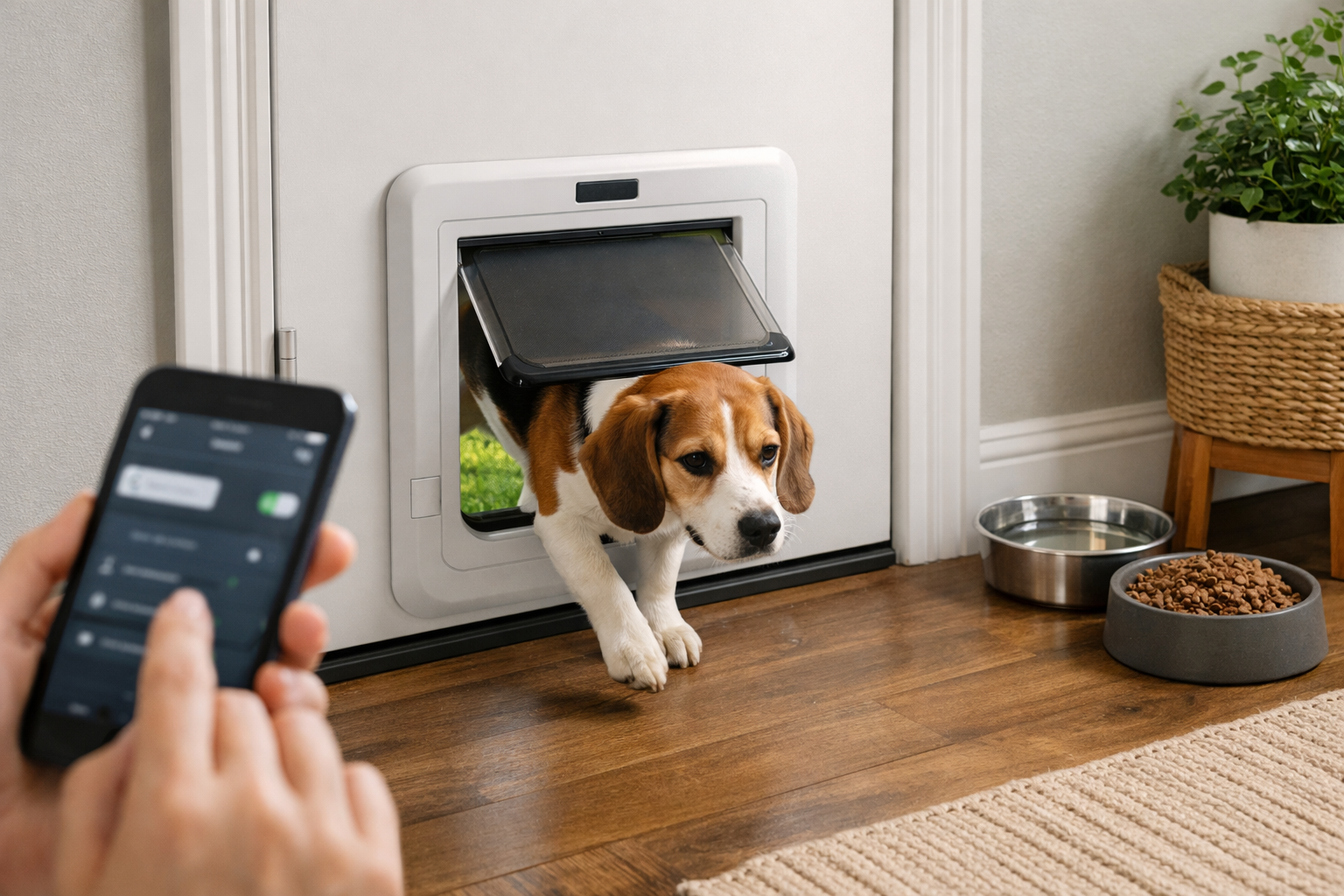
The PetSafe SmartDoor Connected is a practical starting point for households that want mainstream app features without moving immediately to a premium reinforced system. It uses paired Pet Door Keys for selective entry and exit, and the Medium model can also recognize several listed microchip formats.
Through the My PetSafe app, owners can remotely lock or unlock the door, set schedules for individual pets, and receive notifications about door use, lock status, and battery status. That combination is especially useful when pets have different routines—for example, a cat that can use the door during the day and a dog that needs to stay in overnight.
PetSafe sells the SmartDoor Connected in Medium and Large sizes. It requires a 2.4-GHz Wi-Fi connection for its connected features. The Medium model uses four C batteries, while the Large model uses four D batteries; an optional wall adapter is also available. Confirm your preferred power setup and whether your home Wi-Fi reaches the installation point before ordering.
The key limitation is microchip compatibility. Do not assume the Large model offers the same implanted-microchip support as the Medium model, and verify that your pet’s chip is on PetSafe’s supported list. For many multi-pet households, the Pet Door Key approach may be the more straightforward path.
For feature details and compatibility notes, see PetSafe’s SmartDoor Connected product documentation.
SureFlap Microchip Pet Door Connect: best for microchip-first access
The SureFlap Microchip Pet Door Connect is a strong fit for pet owners who specifically want a door that works with an existing implanted microchip. It is designed for large cats and small dogs and can also work with an RFID collar tag when needed.
The primary benefit is selective entry. The door is intended to recognize authorized pets and keep unauthorized animals from entering. In the companion app, owners can remotely lock or unlock the door, create curfews, receive entry and exit notifications, review activity reports, and share access with other household members.
There is an important setup requirement: app access depends on the separate Sure Petcare Hub. The Hub connects to an available Ethernet port on the home router. Without it, the product continues to work as a standard microchip pet door, but its remote and reporting features are unavailable.
SureFlap lists battery life of up to six months using four C batteries, though real battery life can depend on use and conditions. This is a good choice when you want chip-based authentication and your pet fits the opening. It is not the right choice for a medium or large dog that exceeds the product’s intended size range.
Review the manufacturer’s Microchip Pet Door Connect specifications before choosing an installation location or purchasing the required Hub.
Pawport Smart Pet Door: best for security-conscious large-dog homes
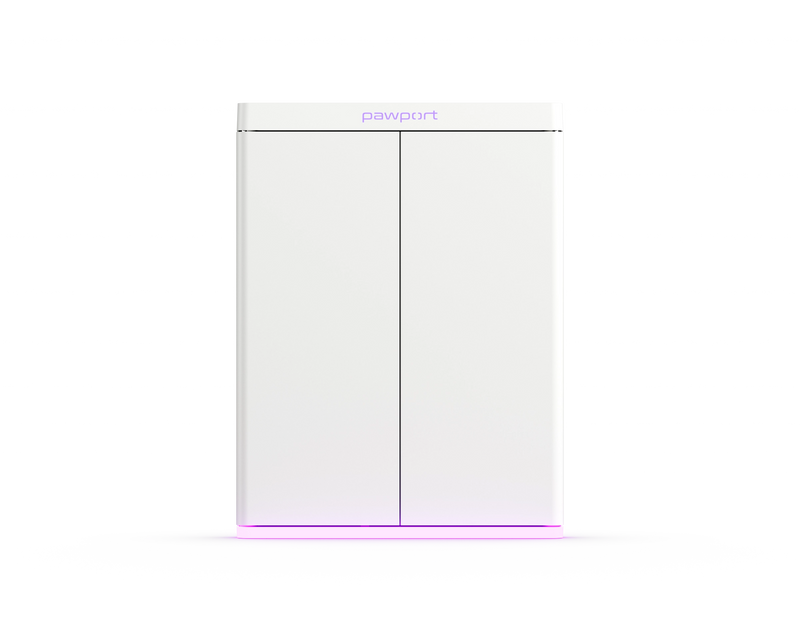
The Pawport Smart Pet Door takes a different approach from microchip readers. It uses Smart Pet Tags rather than implanted-chip recognition, so each authorized pet needs to wear its assigned tag. In return, it offers a more security-focused system with pet-specific access settings, schedules, remote controls, notifications, and activity tracking.
Pawport says its door uses two steel deadbolts, steel and aircraft-grade aluminum construction, a firm seal, and an integrated tamper alarm. Those are manufacturer claims rather than independent security testing, but the physical-lock emphasis distinguishes Pawport from simpler electronic flaps.
The app can manage multiple pets and doors, and the platform supports Amazon Alexa, Google, and Siri Shortcuts integrations. Pawport also offers Medium, Large, and Extra Large models that the manufacturer rates for pets up to 100, 150, and 200 pounds, respectively. Check both the stated pet-size guidance and the actual flap or opening dimensions; a dog’s shoulder width and comfort moving through the opening matter as much as weight.
This is a premium-oriented option for homes where preventing unwanted entry is the top priority. Confirm the power configuration, any optional battery system, tag requirements, and installation package before purchase. A reinforced pet door is only as secure as the door, wall, or frame into which it is installed.
High Tech Pet WiFi Power Pet Door: best motorized door and timer controls
The High Tech Pet WiFi Power Pet Door is an option for owners who prefer a collar-activated, motorized design. Instead of expecting a pet to push through a flap, the system opens for an authorized pet and uses directional sensing intended to control how pets move through the doorway.
Its app features include remote control, activation or deactivation of the sensor, a hold-open control, operational history, and up to 20 custom timers. That timer capacity may suit households with detailed daily routines, such as limiting outdoor access at night, during school pickup, or while a yard service crew is present.
The door also includes four-way access control and a safety retract system, according to High Tech Pet. Compare the available opening size with your dog’s measurements and verify the recommended installation type before choosing this model.
Because activation depends on the system’s collar-based approach, this is not a substitute for a microchip pet door. It is also wise to confirm the current app requirements and the product’s behavior during local Wi-Fi or power issues before relying on its remote functions as part of a daily routine.
Wayzn Smart Pet Door: best specialized choice for sliding glass doors
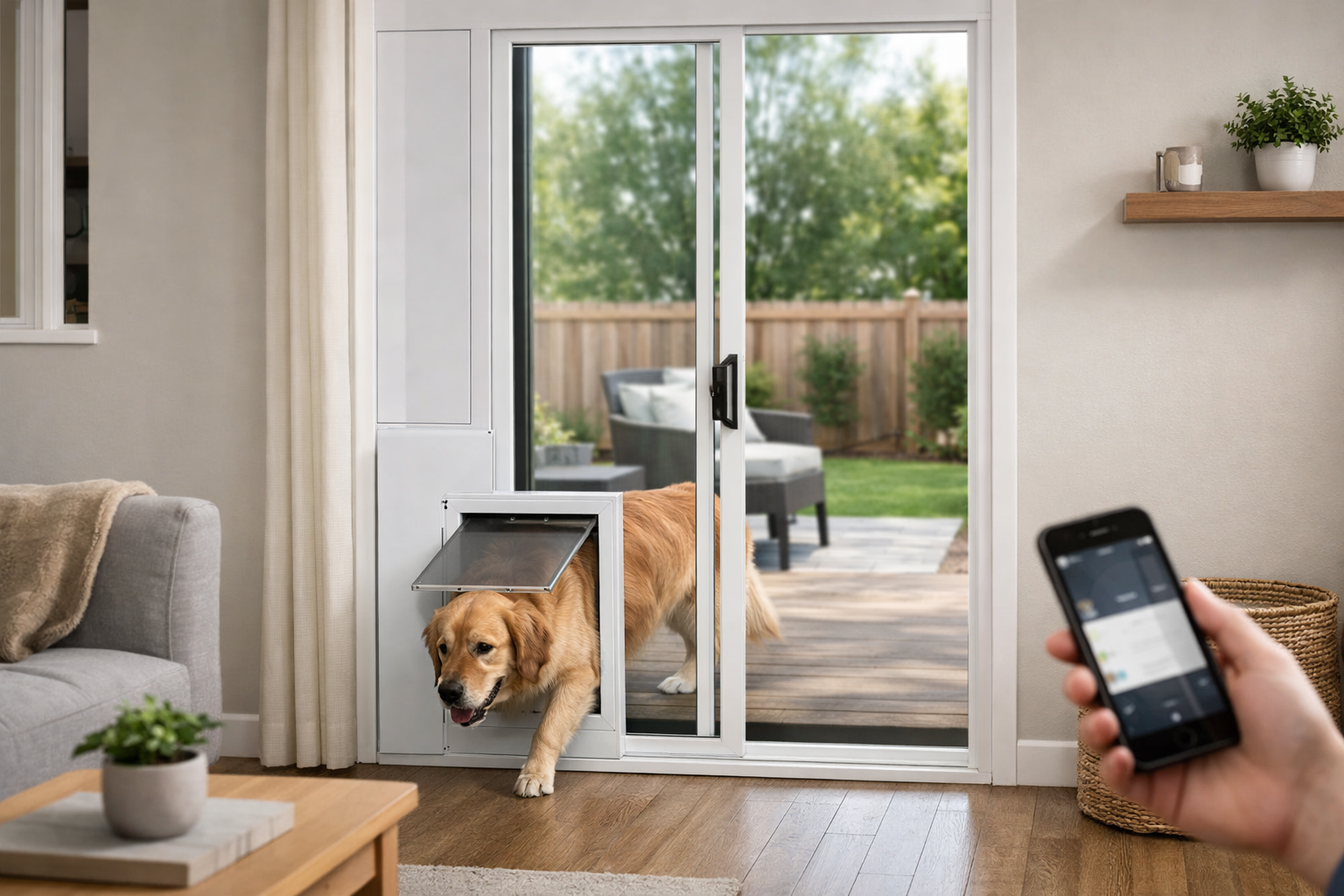
The Wayzn Smart Pet Door is not a conventional pet-door insert. It is designed to operate an existing compatible sliding glass door, which can be attractive for renters or homeowners who do not want to cut an opening into a wall or exterior door.
Wayzn supports app control, schedules, motion activation, Alexa control, additional users, and an optional Pet Tag. It can therefore serve as an app-controlled pet door solution while retaining the full opening of the sliding door when it operates.
Compatibility is the deciding factor. Wayzn is designed for two-panel sliding glass doors where the fixed panel is outermost. It is not designed for three-panel doors, and it is sold in versions based on exposed track length. Measure the track exactly and review the compatibility guidance before treating it as a damage-free alternative.
It is best viewed as a specialized solution for a specific patio-door layout, not a direct substitute for a microchip flap or a secure automatic dog door installed in a wall. If your sliding door does not match Wayzn’s requirements, choose a traditional door- or wall-mounted model instead.
Common buying and installation mistakes
- Assuming any implanted microchip works without checking the manufacturer compatibility list.
- Confusing microchip registry enrollment with reader compatibility.
- Choosing by pet weight instead of shoulder width and opening dimensions.
- Expecting one tag to cover multiple pets or sharing tags between animals.
- Assuming schedules alone block wildlife without individual identification.
- Ignoring entry-only vs exit-only behavior where the product supports it.
- Skipping battery replacement routines or hub/Ethernet requirements (SureFlap Hub, PetSafe Wi-Fi).
- Expecting full app control during internet outages when only local recognition remains.
- Installing without confirming wall/door thickness, weather exposure, and sealing.
- Treating a pet flap as equivalent to an exterior security door or alarm system.
Smart pet door decision table
Editorial summary from the product sections above—confirm compatibility, power, and failure behavior on official pages before purchase.
| Product | Best for | Pet identification | Multi-pet support | Power | App / remote control | Main trade-off |
|---|---|---|---|---|---|---|
| PetSafe SmartDoor Connected | Flexible app schedules and alerts | Pet Door Keys; Medium may read listed microchips per PetSafe | Per-pet schedules in app per article | Batteries; optional adapter | My PetSafe app; 2.4 GHz Wi-Fi for connected features | Microchip support varies by size—verify chip list |
| SureFlap Microchip Pet Door Connect | Chip-first cats/small dogs | Implanted microchip; optional RFID tag | Authorized pets via chip/tag per SureFlap | Batteries (life varies by use) | Hub + Ethernet for app/curfew features | Not for medium/large dogs outside opening |
| Pawport Smart Pet Door | Security-focused large dogs | Smart Pet Tags (collar) | Multiple pets/doors in app per Pawport | Verify power/backup in docs | App, Alexa/Google/Siri per Pawport | Premium; tag required; manufacturer physical-lock claims |
| High Tech Pet WiFi Power Pet Door | Motorized collar activation + timers | Collar-based activation | Timer routines; verify per-pet rules in docs | Per manufacturer install | Wi-Fi app, history, hold-open per article | Not a microchip door; confirm opening size |
| Wayzn Smart Pet Door | Compatible two-panel sliding doors | Optional Pet Tag; motion/schedules per Wayzn | App users/schedules; verify pet rules | Per Wayzn kit | App, Alexa; sliding-door specific | Narrow compatibility—not a wall insert |
How to choose among the best smart pet doors with app control
Start with the access method, then work outward to the installation and home network requirements.
Choose authentication based on your pets
Choose a microchip-focused model if you want to avoid a collar accessory and your pet has a compatible implanted chip. SureFlap is the clearest option here. PetSafe’s Medium model may also work with several listed chip formats, but verify compatibility first.
Choose a tag-based system if you have larger pets, need a motorized door, or want a product such as Pawport, High Tech Pet, or Wayzn. Make sure your pet will comfortably wear the tag, and consider keeping a spare tag where it cannot be accessed from outside.
Measure the pet, not just the existing opening
Measure your pet’s height at the shoulders, width at the widest point, and body depth. A nervous pet may refuse an opening that is technically large enough but feels tight. For large breeds, also consider the height of the threshold and whether the dog can step through comfortably as it ages.
Match the product to the installation surface
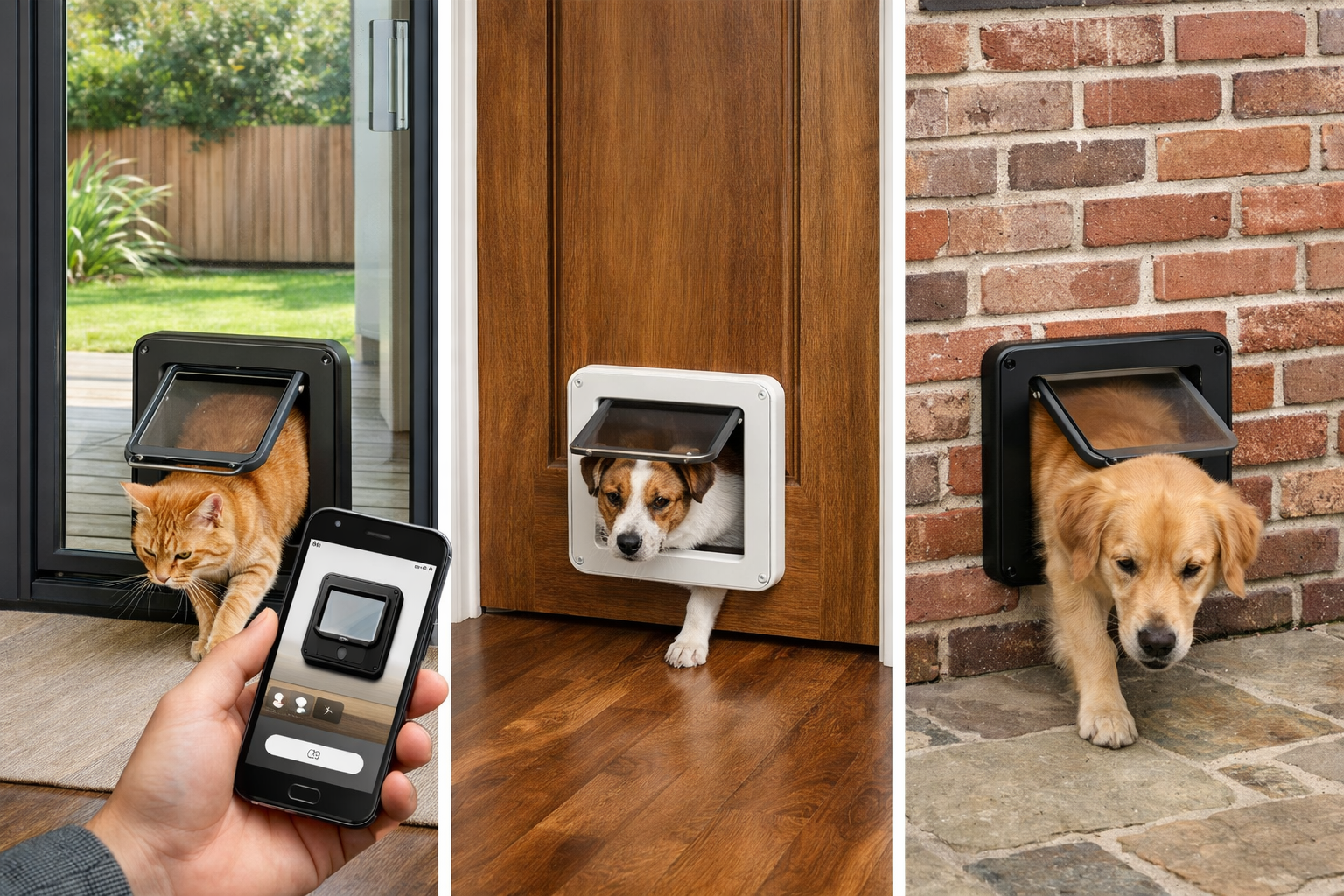
Some products can be installed in doors, walls, or glass with the correct accessories, while Wayzn is designed around a narrow category of sliding glass doors. Verify the permitted mounting surface, wall thickness, glass requirements, trim needs, and whether professional installation makes sense for your home.
Plan for Wi-Fi, hubs, and power
PetSafe requires 2.4-GHz Wi-Fi for connected features. SureFlap’s app functions require its separate Hub and an available Ethernet port on the router. Other Wi-Fi products should also be checked for current network requirements, supported mobile operating systems, and any changes to app or cloud-service policies. If hub placement is awkward, our guide on choosing the right smart home connection can help you plan reliable coverage near the door.
For battery-operated doors, add battery checks to your household routine. For hardwired or adapter-powered products, decide whether the outlet and cable route are protected from weather, chewing, and tripping hazards. If a product offers backup power, verify what functions remain available during an outage.
Use schedules as a safety tool
A schedule is more than a convenience feature. It can limit nighttime roaming, keep pets inside before a delivery window, or create different rules for different animals. Confirm whether the product supports pet-specific schedules rather than only a single door-wide timer if your household has multiple pets with different needs. For more ideas on building routines around connected devices, see How to Create Smart Home Automations for Beginners.
HomeTechSignal Recommendation
Editorial guidance from manufacturer documentation cited in this guide—not hands-on testing of every pet and installation.
Best balanced app control: PetSafe SmartDoor Connected when keys or listed microchips fit your pets and Medium/Large sizing matches the opening.
Best for existing microchips: SureFlap Microchip Pet Door Connect for large cats and small dogs—budget the Hub for app features.
Best security-oriented large-dog path: Pawport when collar tags and reinforced hardware match your install—verify dimensions beyond weight ratings.
Best motorized collar door: High Tech Pet WiFi Power Pet Door when timers and directional sensing fit your routine.
Best sliding-glass specialty: Wayzn only after track and door layout pass compatibility checks.
Choose a basic manual flap instead when you do not need selective entry or app history. For network planning around connected features, see how to choose the right smart home connection.
The bottom line
The best choice depends on what “secure” means for your home. The PetSafe SmartDoor Connected is the most balanced option for many households seeking schedules, alerts, and flexible Medium or Large sizing. The SureFlap Microchip Pet Door Connect is the better choice when using an existing pet microchip is the priority.
For a large-dog household focused on physical locking features, Pawport deserves a close look, while High Tech Pet may suit owners seeking a motorized, collar-activated door with extensive timers. If a compatible sliding glass door is your only practical installation location, Wayzn is the specialized alternative.
Whichever model you choose, verify current accessories, network needs, power behavior, and exact installation requirements before ordering. Those details determine whether a connected pet door will actually improve access control in your particular home.
Useful references: Smart Dog Door SmartDoor Connected Door · SureFlap Microchip Pet Door Connect
Related Home Tech Signal guides: How to Create Smart Home Automations for Beginners, How to Prevent Package Theft With Smart Home Security