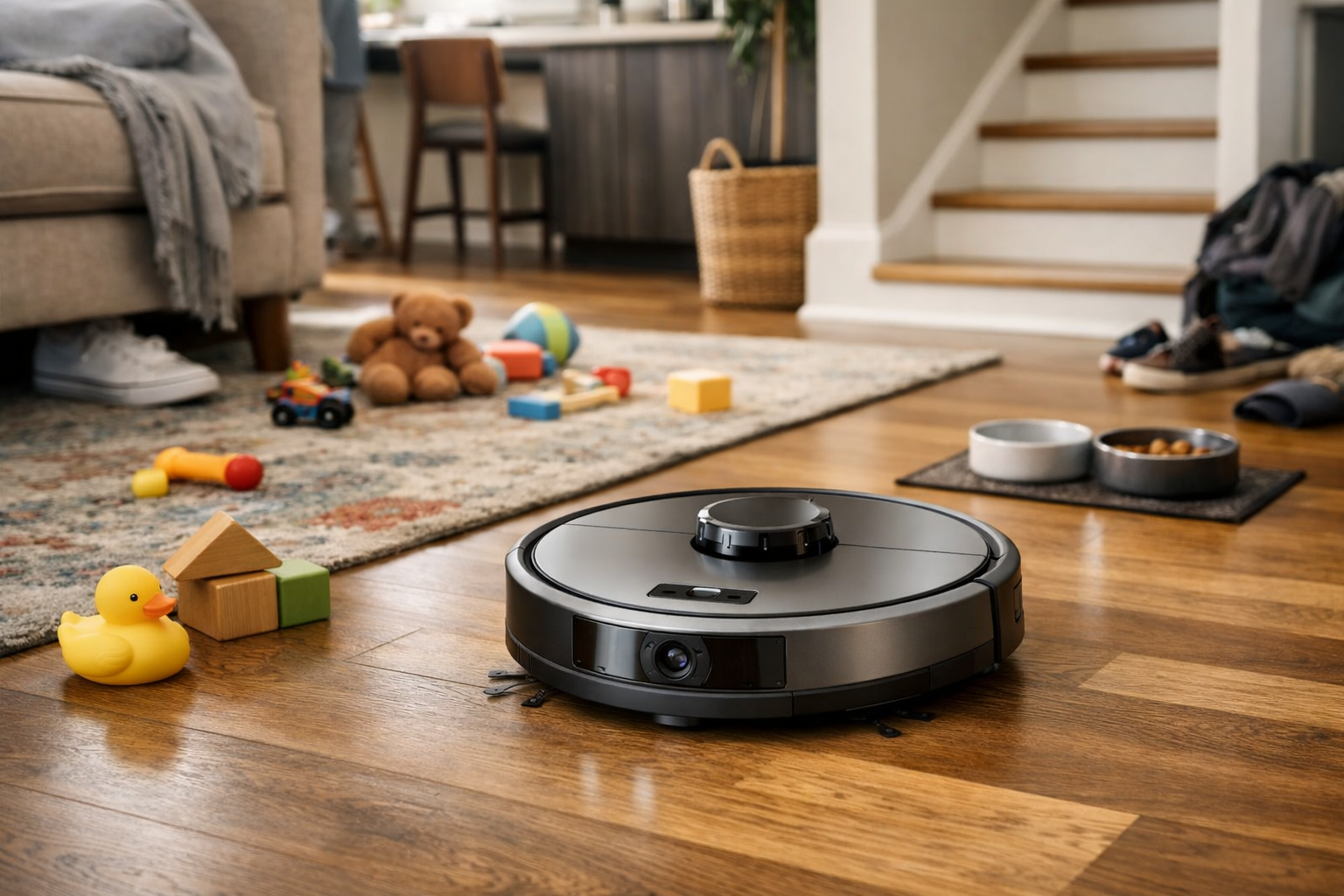
A robot vacuum can make a busy home easier to maintain, but cluttered and multi-level homes expose the limits of cheaper models quickly. A robot that repeatedly catches a charging cable, stalls at a doorway, misses the space under a sofa, or needs a map rebuilt upstairs is not delivering much hands-off help.
The best AI robot vacuums for cluttered homes combine camera- and sensor-based object recognition with practical hardware: slim designs, anti-tangle brushes, threshold-climbing systems, multi-floor mapping, and docks that reduce routine emptying and mop care. They are still not replacements for basic pickup before a cleaning run, especially in homes with children or pets.
Our recommendations below focus on the household problems that matter most: loose toys, pet bowls, cords, low furniture, carpet transitions, raised door tracks, and separate floors. Prices change frequently, so compare current U.S. pricing and retailer support before choosing among these premium models.
What makes a robot vacuum good for cluttered, multi-level homes?
For this kind of home, suction is only one part of the buying decision. A powerful robot that gets trapped every other run may be less useful than a slightly less aggressive cleaner that can complete its route without help.
Obstacle recognition that works with everyday mess
AI obstacle avoidance is designed to help a robot identify and route around items such as shoes, pet accessories, furniture legs, and some loose household objects. Better systems use combinations of cameras, structured light, and other sensors to spot obstacles before contact.
That does not mean a robot can safely run through a fully messy room. Cords, shoelaces, socks, thin clothing, small toys, and pet waste remain higher-risk items. Lighting, object size, floor color, placement, and software updates can all affect what a robot sees. Treat obstacle avoidance as a useful safety layer, not permission to leave every item on the floor.
Threshold crossing instead of stair climbing
Raised door tracks and uneven transitions can stop ordinary robot vacuums. Premium models increasingly use lift systems or retractable legs to handle taller thresholds, but manufacturer ratings are usually based on controlled conditions. The shape, surface, and angle of your actual threshold matter as much as its measured height.
None of these robots should be expected to climb a staircase. Threshold-climbing hardware helps with doorway transitions, not a full flight of stairs.
Low-clearance cleaning and anti-tangle parts
If much of your dust collects under beds, sofas, cabinets, or media consoles, robot height matters. A low-profile robot has a better chance of reaching those areas, provided there is enough clearance and it can navigate around furniture supports.
Long hair and pet fur also change the equation. Look for main-brush and side-brush designs intended to resist tangles, but plan to inspect brushes periodically. Even a strong anti-tangle system can collect thread, ribbon, elastic bands, or unusual debris.
Multi-floor maps and dock maintenance
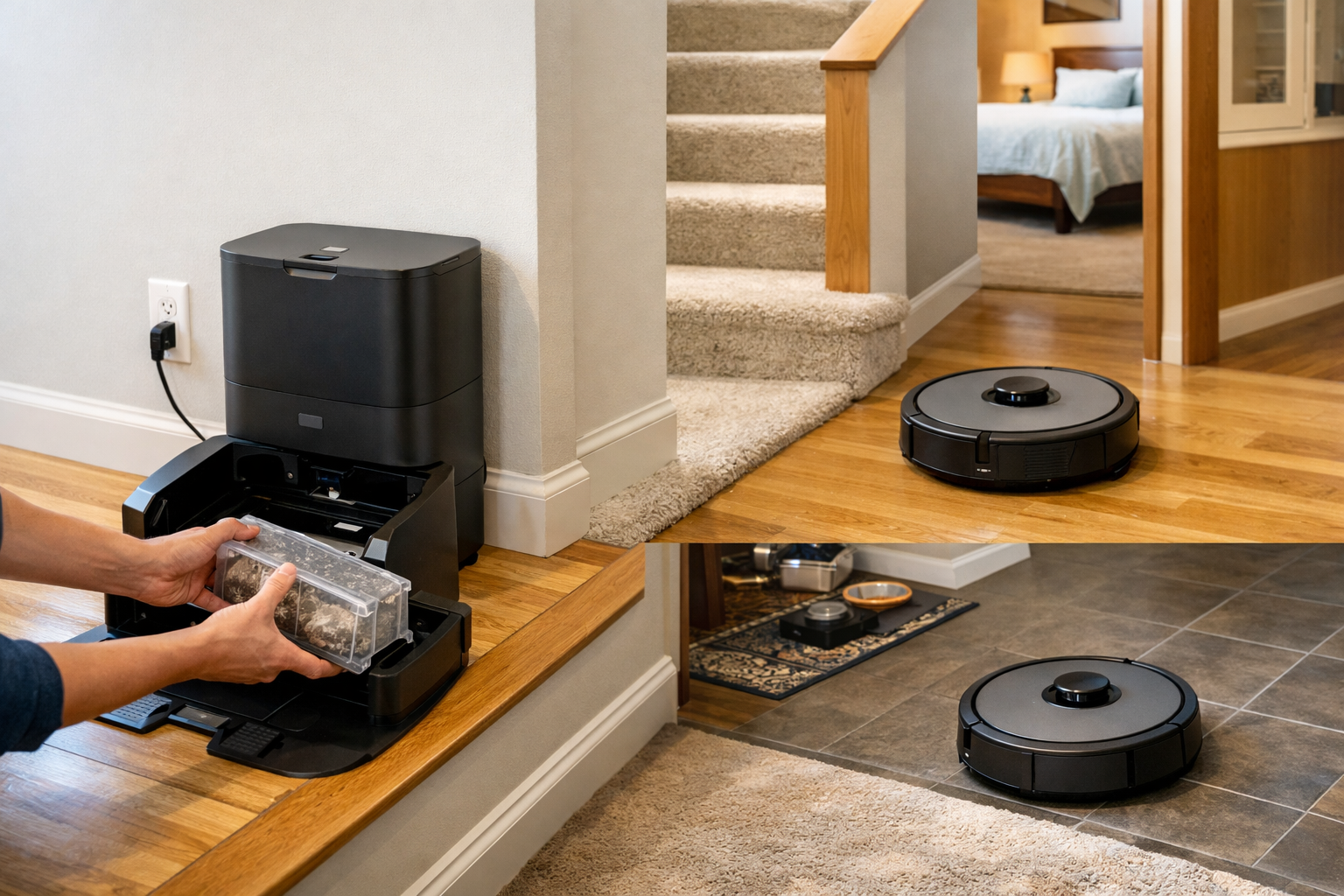
For a two-story home, saved maps are more useful than simply having a smart navigation system. The robot needs to create and retain a separate map for each level, including rooms, boundaries, carpets, and no-go zones.
A self-emptying and mop-washing dock can reduce routine chores, but the dock normally stays on one floor. You will still need to carry the robot to another level, start a job there, and return it to its dock when needed.
Best AI robot vacuums for cluttered homes: quick picks
- Best overall: Roborock Saros 20
- Best for difficult thresholds and dense clutter: Dreame X60 Max Ultra Complete
- Best slim premium alternative: Roborock Saros 10R
- Best threshold-crossing value candidate: Dreame X50 Ultra
Best overall: Roborock Saros 20
The Roborock Saros 20 is the broadest premium pick for households that need advanced navigation, obstacle awareness, carpet handling, and automated maintenance in one system. Its appeal is not one headline specification; it is the combination of features aimed at reducing common interruptions during a cleaning run.
Roborock says the Saros 20 uses its StarSight navigation system alongside RGB and structured-light obstacle recognition. It is designed to recognize obstacles and, when an area is temporarily blocked by a person or pet, return to re-clean that missed space later. That could be useful in active living rooms and kitchens where the floor plan changes throughout the day.
The robot also uses dual anti-tangle brush hardware, a meaningful consideration for homes with shedding pets or residents with long hair. Its AdaptiLift chassis is designed to manage double-layer thresholds up to a combined 3.46 inches under specified conditions. That rating is unusually ambitious, but measure your transitions and leave room for real-world variation before treating it as a guarantee.
For homes with rugs and hard floors, the Saros 20 is intended to adapt its cleaning behavior across surfaces and works with a dock designed to automate more of the vacuuming and mopping routine. Review the full feature list and conditions on the Roborock Saros 20 product page before buying, particularly if threshold height is your deciding factor.
Choose it if: You want a current flagship option with a well-rounded mix of obstacle recognition, anti-tangle hardware, transition handling, and dock automation.
Consider another model if: Your home has especially low furniture or unusually tall and awkward doorway transitions that make the Dreame X60 Max Ultra Complete a better on-paper fit.
Best for difficult thresholds and dense clutter: Dreame X60 Max Ultra Complete
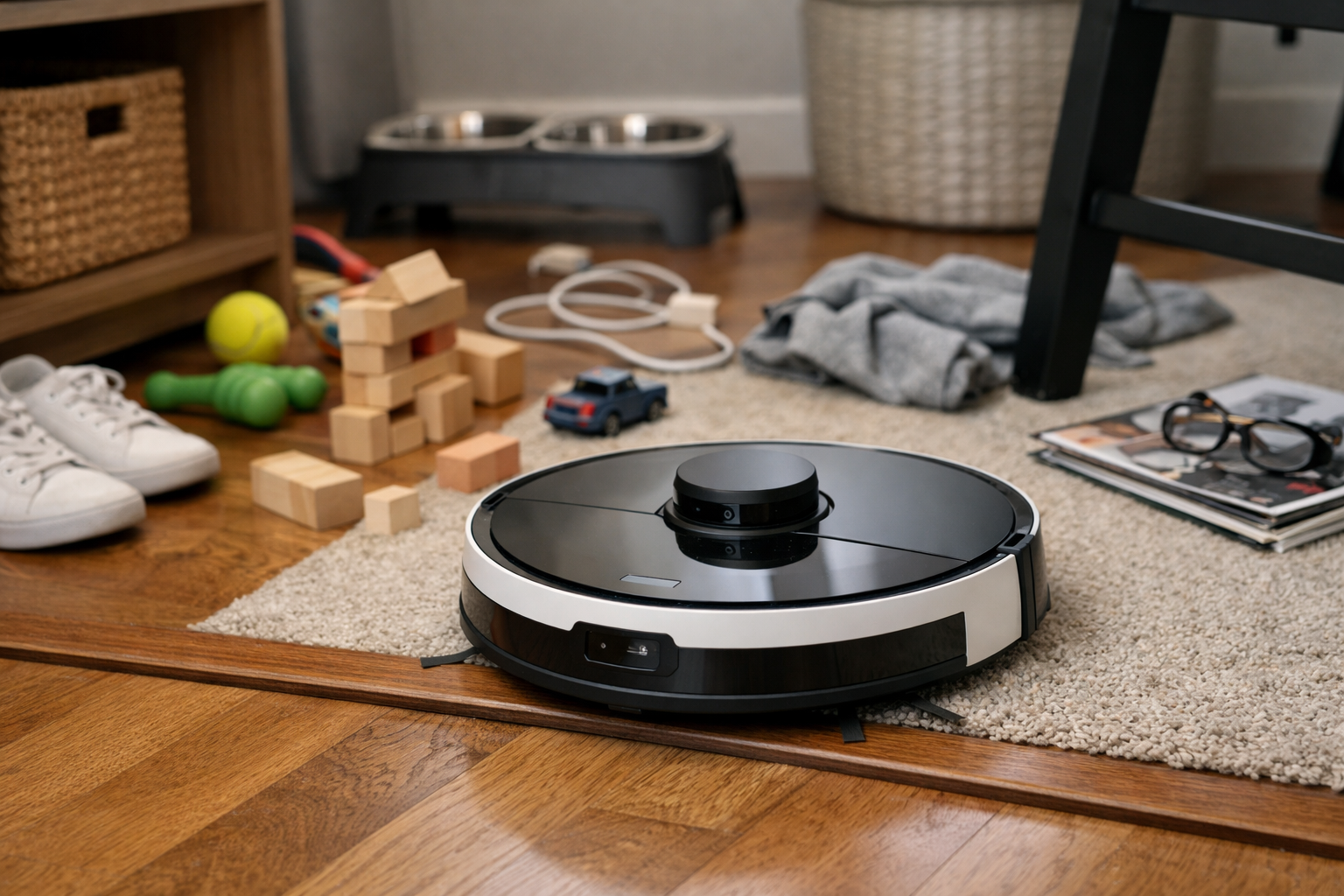
The Dreame X60 Max Ultra Complete stands out on paper for homes that present several navigation problems at once: dense floor clutter, low furniture, hard-to-cross transitions, pets, and mixed flooring.
Dreame lists the X60 Max Ultra Complete at 3.13 inches tall, which makes it a compelling option when under-furniture access is a priority. Its navigation system uses dual AI cameras and proactive lighting, and Dreame states that it can recognize more than 280 object types. In a cluttered home, the practical advantage is not that every item will be perfectly avoided; it is that the robot has more tools to detect and route around common obstacles.
It is also rated by Dreame to cross double-layer obstacles up to 3.47 inches and single-layer steps up to 1.77 inches under stated test conditions. Those ratings make this the pick to investigate first if raised thresholds are a recurring problem. Still, inspect every transition in the home. A sharp metal track, a narrow lip, or a slippery surface can be more difficult than a similarly sized rounded threshold.
The X60 Max Ultra Complete includes automated dock functions for dust handling and mop care. Its liquid-stain detection feature should be verified in the current U.S. app and firmware before purchase, as Dreame indicates that part of the functionality is being delivered through an over-the-air rollout.
Choose it if: Your priority is navigating a complicated first floor with low furniture, multiple transition types, and lots of objects that can appear during the day.
Consider another model if: You prefer a model with more independent comparison context or do not need its more aggressive obstacle-crossing specifications.
Best slim premium alternative: Roborock Saros 10R
The Roborock Saros 10R is a strong premium alternative for buyers who want a slim robot with advanced navigation and object avoidance but do not necessarily need the newest model in the lineup.
It uses Roborock’s StarSight navigation approach and obstacle-recognition hardware, along with anti-tangle brush features intended to reduce hair-related maintenance. Its lower profile is especially relevant in homes where a tall sensor turret would prevent access below sofas, beds, and cabinets.
Independent comparison testing from RTINGS found the Saros 10R superior overall to the Dreame X50 Ultra, citing stronger hard-floor pickup and mopping performance while finding obstacle avoidance and threshold-clearing capability broadly comparable. That makes the Saros 10R worth close attention when its current street price is meaningfully below newer flagship robots.
As with the other picks, it can be part of a multi-floor routine only if your specific app version and model configuration support saved maps for each level. The robot will not move itself upstairs, but a slim design can make it more useful once you carry it to the next floor.
Choose it if: You want an established, slim premium choice with strong all-around cleaning credentials and potentially better value than the newest flagships.
Consider another model if: Your main issue is unusually high thresholds, where the X60 Max Ultra Complete or X50 Ultra may deserve closer measurement-based comparison.
Best threshold-crossing value candidate: Dreame X50 Ultra
The Dreame X50 Ultra remains relevant for homes with raised door tracks, room transitions, and low furniture. Its defining feature is Dreame’s ProLeap retractable-leg system, rated to cross obstacles up to 6 centimeters under the company’s stated conditions.
It also uses VersaLift navigation, which lowers the sensor assembly to approximately 89 millimeters for access beneath lower furniture. Dreame says its AI system can identify up to 200 object types, and the robot includes anti-tangle brush hardware intended to help with hair and fur.
This is the model to compare when a doorway transition is your primary obstacle and its current price is lower than the newer X60 Max Ultra Complete. The X50 Ultra is an older-generation option in this group, however, so do not assume it is automatically the better deal. Compare current pricing, warranty terms, replacement-part availability, and the specific features you will use.
Choose it if: You want to prioritize threshold handling and under-furniture access, and current pricing makes it a compelling alternative.
Consider another model if: You want Dreame’s newer dual-camera system and higher stated object-recognition count, or you prefer the independent comparison advantage of the Saros 10R.
How multi-floor robot vacuum cleaning actually works
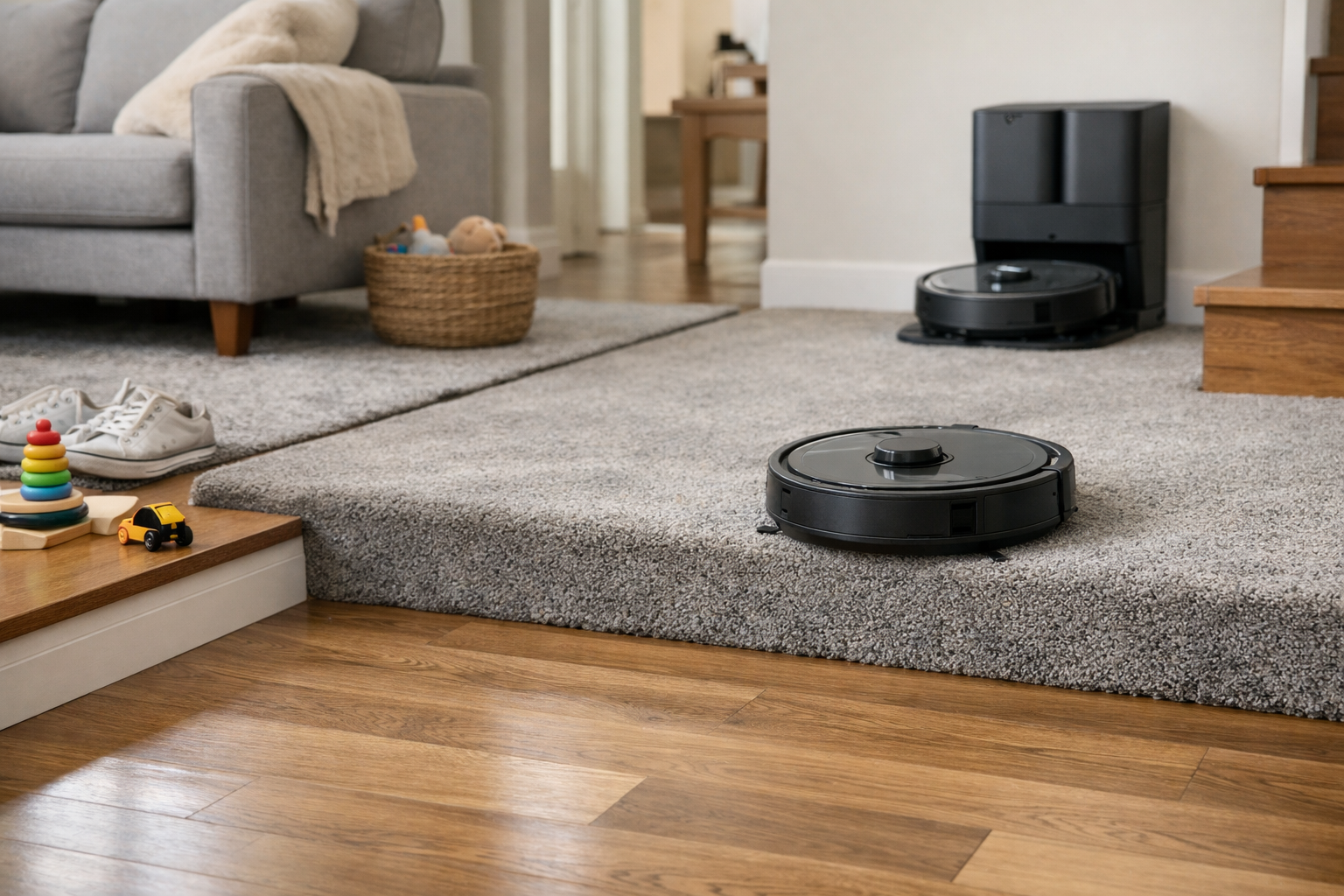
A robot vacuum for a two-story home does not need a dock on every level, but it does need your help moving between levels. In most setups, you carry the robot upstairs, place it in an open area, select the appropriate floor in the app, and start cleaning. When the job is finished, you carry it back to the dock floor for charging, emptying, and mop maintenance.
Saved maps make this process much smoother. Roborock’s multi-level mapping guidance explains that compatible models can create additional maps after you carry the robot to another floor. The robot can later recognize the floor and use its corresponding saved map without moving the dock.
Before buying, verify these points for the exact model you are considering:
- Whether the U.S. app and current firmware support multiple saved maps.
- How the robot identifies the correct floor after manual transport.
- Whether no-go zones, room names, carpet settings, and cleaning schedules can be managed separately by floor.
- What happens when the robot needs to recharge during an upstairs cleaning job.
- Whether you want a second dock or charging arrangement, if available, for a frequently cleaned upper level.
For most households, one dock on the main floor is workable. It is less convenient if you expect fully unattended daily cleaning upstairs, since the robot cannot return down a staircase on its own.
How much clutter should you still remove?
Even the best AI robot vacuums for cluttered homes work more reliably with a short pre-run check. The goal is not to make every room perfect. It is to remove the items most likely to cause a jam, smear, or navigation mistake.
- Pick up cords and charging cables. Thin cables can be hard to identify and may wrap around brushes or wheels.
- Remove socks, shoelaces, clothing, and ribbons. These are common entanglement hazards.
- Move very small toys and loose building pieces. Small objects can be missed, pushed around, or pulled into the cleaning path.
- Handle pet waste immediately. Do not rely on object detection for a risk that can create a major cleanup problem.
- Check under chairs and around pet bowls. A robot may avoid these areas conservatively, leaving spots that need occasional manual attention.
- Keep the dock approach clear. The robot needs unobstructed space to return for charging, emptying, or mop washing.
It is also smart to supervise the first few cleaning runs. Watch where the robot hesitates, what it avoids, and where it gets stuck. Then add no-go zones, virtual walls, cord covers, or a small threshold ramp where needed.
Buying checklist for a two-story or cluttered home
Before deciding, walk through the home with a tape measure and a realistic picture of your daily mess. The right robot vacuum for cluttered homes is the one that solves the obstacles you actually have.
- Measure thresholds: Record the height, width, surface, and shape of every problematic doorway transition.
- Measure furniture clearance: Check the lowest point under beds, sofas, cabinets, and radiators, not just the visible front edge.
- Identify your clutter: Cords, pet toys, children’s toys, long hair, shoes, and pet bowls create different navigation challenges.
- Consider lighting: Camera-based systems may perform differently in dark rooms or under dim furniture.
- Plan the dock location: Choose a stable, accessible area near power with enough open floor around it.
- Check carpet behavior: If you have thick rugs or many carpet edges, verify how the robot handles them while vacuuming and mopping.
- Review maintenance needs: Automated docks reduce chores but still need fresh water, dirty-water disposal, cleaning, and replacement bags or pads.
- Verify privacy settings: Review camera-related settings, data controls, and app permissions before connecting any camera-equipped robot to your home network.
- Compare current prices: Do not choose based on an outdated launch price. Premium robot-vacuum pricing and promotions can shift substantially.
Navigation, obstacle detection, and “AI” object recognition
Navigation (LiDAR, visual SLAM, mapping) helps the robot know where it is and plan routes—it does not by itself identify a sock versus a cable. Obstacle detection spots something in the path; object recognition (when documented) may classify categories such as shoes or cords. Camera-based systems can support richer classification but raise privacy questions; structured light or other depth sensing may detect geometry without the same image workflow.
LiDAR or “AI” branding does not guarantee zero entanglement. For pet-waste and cable-specific avoidance claims, see our dedicated robot vacuums that avoid pet waste and cables guide rather than expecting every model here to document the same object list.
Who should buy an AI clutter robot—and who should skip?
- Buy if floors are often messy with shoes, toys, cables, or pet items and you want fewer rescues during unattended runs.
- Buy if you will use maps, no-go zones, and a short pre-run pickup habit—not instead of them.
- Skip or reconsider if rooms are already cleared before every run, you dislike camera robots, or you need guarantees on thin cords, liquids, or pet waste without checking manufacturer lists.
- Skip if you expect hands-off multi-floor cleaning without carrying the robot between levels.
Low light, privacy, and real-world clutter limits
Low light: Camera-heavy systems (for example Dreame’s dual AI cameras with proactive lighting) may behave differently in dim rooms than in bright kitchens. Mapping success and object classification are separate—test your actual rooms on the first runs.
Privacy: Review each brand’s app settings for obstacle photos, data sharing, and whether capture can be limited in bedrooms or offices. Do not assume images stay on-device unless the manufacturer documents that behavior for your model.
Limits: Advanced avoidance reduces collisions and entanglement; it does not replace clearing liquids, long strings, fragile items, or confirmed pet-waste risk. Treat it as fewer interruptions, not a perfectly clear floor.
Pre-cleaning: what you should still remove
Even with strong avoidance, remove thin charging cords, liquids, pet waste, long ribbons, and sharp items when you can. Ordinary shoes, larger toys, or some socks may be routed around when the manufacturer documents recognition—but thin black cords on dark rugs remain a common failure mode. Use no-go zones around cable clusters and feeding areas.
Common buying and setup mistakes
- Buying on “AI” marketing without checking navigation versus object lists.
- Assuming LiDAR or mapping equals cable or sock recognition.
- Expecting pet-waste avoidance without explicit manufacturer support.
- Ignoring low-light rooms for camera-based models.
- Skipping privacy settings on camera-equipped robots.
- Leaving the dock in a cramped or cluttered lane.
- Choosing suction specs over avoidance and maintenance burden.
- Changing several app settings at once instead of watching supervised first runs.
Cluttered-home robot vacuum decision table
Summary from the product sections above—confirm current firmware, app features, and U.S. availability before purchase.
| Product | Best for | Navigation (per article) | Obstacle sensing | Camera? | Small-clutter handling | Privacy / low-light note | Main trade-off |
|---|---|---|---|---|---|---|---|
| Roborock Saros 20 | Best overall premium mix | StarSight navigation | RGB + structured-light recognition; re-clean when blocked | RGB camera + structured light cited | General obstacle routing; not a guarantee on every cord | Verify app/camera settings; lighting affects vision systems | Ambitious threshold rating—measure your real transitions |
| Dreame X60 Max Ultra Complete | Dense clutter, low furniture, thresholds | Listed navigation with dual AI cameras | Dreame lists 280+ object types; proactive lighting | Dual AI cameras per Dreame | Strong on-paper recognition; still not full-room mess immunity | Camera + lighting; review privacy options in app | Some features may roll out via OTA—verify before buy |
| Roborock Saros 10R | Slim premium alternative | StarSight navigation | Obstacle-recognition hardware (per Roborock) | Not detailed separately here—check Roborock docs | Comparable avoidance to X50 in RTINGS comparison cited | Slim profile helps under furniture; same camera cautions as line | Older flagship vs Saros 20—compare street price |
| Dreame X50 Ultra | Threshold value candidate | VersaLift navigation (lowers sensor) | Dreame lists up to 200 object types | AI vision per Dreame marketing | ProLeap legs for transitions; verify real door tracks | Older gen vs X60; confirm app features | May trail newer X60 on recognition hardware |
HomeTechSignal Recommendation
- Best overall for cluttered homes: Roborock Saros 20 for balanced avoidance, anti-tangle hardware, transitions, and dock automation.
- Best for difficult thresholds and dense clutter: Dreame X60 Max Ultra Complete when low height and transition geometry are the pain points.
- Best slim premium pick: Roborock Saros 10R when under-furniture access and value matter.
- Best threshold-focused value check: Dreame X50 Ultra when ProLeap transitions and pricing beat newer models for your home.
- Best for cable/pet-waste-specific needs: Read the pet waste and cables guide—do not assume this clutter list documents the same guarantees.
- Best if basic avoidance is enough: A tidier home with good pre-cleaning may not need flagship AI; this article targets harder clutter cases.
The bottom line
The best AI robot vacuums for cluttered homes are most valuable when they reduce the reasons a cleaning run fails. For the broadest current premium feature set, start with the Roborock Saros 20. The Dreame X60 Max Ultra Complete is the more specialized option for dense clutter, low furniture, and challenging threshold geometry. The Roborock Saros 10R is a compelling slim premium alternative, while the Dreame X50 Ultra is worth comparing when threshold-crossing capability and current sale pricing are the priorities.
No model can climb stairs or eliminate every pre-cleanup task. But with separate maps for each floor, a clear dock area, realistic clutter habits, and a robot matched to your thresholds and furniture, a premium AI robot vacuum can take over a meaningful share of day-to-day floor maintenance.
Useful references: How to create multiple maps for multi-level house? · Obstacle Detection and PrecisionVision Support
Related Home Tech Signal guides: Best Robot Vacuums That Avoid Pet Waste and Cables, How to Create Smart Home Automations for Beginners, Best Local AI Security Cameras (privacy / onboard processing context)