Disclosure: As an Amazon Associate I earn from qualifying purchases.
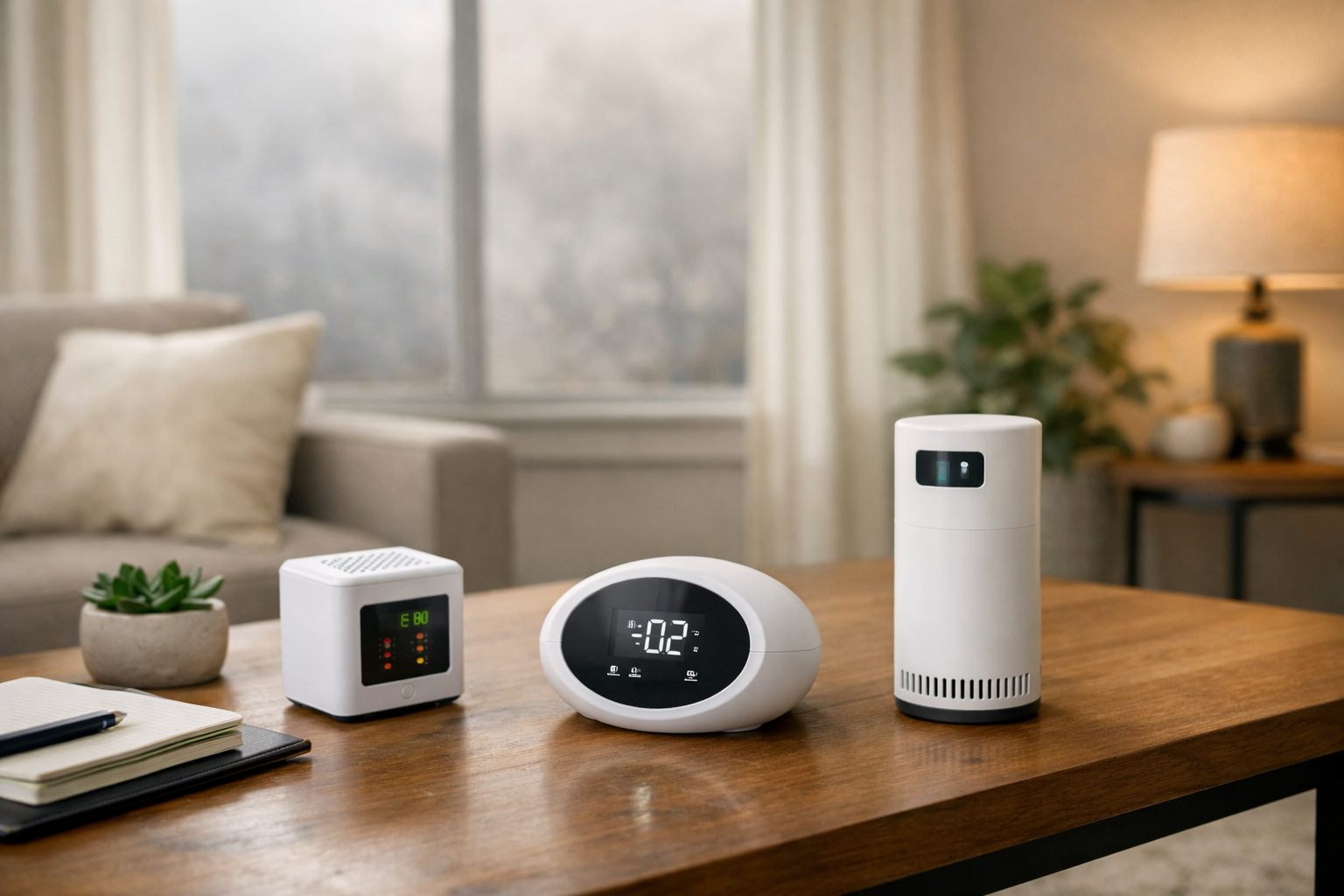
When wildfire smoke moves into your area, the indoor reading that matters most is PM2.5: fine particle pollution small enough to reach deep into the lungs. Outdoor conditions can change quickly, and your home may not behave like the nearest public monitoring station. An indoor monitor gives you a way to see whether particles are getting inside and whether your filtration steps are lowering them.
The best indoor air quality monitors for wildfire smoke are not necessarily the ones that measure the most things. A useful smoke monitor needs a PM2.5 sensor first. After that, choose based on how you want to check readings: on a built-in screen, in an app, through a visible status light, or in a smart-home dashboard.
These are decision-support tools, not regulatory monitors or medical devices. They are most valuable for following trends, comparing rooms, spotting particle spikes, and checking whether closing windows, improving HVAC filtration, or running an air purifier reduces PM2.5 over time.
Quick picks
- Best for simple, at-a-glance particle awareness: PurpleAir Touch
- Best display-based monitor with broader air data: IQAir AirVisual Pro
- Best for PM2.5 plus radon and other indoor measurements: Airthings View Plus
- Best for Home Assistant and open-source-minded users: AirGradient ONE
What to look for in an indoor wildfire-smoke sensor
Start with PM2.5, not CO2 or VOCs
Wildfire smoke is a complex mix of pollutants, but PM2.5 is the most practical measurement for tracking its particle component indoors. A home PM2.5 sensor can show whether particulate pollution rises after a window is opened, falls after an air cleaner runs, or differs between a bedroom and a main living space.
CO2, VOC, radon, temperature, and humidity readings can still be useful. CO2 can help you understand ventilation patterns, for example. But a low CO2 or VOC reading does not mean wildfire particles are low. None of those measurements substitutes for PM2.5 when smoke is the concern.
Choose a display style you will actually use
An indoor air quality monitor with display is convenient during a fast-moving smoke event because you can check the room without reaching for your phone. A color screen can provide more detail, while a simple light indicator can be easier to notice across a room. App and web dashboards are better for reviewing history, comparing rooms, or checking a monitor while away from home.
Consider power and placement before buying
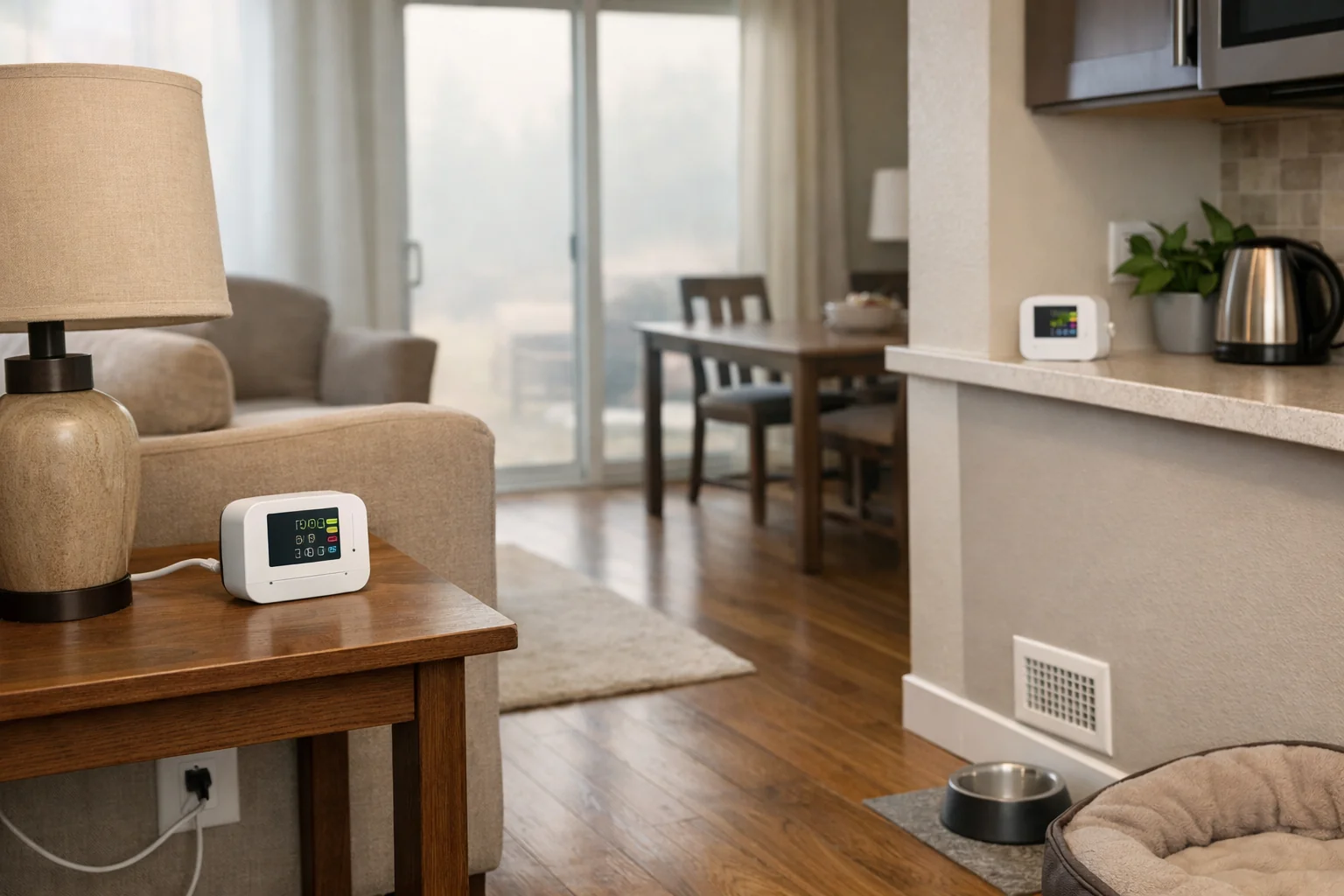
A continuously powered monitor can be a better fit for watching short-term smoke changes or testing an air purifier. Battery operation can be useful for moving a monitor between rooms, but sampling behavior may vary by device and power mode. Check the current manufacturer documentation for each model’s power requirements, sampling intervals, included adapter, connectivity behavior, and alert options before purchasing.
Extra sensors are optional, not a smoke requirement
A monitor with radon, CO2, or VOC sensing may consolidate several household measurements in one device. That can justify spending more if you will use the additional data year-round. If your main goal is a real-time wildfire smoke monitor, though, prioritize a clearly presented PM2.5 reading and a workflow that makes it easy to act on that reading.
Best indoor air quality monitors for wildfire smoke
PurpleAir Touch: Best for simple, at-a-glance PM2.5 awareness
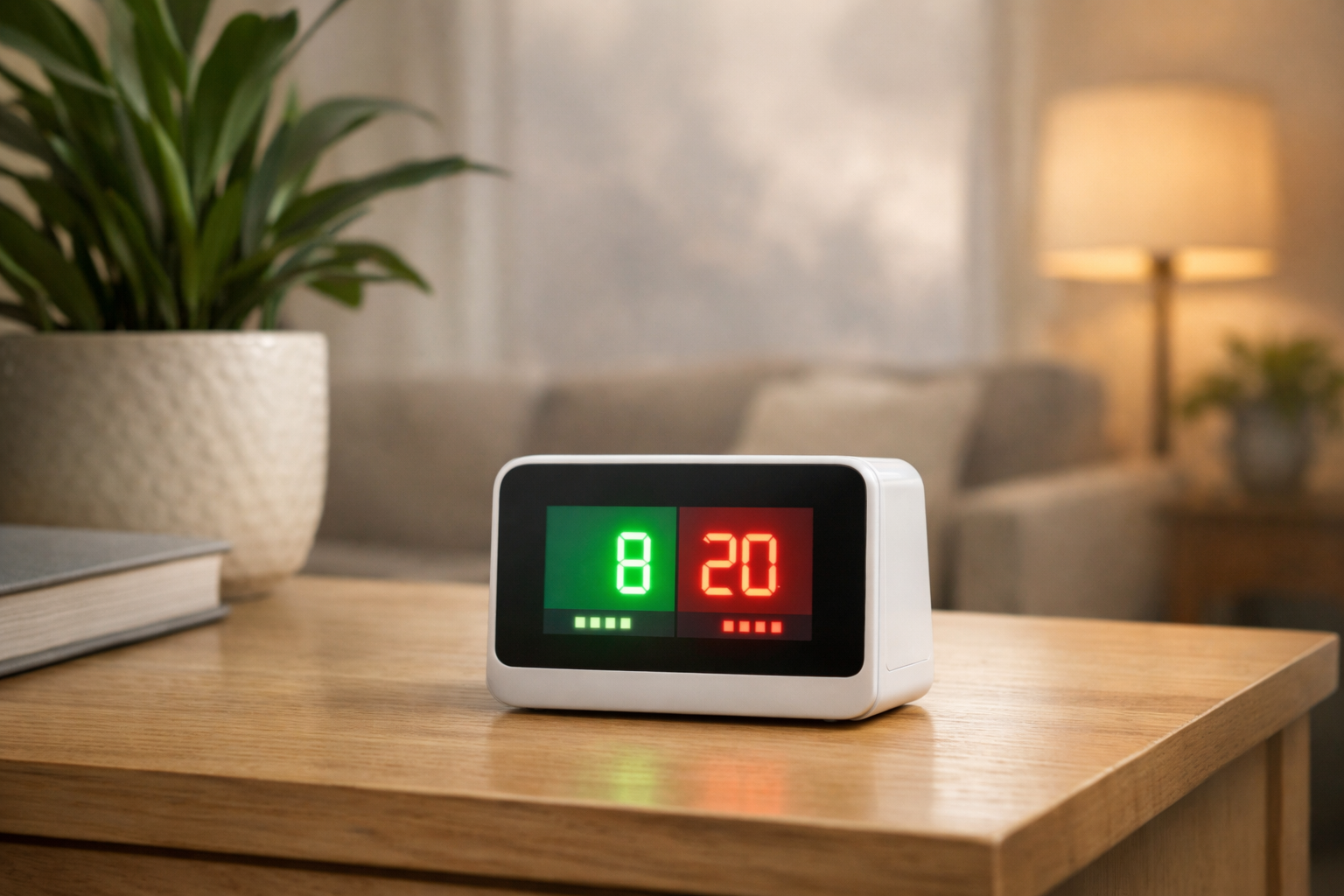
Who it is for: People who want a dedicated indoor particle monitor with an easy-to-see visual status indicator rather than a broad multi-pollutant dashboard.
PurpleAir Touch is the most focused recommendation here for households primarily concerned with airborne particles. PurpleAir positions the Touch as an indoor monitor, and its full-color LED ring is designed to make changing indoor particle conditions visible at a glance. That can be especially helpful when a smoke event is developing and you want a quick check before deciding whether to close windows or start filtration.
Its narrower focus is also its tradeoff. PurpleAir Touch is best viewed as a particulate-monitoring tool, not a single device for tracking CO2, radon, VOCs, and other environmental measurements. If you want a screen filled with multiple pollutant categories, the IQAir or Airthings options below are better aligned with that goal.
For smoke use, put the PurpleAir Touch in the room where people spend the most time, then watch for sustained changes rather than reacting to every brief fluctuation. Independent AQ-SPEC laboratory evaluation of the PurpleAir PA-I Indoor found useful PM2.5 performance under its tested conditions. That is encouraging context for PurpleAir’s indoor particle-monitoring approach, but it does not prove every current model will produce identical results in every home.
IQAir AirVisual Pro: Best for a clear display and broader smoke context
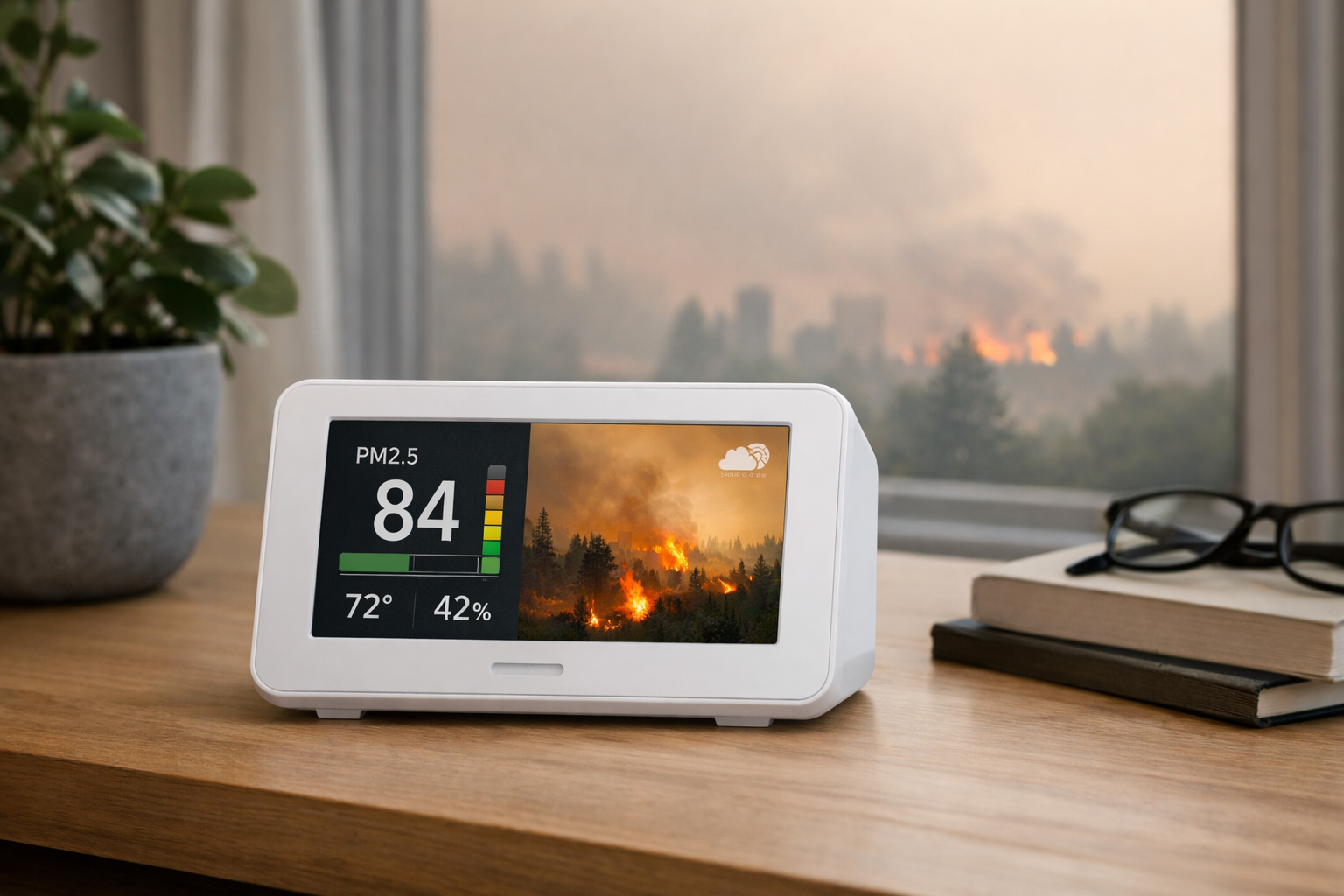
Who it is for: Households that want PM2.5 front and center, plus CO2, TVOCs, temperature, and humidity on a built-in color display.
IQAir AirVisual Pro is a strong fit if you want to see several indoor conditions in one place without losing sight of PM2.5. It measures PM2.5, CO2, temperature, humidity, and TVOCs, and it offers display, app, and web access. IQAir specifically identifies wildfire smoke and outdoor pollution entering buildings as use cases for the monitor.
The screen is its practical advantage over monitors that rely mostly on an app. You can glance at the device while changing your HVAC filter, running a portable air cleaner, or checking rooms after doors have been opened. The added CO2 reading may also help you think through ventilation choices, though it should not be interpreted as a smoke measurement.
For more detail on its listed capabilities and current purchase information, review the manufacturer’s AirVisual Pro Indoor Monitor page. AQ-SPEC testing also found good PM2.5 precision in the AirVisual Pro evaluation under the tested laboratory conditions. As with any consumer PM2.5 sensor, use the result as support for tracking conditions and trends, not as a guarantee of regulatory-grade accuracy.
Airthings View Plus: Best for households that also want radon monitoring
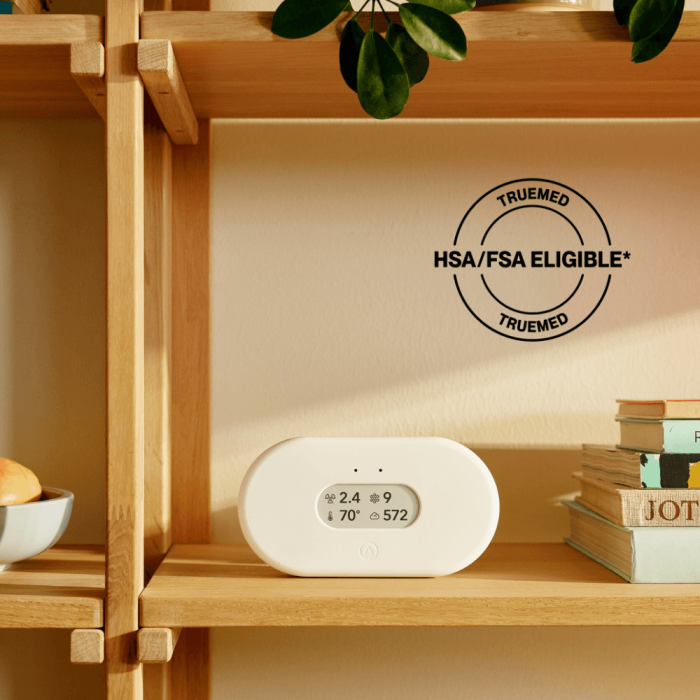
Who it is for: Buyers who want wildfire-smoke PM2.5 data but also want a long-term monitor for radon, CO2, VOCs, and indoor environmental conditions.
Airthings View Plus takes the broadest whole-home approach in this guide. Along with PM2.5, it measures radon, CO2, VOCs, temperature, humidity, and pressure. That sensor mix makes sense for someone who wants a monitor to remain useful well after smoke season ends.
The device supports battery or USB-powered operation, but that flexibility deserves a little planning. If you intend to compare PM2.5 changes while an air purifier runs, verify the current sampling interval for the power mode you expect to use. A battery-saving interval may not suit every short-term filtration test as well as a continuously powered setup.
View Plus is a sensible choice for a primary living area where you want one display for several indoor health and comfort indicators. It may be more information than necessary for a renter who only wants a basic indoor PM2.5 monitor, but its radon measurement can add meaningful value for homeowners who would otherwise buy a separate radon device.
AirGradient ONE: Best for Home Assistant and open-source users
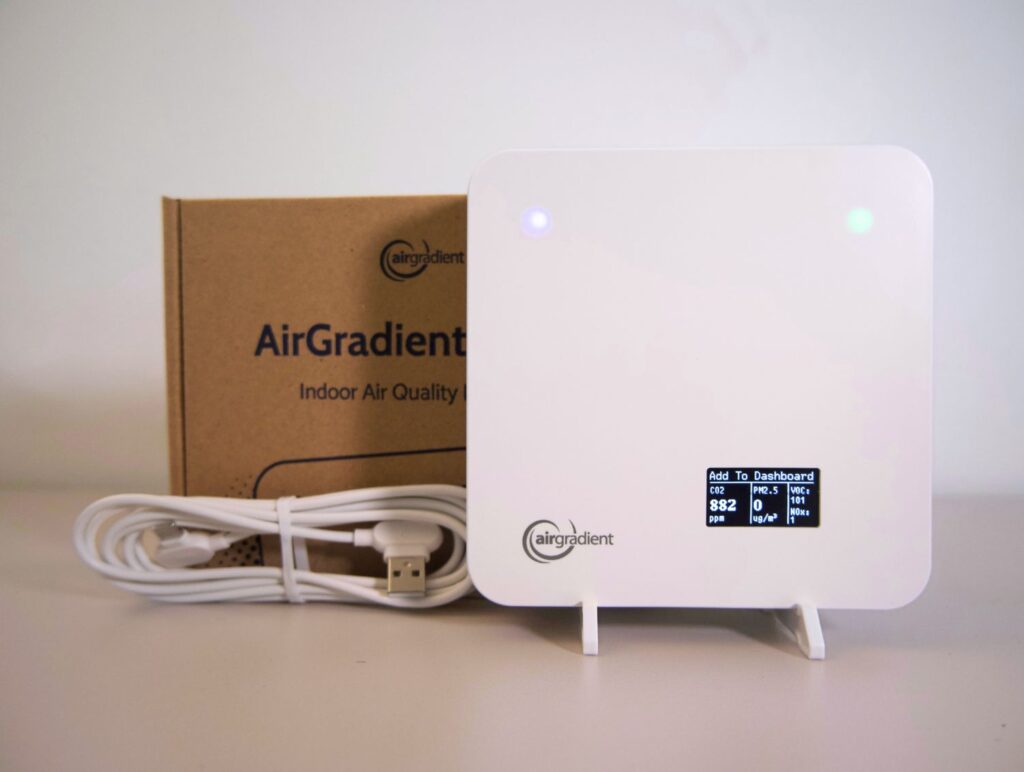
Who it is for: Technically inclined buyers who want PM2.5 monitoring alongside local integration options and a device designed around transparency.
AirGradient ONE measures PM2.5, CO2, TVOCs, NOx, temperature, and humidity. It is USB-powered and supports local Home Assistant integration, making it the most natural fit for a household that already uses dashboards, automations, or locally managed smart-home tools.
The open-source orientation is a meaningful differentiator. AirGradient offers a dashboard without requiring an ongoing subscription for basic access, while Home Assistant support can make it easier to place its readings beside HVAC, purifier, or window-sensor data. Before building automations around it, verify current local-access, network, and internet-outage behavior in the latest documentation.
AirGradient ONE is not the simplest option for someone who only wants to glance at one number on the kitchen counter. But it is one of the better choices for an enthusiast who wants to compare room conditions, log smoke events, or integrate a smart indoor air quality monitor into a larger home system.
How accurate are consumer PM2.5 monitors?
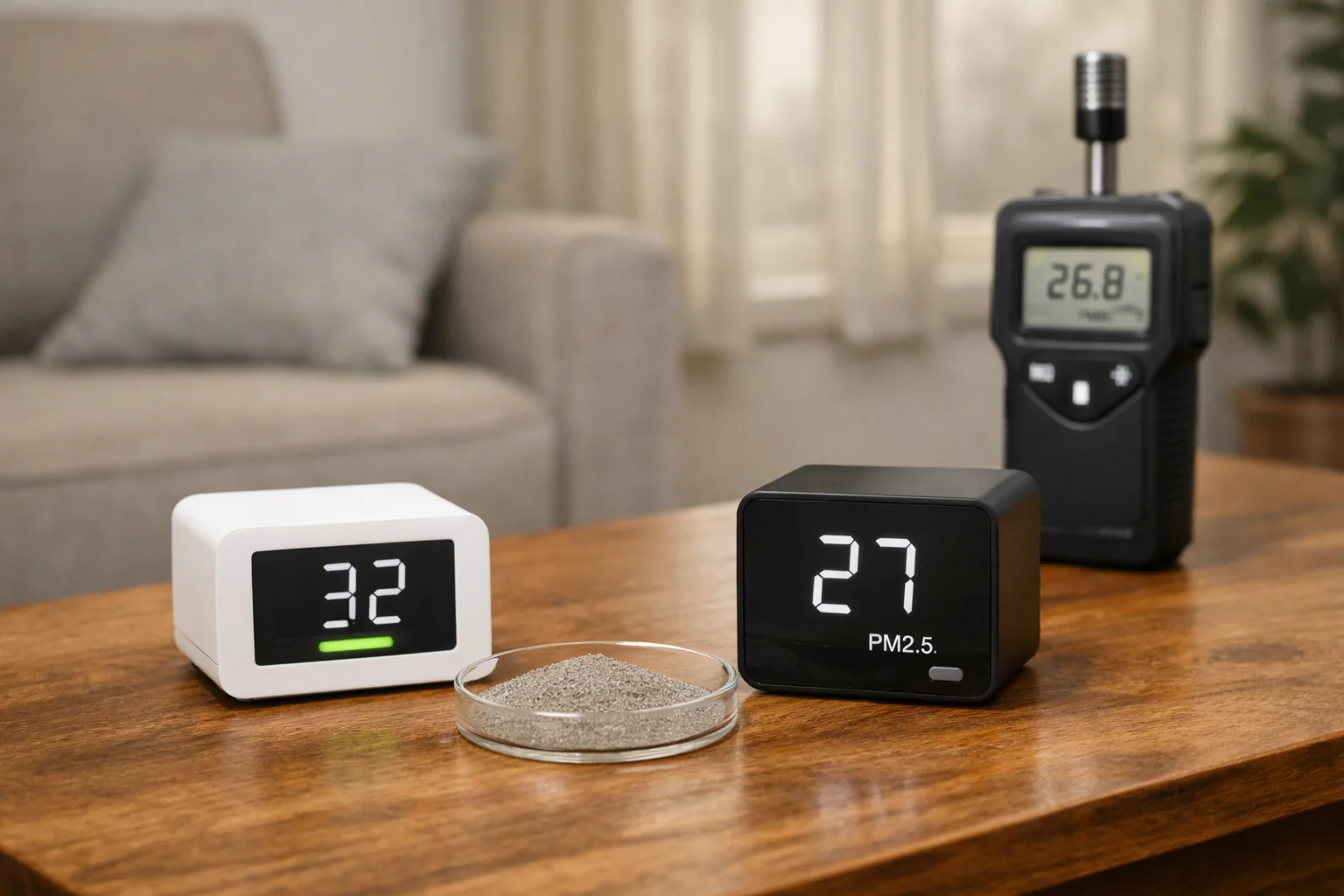
Consumer monitors can be useful without being perfect. The EPA advises using low-cost air pollution monitors to understand localized conditions and changes over time, while recognizing that they are not replacements for regulatory-grade monitoring. Readings can be influenced by temperature, relative humidity, particle type, and the sensor itself.
Indoor activities matter, too. Cooking, candles, cleaning products, vacuuming, and other sources can create temporary particle or gas spikes. During smoke season, a rise in PM2.5 does not automatically mean outdoor smoke has entered the home. Look at what was happening in the room, whether doors or windows were open, and whether the change persists.
This is why the best indoor air quality monitors for wildfire smoke are best used as comparison tools. A monitor can help answer practical questions such as:
- Did PM2.5 fall after I shut the windows and ran the air purifier for an hour?
- Is the bedroom staying cleaner than the open-plan living room?
- Did a cooking event create a short-term indoor spike?
- Does moving the purifier closer to the occupied area change the trend?
Do not compare a consumer device’s number too rigidly against a nearby outdoor station. Different locations, timing, airflow, particle composition, and indoor sources all matter. Use outdoor public reporting to understand regional smoke conditions, then use your indoor sensor to understand your own rooms.
How to place and use an indoor PM2.5 monitor
Placement can matter nearly as much as the monitor you buy. EPA guidance recommends placing an indoor monitor in the occupant breathing zone, generally around 3 to 6 feet above the floor, with airflow around the device left unobstructed. A shelf, side table, or counter in the main occupied area often works better than a hidden corner.
- Keep it away from direct purifier output. A monitor directly in the clean-air stream can make the entire room look cleaner than it is.
- Avoid HVAC vents, open windows, and exterior doors. Those locations can overemphasize a localized air stream rather than the air people are breathing in the room.
- Do not place it beside cooking areas. Kitchen emissions can dominate the reading and obscure the room’s smoke trend.
- Give it time after moving it. Let the monitor settle in a location before drawing conclusions from its readings.
To check an air quality monitor for air purifier performance, start with the monitor in a representative location and record the PM2.5 trend before changing anything. Then close windows and exterior doors as appropriate, run the purifier at a chosen setting, and watch what happens over a consistent period. Keep cooking and other particle-producing activities to a minimum during the comparison.
The goal is not to prove an exact clean-air delivery rate from one sensor. It is to see whether your actual setup produces a sustained decrease in indoor particles. If it does not, check room size, purifier placement, filter condition, open pathways to smoky outdoor air, and whether the monitor is positioned in a direct draft.
For larger or multi-story homes, one monitor cannot characterize every room. A single unit in the main living area is a good starting point. Add a second monitor if a bedroom, nursery, home office, or basement is used heavily and separated enough that its air may behave differently. You can also move one portable monitor between rooms, but avoid treating readings from different times as a perfect side-by-side comparison when outdoor conditions are changing.
What an air sensor cannot tell you
Even the best air quality monitor for smoke has limits. A PM2.5 reading does not measure every gas and chemical found in wildfire smoke, and it cannot tell you whether conditions are safe for every person in your household. People with asthma, heart or lung conditions, older adults, young children, and other sensitive individuals may need to follow more cautious health guidance.
A sensor also does not clean the air. It helps you see the likely effect of actions such as closing windows, using a properly sized portable air cleaner, and maintaining suitable HVAC filtration. Continue to check official regional air-quality information and local public-health guidance during an active smoke event.
For practical advice on choosing, placing, and interpreting a low-cost indoor monitor, the EPA’s guidance on low-cost air pollution monitors and indoor air quality is a useful reference.
Which monitor should you buy?
Choose PurpleAir Touch if your priority is simple, visible indoor particulate awareness. Choose IQAir AirVisual Pro if you want a more detailed color display and PM2.5 alongside CO2, TVOCs, temperature, and humidity. Choose Airthings View Plus if radon and broad year-round indoor monitoring are part of the plan. Choose AirGradient ONE if local integration and an open-source approach matter most.
For most smoke-season buyers, the deciding question is straightforward: will this device make it easy to watch PM2.5 and confirm whether your filtration strategy is helping? If the answer is yes, one of these best indoor air quality monitors for wildfire smoke can provide useful room-level evidence when outdoor conditions become difficult to predict.
Useful references: Using Air Quality Sensors for Smoke: What to Consider and Understanding Sensor Data · Best Practices Guide for Improving Indoor Air Quality in Commercial/Public Buildings During Wildland Fire Smoke Events
Related Home Tech Signal guides: Best Home Energy Monitors for Tracking Electricity Use