Disclosure: As an Amazon Associate I earn from qualifying purchases.
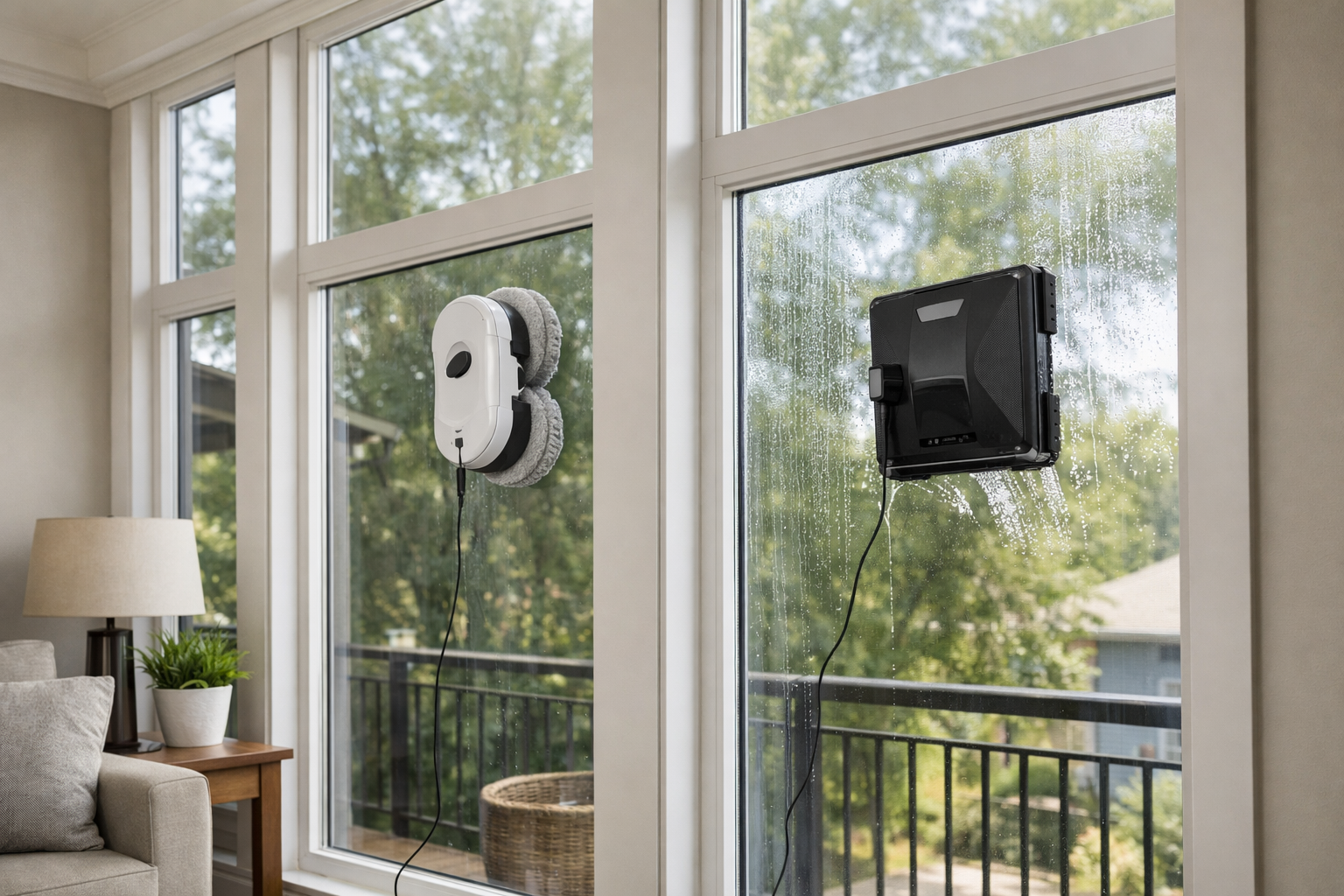
Cleaning floor-to-ceiling windows, balcony glass, and high exterior panes can be a difficult chore even when the glass is technically reachable from inside. A window-cleaning robot can reduce the stretching, ladder work, and repetitive wiping involved, but it is not an unattended appliance. You still need a safe place to attach and remove it, a correctly secured safety tether, and a clear drop zone below.
The best window-cleaning robots for tall windows are usually models with portable power, dependable safety systems, enough runtime for several panes, and support for the specific glass in your home. Large framed windows, narrow sidelights, frameless shower panels, and exterior glass doors can each call for a different design.
For most people with multiple large windows, the ECOVACS WINBOT W3 OMNI has the most complete feature set. The ECOVACS WINBOT W2 PRO OMNI is the more practical value pick for large and exterior panes, while the smaller WINBOT MINI is better suited to narrow or obstructed glass. The HOBOT S7 Pro is worth considering for large frameless panels if you are comfortable with more active supervision.
Quick Picks: The Best Window-Cleaning Robots for Tall Windows
| Model | Best for | Why it stands out | Watch out for |
|---|---|---|---|
| ECOVACS WINBOT W3 OMNI | Best overall premium option | Portable battery station, automatic pad washing, water spraying, edge cleaning, and multiple cleaning modes. | Independent testing of this newer model remains limited. |
| ECOVACS WINBOT W2 PRO OMNI | Best value for tall and exterior windows | Portable battery station, cable management, dual power modes, and strong independent results on several glass types. | Cannot reach every deep corner and still needs manual placement between panes. |
| ECOVACS WINBOT MINI | Best for narrow or obstructed windows | Compact body designed for smaller flat panes and some windows with handles, bars, or guardrails nearby. | Not the best choice for cleaning many large panes in one session. |
| HOBOT S7 Pro | Best alternative for large frameless glass | Edge-leakage sensors are designed to help it work on edgeless glass. | Independent testing found streaks and weaker results on heavy exterior grime. |
Who should buy a window-cleaning robot?
- Homes with large vertical panes, balcony glass, or high interior windows you can reach safely to place and remove the robot.
- Users who want maintenance cleaning between deeper manual or professional washes.
- Buyers who can secure a safety tether to a stable anchor and keep the drop zone clear.
- Households with multiple flat framed—or officially supported frameless—panes that meet size requirements.
Who should skip or reconsider?
- Any setup that requires leaning outside, defeating window guards, or reaching into an unsafe position.
- Cracked, damaged, textured, wet, or unsupported glass; panes smaller than the manufacturer minimum.
- Heavy exterior grime, construction residue, or etched glass that needs restoration—not routine wiping.
- Situations where you cannot anchor a tether or supervise the run (especially above people, vehicles, or public areas).
- Exterior high-rise glass where professional rope or platform cleaning is the safer standard.
Tall-window safety and backup-power basics
Placement and retrieval must be possible from a safe indoor position. Do not lean out of a window or bypass safety restrictions to attach a robot. Secure the tether to a stable anchor exactly as the manual describes; the rope is secondary fall protection, not a substitute for correct suction and supervision.
Keep people, pets, and vehicles out of the drop zone. Exterior use above ground level needs active oversight—edge detection and frameless modes are not universal guarantees.
Backup battery / outage behavior: On models that advertise backup power, treat it as a short-term safety feature to help maintain suction during a power interruption—not cordless, all-day cleaning. Many WINBOT setups still rely on a portable station or mains path during normal operation; verify the exact power workflow in the manual before buying.
Cleaning expectations: Robots excel at dust, fingerprints, and light film on maintained glass. Baked-on minerals, paint, pollen packs, and damaged surfaces may still need manual prep or professional cleaning—plan for multiple passes and clean pads rather than spotless guarantees.
What to Look For in a Robot Window Cleaner
A robot window cleaner uses suction to stay attached to smooth glass while it moves cleaning pads across the surface. That basic concept sounds simple, but tall and difficult-to-reach windows expose the practical differences between models.
Portable power matters on tall glass
A plug-in robot may work well near a standard outlet, but a portable battery station is more convenient for balcony glass, upper-story windows, and rooms where the nearest outlet is several feet away. It also reduces the need to route a power cable across a doorway or living area.
Battery power does not make a robot cordless in every sense. Many models still use a safety tether, and some include a connected power or control cable. Check the full cable length and think through where the station will sit before buying.
A safety tether is not optional
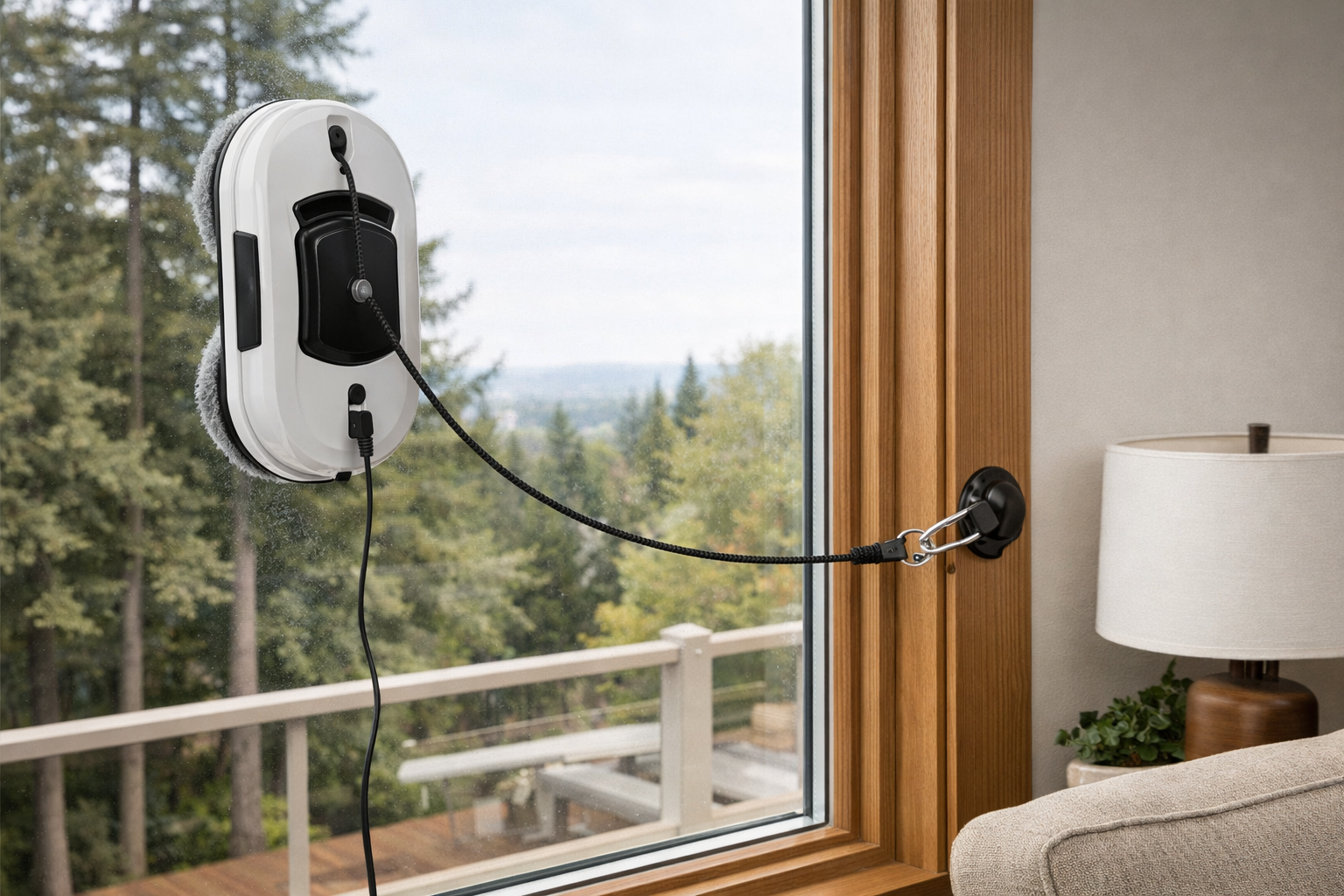
For elevated windows, attach the tether to a secure anchor point as directed in the manufacturer’s instructions before placing the robot on the glass. Keep children, pets, vehicles, and people out of the potential drop zone. Inspect the tether, connection points, pads, and glass before every use.
Backup power can help a robot remain attached during an outage, but it does not make the setup failproof. ECOVACS lists a multi-stage protection system for its W3 OMNI, including a composite safety cable rated for 100 kg and continued attachment for more than 30 minutes after power loss. Those are manufacturer specifications, not a reason to leave the machine unattended.
Match the robot to the pane size
Check both the manufacturer’s minimum window size and the physical dimensions of the robot. A larger square robot may clean a picture window efficiently but be unable to fit on a narrow sidelight or a small divided pane.
Also verify that your glass is flat and smooth. Most manufacturer compatibility claims center on flat framed or frameless glass. Textured, uneven, angled, frosted, heavily coated, wet, or damaged surfaces may not provide reliable suction or predictable cleaning results.
Expect maintenance cleaning, not miracle restoration
These machines are most useful for keeping regularly cleaned glass presentable—similar to how robot vacuums maintain floors between deeper cleans. They can help with ordinary dust, fingerprints, light outdoor film, and water marks, but deeply set grime, mineral deposits, paint overspray, or sticky residue may still require manual treatment.
Fresh, clean pads matter. A dirty pad can spread soil and contribute to streaking, especially in direct sunlight. Use the manufacturer-approved cleaning solution if one is specified, and avoid saturating the glass or pad.
Best Overall: ECOVACS WINBOT W3 OMNI
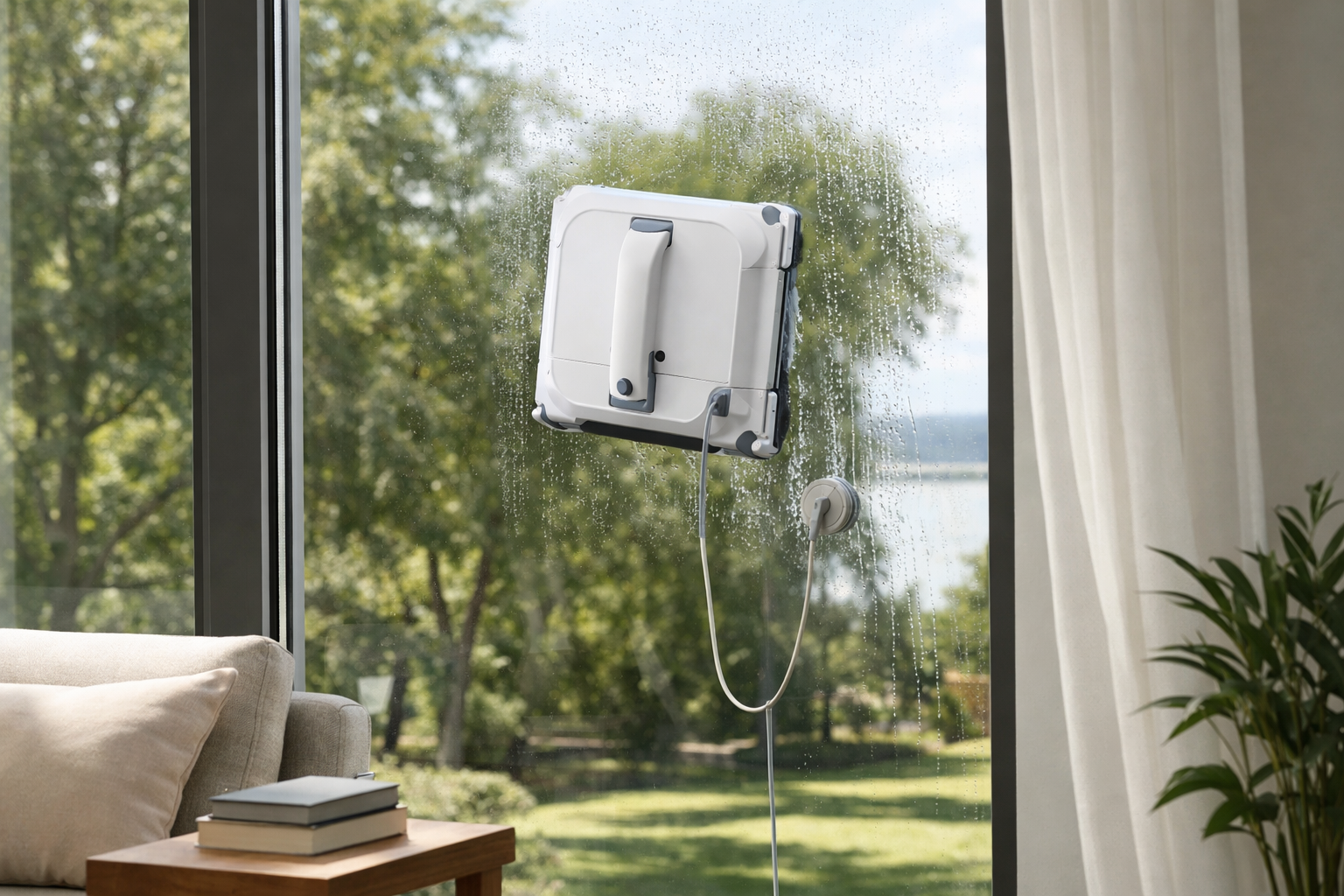
The ECOVACS WINBOT W3 OMNI is the premium choice for homeowners or property managers who want to maintain several large windows without setting up a separate bucket, outlet connection, and pad-cleaning routine for every pane.
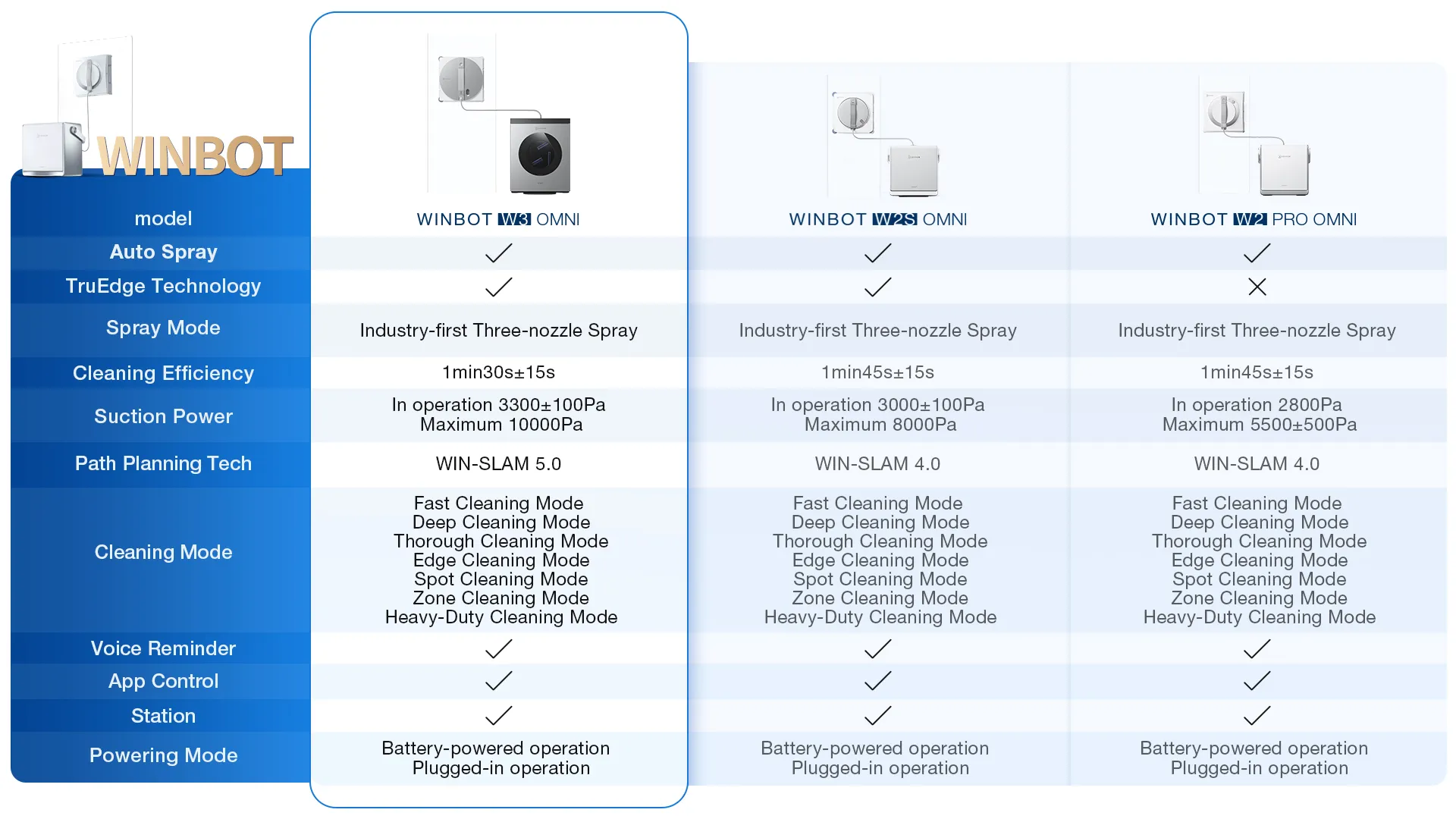
According to the ECOVACS WINBOT W3 OMNI product page, this model pairs with a portable station that supplies battery power and automatically washes the cleaning pads. It also has automatic water spraying, WIN-SLAM 5.0 navigation, edge-cleaning functions, and eight app-based cleaning modes.
ECOVACS lists up to 130 minutes of battery operation, which makes the W3 OMNI especially appealing for homes with many floor-to-ceiling panes or large sliding glass doors. The portable station can be a meaningful advantage where outlet access is awkward, such as a balcony, sunroom, or room with windows spread across several walls.
The trade-off is that this is a feature-heavy flagship model, and independent real-world testing of its streak performance, noise, edge coverage, and battery endurance is still limited. Before purchasing, verify current pricing, included pads and solution, replacement-part availability, and warranty terms from an authorized U.S. seller.
Choose it if: You want the most automated cleaning workflow available for several large panes and value a portable station with automatic pad washing.
Skip it if: Your main problem is a single narrow window or you want the most economical route to routine glass maintenance.
Best Value for Tall and Exterior Windows: ECOVACS WINBOT W2 PRO OMNI
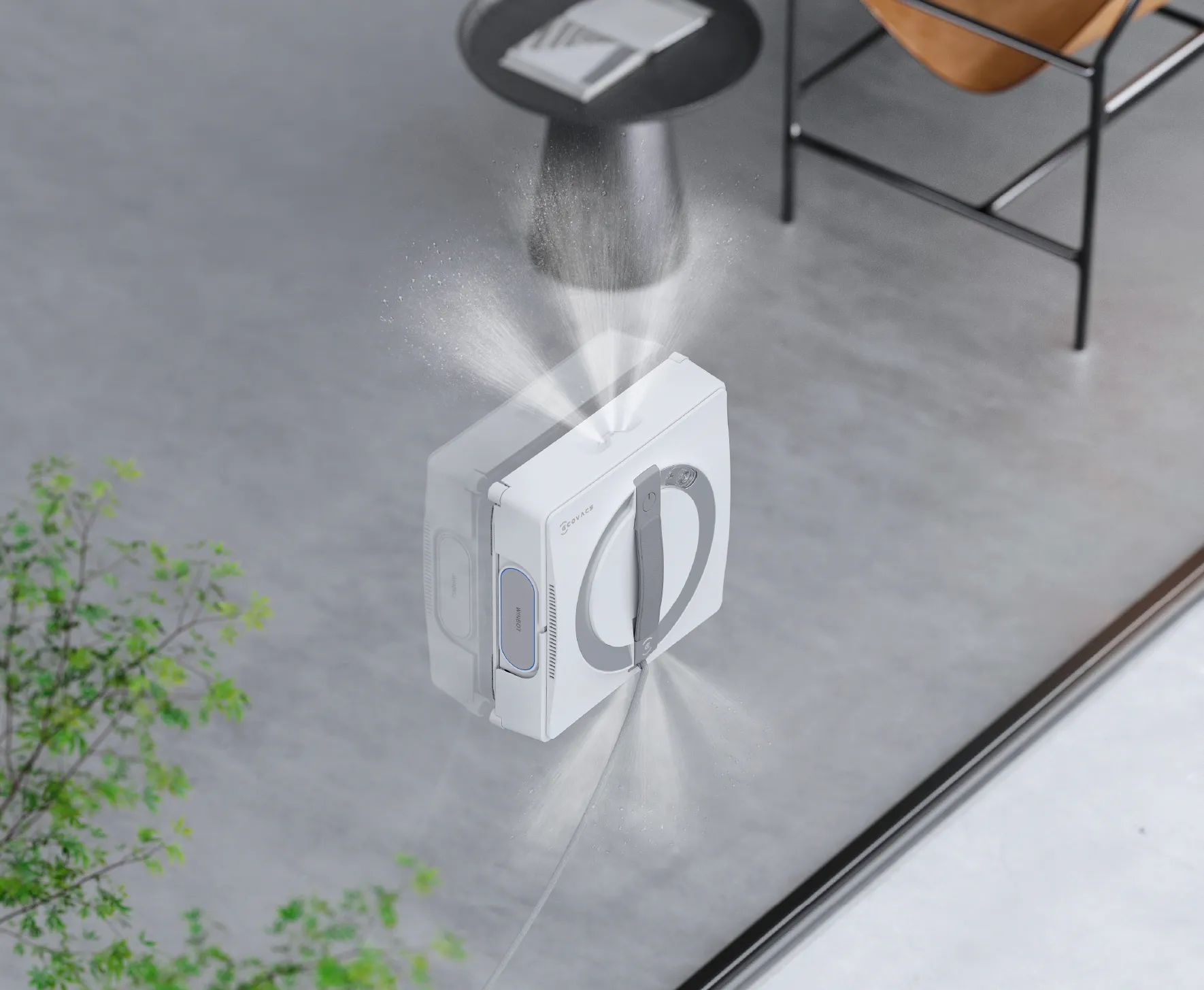
The ECOVACS WINBOT W2 PRO OMNI is the strongest all-around value option for large windows because it combines a portable battery station with features that have also received meaningful independent testing.
ECOVACS says its portable station includes an integrated battery, automatic cable management, and dual power modes. The company lists up to 110 minutes of operation per charge and a minimum compatible window size of about 11.81 by 15.75 inches. Its robot body is approximately 10.7 inches square, so it is not a sensible pick for very small panes.
The manufacturer positions the W2 PRO OMNI for flat framed and frameless glass. In independent testing, TechRadar found it performed well on dirty windows, floor-to-ceiling panes, frameless glass, mirrors, and shower doors. That makes it a flexible option for a home with both large exterior windows and interior glass surfaces.
There are still limits. The reviewer found that it could not reach the deepest corners, and you must physically place it on each pane and remove it when finished. In other words, it can reduce the difficult part of scrubbing broad sections of glass, but it cannot travel from one window to another on its own.
For readers comparing the best window-cleaning robots for tall windows, this is the model to start with when you want portable power and broad glass compatibility without stepping up to the W3 OMNI’s more premium automated station.
Choose it if: You have floor-to-ceiling windows, sliding doors, mirrors, or shower glass and want a portable system with independently reviewed performance.
Skip it if: Your panes are below the stated minimum size or have architectural obstructions that leave very little clear glass area.
Best for Narrow or Obstructed Windows: ECOVACS WINBOT MINI

Large window-cleaning robots can be awkward on narrow panes, windows divided by mullions, and glass near handles or bars. The ECOVACS WINBOT MINI is the better fit when physical size is the deciding factor.
ECOVACS lists an 8.46-inch-square body and a 2.17-inch thickness for the WINBOT MINI. The company says it supports windows as small as 22 by 25 cm, or roughly 8.7 by 9.8 inches, and is designed for both framed and frameless flat windows.
Its compact form is the main reason to choose it. ECOVACS also says the MINI can work around certain guardrails, security bars, handles, and narrow-window layouts. Those are manufacturer compatibility claims, so consider them a starting point rather than a guarantee. Measure the unobstructed glass area, account for the robot’s full footprint, and confirm that the tether and cable can be routed safely.
The MINI makes the most sense as a specialized cleaner for difficult architectural features, apartment windows, sidelights, or smaller interior glass panels. It can also be a practical choice where a larger robot cannot be placed flat on the pane with enough clearance.
Choose it if: Your biggest challenge is narrow glass, nearby handles, security bars, or limited clearance.
Skip it if: You have many large exterior panes and want the longest possible runtime per cleaning session.
Best for Large Frameless Glass: HOBOT S7 Pro
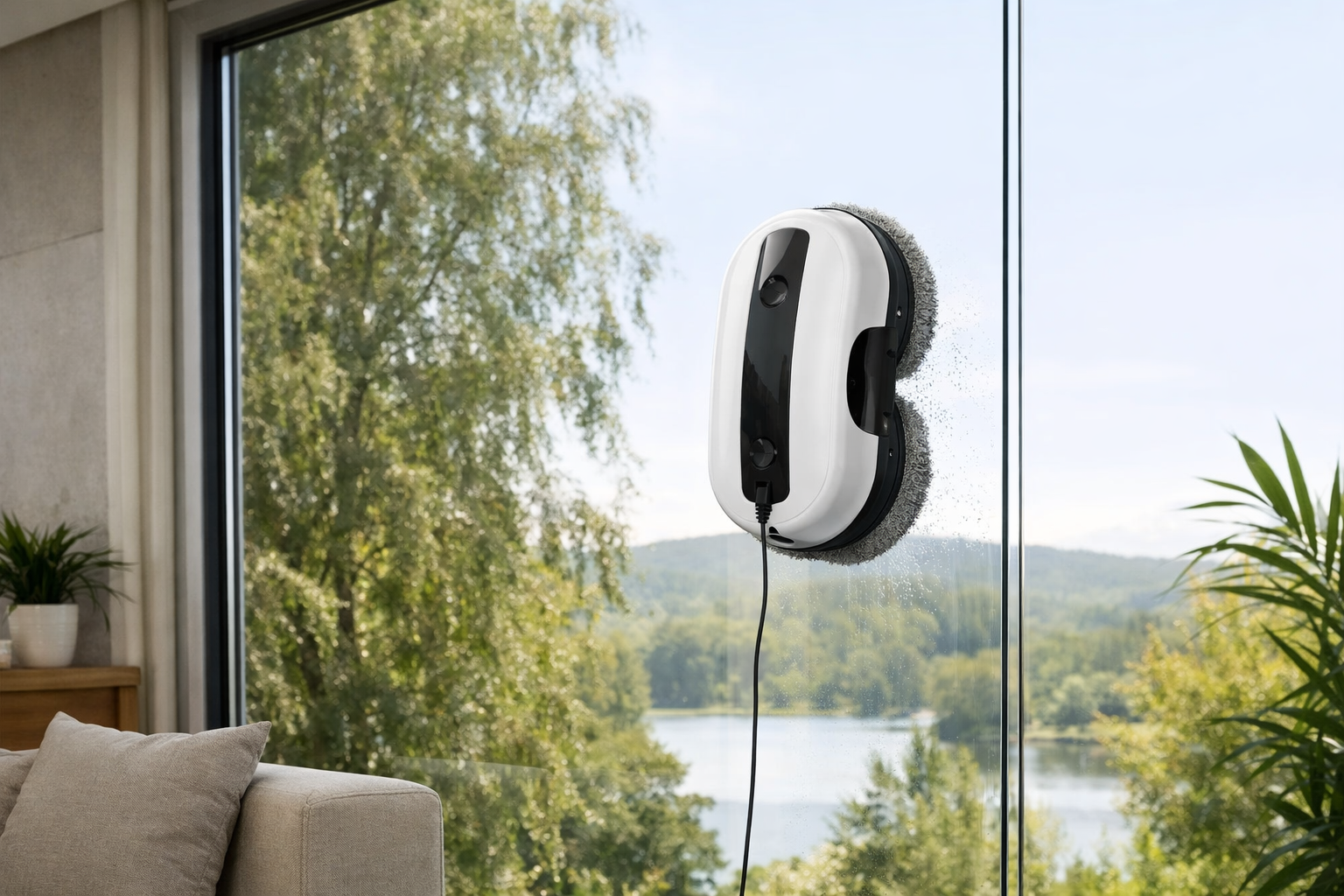
The HOBOT S7 Pro is an alternative for buyers focused on wide frameless panels, such as balcony barriers, large mirrors, glass doors, or broad interior partitions. Its edge-leakage sensors are intended to help it recognize edgeless glass rather than driving off an exposed edge.
In independent testing, the HOBOT S7 Pro handled frameless glass and performed well for lighter maintenance cleaning. Its dual reciprocating pads can be useful for keeping a regularly maintained pane looking presentable without hand-wiping the whole surface.
However, the same testing found more mixed results on heavy exterior dirt and noted that the robot could leave streaks. The reviewer also documented one fall during testing, which is a useful reminder that edge sensing is not a substitute for a correctly attached safety cable and active supervision.
The HOBOT S7 Pro is not a hands-off robot vacuum for windows. You need to move it from pane to pane, monitor its operation, and be ready to intervene if it loses suction or encounters an obstacle. Before buying, verify current authorized U.S. availability, support options, and the warranty that applies to the specific seller.
Choose it if: Frameless glass is your priority and you are willing to accept more hands-on oversight for routine cleaning.
Skip it if: Your exterior panes regularly collect heavy dirt, pollen buildup, or stuck-on debris that needs more aggressive manual cleaning.
Common buying and setup mistakes
- Assuming “frameless detection” works on every edgeless panel without checking minimum size and surface condition.
- Skipping the safety tether or using a weak anchor point.
- Treating portable battery stations as fully cordless robots while ignoring tether and cable routing.
- Ignoring manufacturer minimum pane dimensions—especially with large square robots on sidelights.
- Over-wetting pads or using unapproved solutions that streak or slip.
- Starting on heavily soiled glass without a dry pass or manual prep where recommended.
- Expecting perfect corners or autonomous travel between separate panes.
- Running unattended above ground level or during unsupported weather.
- Using on damaged, frosted, coated, or uneven glass against manufacturer guidance.
- Assuming app features are required for basic cleaning when manual controls suffice.
Window-cleaning robot decision table
Editorial summary from the sections above—confirm current specs, safety steps, and compatibility on official product and support pages before purchase.
| Product | Best for | Window type | Safety system | Cleaning method | Power / backup | Main trade-off |
|---|---|---|---|---|---|---|
| ECOVACS WINBOT W3 OMNI | Premium multi-pane maintenance | Large flat framed/frameless per ECOVACS | Tether + ECOVACS-listed protection (incl. backup attachment claims) | Pads, spray, station pad washing, app modes | Portable station; manufacturer backup claims | Flagship cost; limited independent testing cited in article |
| ECOVACS WINBOT W2 PRO OMNI | Tall/exterior value pick | Flat framed/frameless; min size per ECOVACS listing | Tether required; cable management on station | Pads; portable station; dual power modes per ECOVACS | Portable station (~110 min listed); verify backup behavior in manual | Cannot reach every corner; manual moves between panes |
| ECOVACS WINBOT MINI | Narrow or obstructed panes | Smaller framed/frameless flat glass per ECOVACS | Tether per WINBOT safety guidance | Compact body around handles/bars (verify clearance) | Check MINI power setup in manual | Not ideal for many large panes per session |
| HOBOT S7 Pro | Large frameless panels | Frameless focus; edge-leakage sensors per HOBOT | Safety cable; active supervision emphasized in testing | Dual reciprocating pads | Confirm power/cord requirements in manual | Streaks/heavy dirt limits; testing noted a fall—supervise closely |
Safety and Setup: What These Robots Cannot Do
The best window-cleaning robots for tall windows can make routine upkeep more manageable, but they do not eliminate the safety planning involved with elevated glass.
- They cannot place themselves on the window. You need a safe, reachable position to attach and later remove the robot.
- They cannot clean an exterior pane from indoors unless you can safely reach and place the robot on that exterior surface. A robot cleans the side of the glass to which it is attached; it cannot pass through a closed window.
- They cannot move between separate panes. Divided windows, sliding doors, and multiple rooms require manual repositioning.
- They do not replace safety tethering. Attach the tether to a secure anchor point every time, including on lower floors.
- They are not designed for every surface. Confirm compatibility before using one on textured, damaged, curved, tilted, frosted, coated, or wet glass.
- They cannot handle all deep-cleaning jobs. Remove loose grit first and manually address stubborn deposits to avoid smearing or pad damage.
- They should not run unattended. Stay nearby, especially outdoors and above ground level, and keep the drop zone clear.
Before using an ECOVACS unit, review the manufacturer’s WINBOT W3 OMNI setup and safety guidance. The support materials cover tether attachment, pad care, slipping alerts, low-suction alerts, and basic maintenance steps that are relevant to safe operation.
HomeTechSignal Recommendation
Editorial guidance from manufacturer documentation and cited testing in this guide—not hands-on comparison of every pane type.
Best overall premium workflow: ECOVACS WINBOT W3 OMNI when you maintain many large panes and want station-based pad washing and spraying—after verifying U.S. pricing and safety steps.
Best balanced value for tall glass: ECOVACS WINBOT W2 PRO OMNI when portable power and independently reviewed performance on several glass types matter most.
Best for tight or obstructed panes: ECOVACS WINBOT MINI when minimum size and clearance—not runtime—are the constraint.
Best frameless-focused alternative: HOBOT S7 Pro only if you accept closer supervision and lighter maintenance duty; confirm availability and tether discipline.
Choose professional cleaning instead when exterior high-rise access is unsafe, glass is damaged, or soil needs restoration—not routine wiping. For other hands-off floor maintenance robots, see our guides to robotic pool cleaners and AI robot vacuums for cluttered homes.
Which Window-Cleaning Robot Should You Buy?
Choose the ECOVACS WINBOT W3 OMNI if you want a premium system for maintaining many large windows and value automatic pad washing, spraying, and extended portable operation. It is the feature leader, though buyers should verify current U.S. pricing and availability before committing.
Choose the ECOVACS WINBOT W2 PRO OMNI if you have tall exterior glass, floor-to-ceiling panes, or several types of flat glass around the home. Its portable station and independent testing make it the most balanced recommendation for many households.
Choose the ECOVACS WINBOT MINI if large robots will not fit your windows. Its smaller body makes it the more sensible choice for narrow, obstructed, or small flat panes, provided your glass meets the stated size and surface requirements.
Choose the HOBOT S7 Pro if your priority is large frameless glass and you understand its limitations with heavy dirt, streaking, and supervision. Confirm U.S. availability and support before purchase.
Ultimately, the right robot window cleaner is a maintenance tool rather than a total replacement for manual washing. Measure your smallest pane, inspect the glass type, plan the tether anchor and drop zone, and make sure you can safely reach every point where the robot must be installed or removed. Those checks matter more than any single advertised cleaning mode.
Useful references: WINBOT W3 OMNI Window Cleaning Robot · WINBOT W2 PRO OMNI Window Cleaning Robot
Related Home Tech Signal guides: Best Robotic Pool Cleaners, Best AI Robot Vacuums for Cluttered Homes