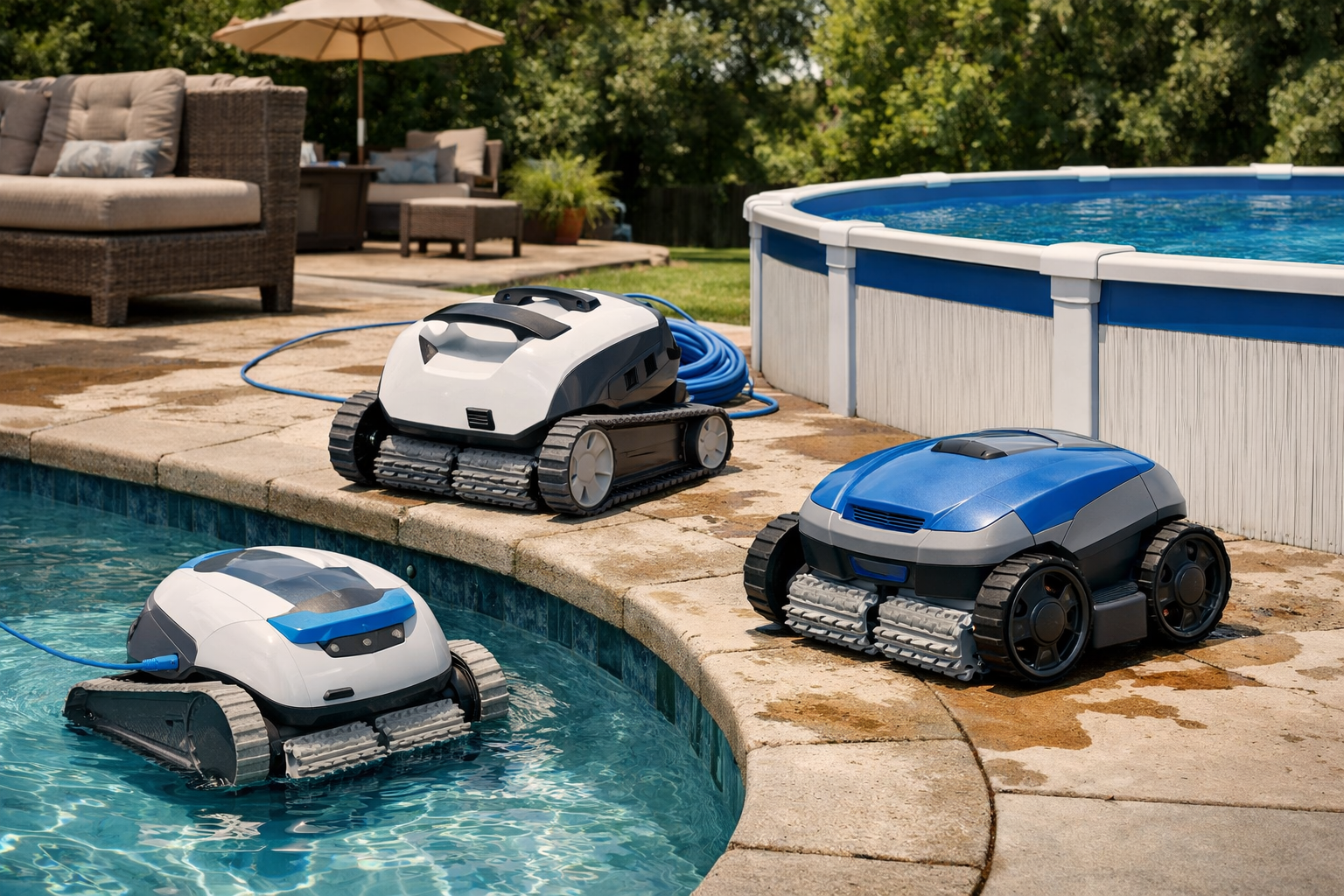
Shopping for a pool robot can get confusing quickly. Many models promise wall climbing, waterline scrubbing, smart navigation, long battery life, and app control—but those features do not mean the same thing for every pool.
The best choice depends less on a headline suction claim and more on your pool’s shape, surface, size, debris load, and the areas you want the robot to reach. A cordless cleaner can make routine cleanup easier, for example, but its usefulness comes down to whether its listed runtime, charging process, retrieval method, and coverage match your pool.
This guide compares several of the best robotic pool cleaners using manufacturer specifications. Treat stated runtimes, coverage claims, and navigation features as product specifications rather than independent performance-test results. Before buying, confirm compatibility with your pool surface, slopes, coves, steps, sun shelf, and dimensions.
Best robotic pool cleaners at a glance
| Model | Consider it for | Listed cleaning coverage | Notable specifications |
|---|---|---|---|
| Maytronics Dolphin LIBERTY 600 | Large pools and broad cordless coverage | Floor, walls, waterline, and steps | Rated for pools up to 50 feet; up to 4.5 hours of runtime; Maytronics One app |
| Aiper Scuba X1 | In-ground pools needing floor, wall, and waterline modes | Floor, walls, and waterline | Up to 180-minute runtime; five cleaning modes; 5-liter top-load basket |
| Aiper Scuba S1 | Smaller or simpler above-ground and in-ground pools | Floor and walls | Up to 1,600 square feet; automatic and scheduled cleaning; listed 150- to 180-minute battery life depending on version |
| Aiper Scuba S1 Pro | Waterline coverage and sloped-wall claims | Floor, walls, and horizontal waterline cleaning | Up to 180-minute battery life; 5-liter basket; dual-layer filtration |
| Beatbot AquaSense 2 Ultra | Multi-area cleaning modes and surface-parking retrieval | Water surface, floor, walls, and waterline | AI-assisted mapping; app control; automatic surface parking |
| Maytronics Dolphin Nautilus CC Plus | Buyers who prefer corded, scheduled cleaning | Floor and walls | Rated for pools up to 40 feet; two-hour cycle; Wi-Fi app scheduling |
There is no universal winner for every backyard. The most useful way to narrow the field is to start with the parts of your pool that are hardest to clean manually.
How to choose a robotic pool cleaner
Start with your pool type and dimensions
Above-ground and in-ground pools can have very different walls, floor transitions, coves, liners, and entry points. Do not assume a robot that works in an in-ground pool will handle every above-ground pool wall or cove equally well.
Check the manufacturer’s stated pool-size limit, then compare it with your pool’s actual length, width, and shape. A long freeform pool may be harder for a robot to cover than a simple rectangular pool with a similar square-footage figure.
If you are looking for the best robotic pool cleaner for an above ground pool, prioritize explicit above-ground compatibility, a manageable weight for lifting, and a cleaner that can work with your wall shape. Verify whether the manufacturer supports your specific liner, cove, and wall construction.
Separate floor cleaning from wall and waterline cleaning
“Wall climbing” is not a single, universal capability. One robot may climb a wall but mainly focus on floor cleaning. Another may travel along the waterline to scrub the ring where oils, sunscreen, and airborne debris accumulate.
Waterline cleaning is especially worth evaluating if you routinely see buildup around the top edge of the pool. It is also one of the capabilities most affected by water conditions, wall material, pool geometry, battery charge, debris, and the selected cleaning mode.
A robotic pool cleaner that climbs walls may still struggle with steep slopes, highly textured surfaces, sharp transitions, irregular curves, or tight coves. Steps and sun shelves deserve special attention: a robot may clean around them without being able to clean every horizontal step surface.
Compare runtime by cleaning mode
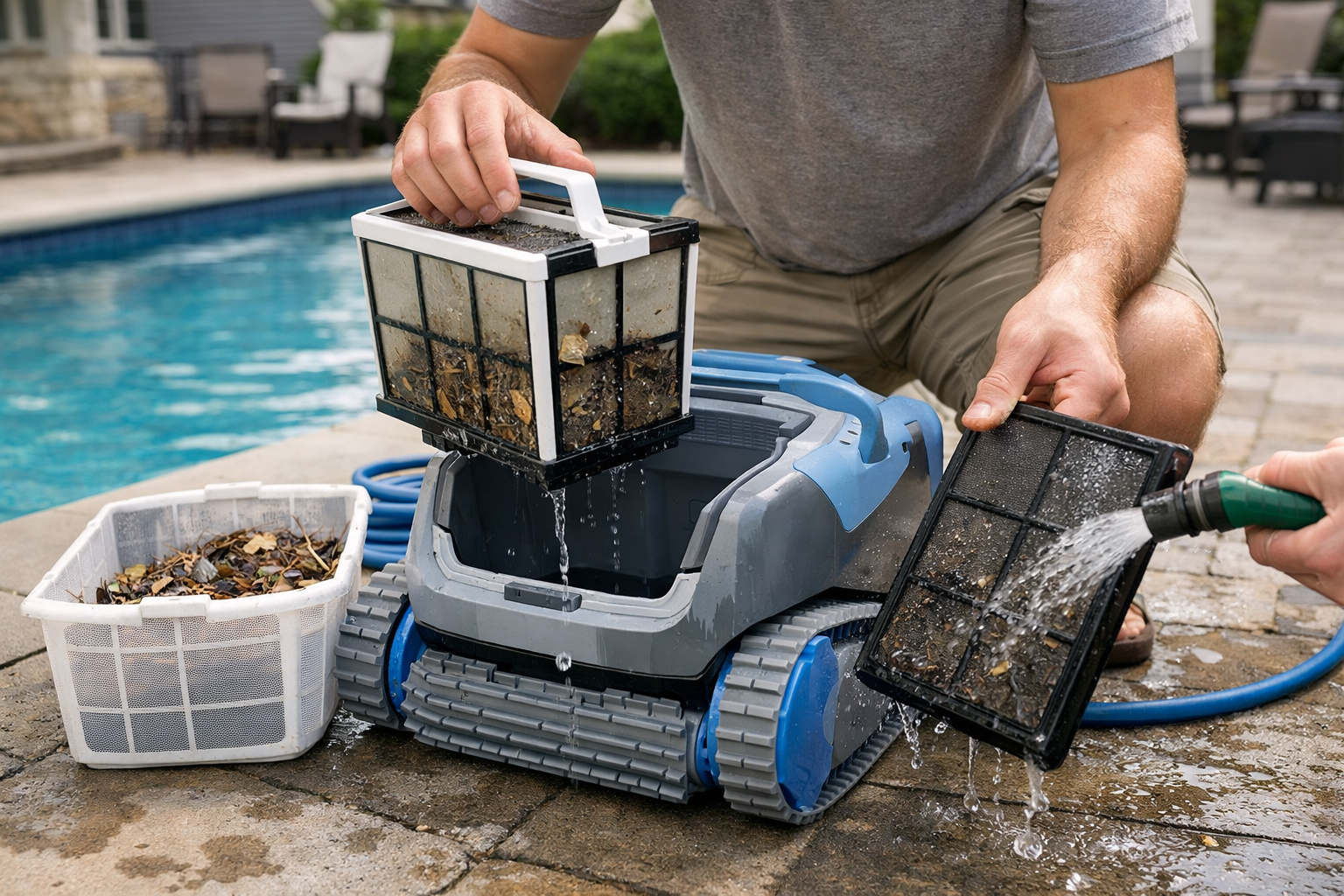
Battery claims should be read in context. A cordless robotic pool cleaner may deliver different runtime depending on whether it is cleaning the floor only, climbing walls, scrubbing the waterline, or using a broader coverage mode.
Look at the listed runtime, charge time, pool-size recommendation, and available cleaning modes together. A model with a longer maximum runtime is not automatically the better fit if that figure applies only to a lower-demand floor-cleaning mode.
Think about debris and filtration before navigation
Navigation features can help a cleaner cover the pool methodically, but the basket and filtration system determine what it can retain between emptying. Consider the debris your pool receives most often: leaves, seed pods, sand, fine dust, pollen, or small particles.
A larger basket can be useful under trees or during heavy debris periods. Fine-particle filtration can matter more for dusty pools, but verify what filter inserts are included and how often they need to be rinsed or replaced.
Plan for retrieval and storage
Cordless robots eliminate cable handling, but they still need charging, lifting, cleaning, and dry storage. Automatic parking near the water surface can make retrieval easier, though you should confirm how the feature works in your pool and whether a retrieval hook is included.
Also consider the cleaner’s weight when wet. This matters more for owners who will routinely lift a robot from a deep end, a raised deck, or an above-ground pool wall.
Best cordless robotic pool cleaners for different pool priorities
Maytronics Dolphin LIBERTY 600: Large pools and broad cordless coverage
The Maytronics Dolphin LIBERTY 600 is a cordless option for owners who want coverage beyond the floor. Maytronics specifies cleaning for floors, walls, waterline areas, and steps, with a pool-size rating of up to 50 feet.
The manufacturer lists runtime of up to 4.5 hours and support through the Maytronics One app. Listed app-related features include filter-status monitoring, cleaning programs, and Eco Mode. That combination may appeal to owners of larger pools who want to avoid a floating cable while retaining access to settings and maintenance information.
Before treating step coverage as a deciding feature, verify what that means for your pool’s entry design. Broad steps, tanning ledges, rounded transitions, and submerged benches can be difficult areas for any robotic cleaner.
Aiper Scuba X1: In-ground pools with waterline priorities
The Aiper Scuba X1 is a cordless in-ground model with listed floor, wall, and waterline cleaning. Aiper specifies five cleaning modes, WavePath 3.0 navigation, a 5-liter top-load basket, app updates and monitoring, and up to 180 minutes of runtime.
This model is worth considering if you want to choose among different coverage modes rather than run the same full-pool program every time. For instance, floor-only cleaning may make sense after a windy day, while a broader cycle can be more useful before guests arrive.
Its waterline capability should still be treated as pool-dependent. Check whether your wall material, waterline tile, curve radius, and pool shape are covered by the manufacturer’s guidance before expecting consistent waterline travel.
Aiper Scuba S1: Smaller or simpler pools
The Aiper Scuba S1 is positioned as a lower-complexity cordless option for above-ground and in-ground pools. Its U.S. product information lists floor and wall modes, automatic and scheduled cleaning, a pool-size limit of up to 1,600 square feet, and 150 to 180 minutes of battery life depending on the listed version.
For a pool with a straightforward floor plan and moderate debris, its simpler feature set may be enough. It can be a more sensible fit than paying for specialized waterline or surface-cleaning functions you may not need.
Confirm exactly which version is being sold before purchase, particularly when comparing battery life and included features. Product naming, bundles, promotions, and retailer listings can change.
Aiper Scuba S1 Pro: Horizontal waterline cleaning and sloped-wall claims
The Aiper Scuba S1 Pro adds features aimed at more demanding in-ground pools. Aiper lists horizontal waterline cleaning, app-selected cleaning modes, a 5-liter basket, dual-layer filtration, 180-minute battery life, and claimed ability to climb sloped walls.
This is a model to examine if a pool robot that cleans the waterline is a higher priority than basic floor coverage. The dual-layer filtration may also be relevant for pools that collect a mix of larger debris and finer particles.
Still, a claim that a robot can climb sloped walls is not a guarantee for every slope or finish. Review manufacturer compatibility information and consider your pool’s plaster, tile, vinyl, fiberglass, or pebble-like surface before relying on that feature.
Beatbot AquaSense 2 Ultra: Multi-area cleaning and retrieval
The Beatbot AquaSense 2 Ultra is specified for above-ground and in-ground pools and is listed to clean the water surface, floor, walls, and waterline. Beatbot also lists AI-assisted mapping, app control, and automatic surface parking to simplify retrieval.
According to Beatbot’s product information, it can run for up to five hours in floor-cleaning mode or up to 4.5 hours when cleaning walls and the waterline. Those figures are useful for comparing modes, but actual battery endurance will vary with the program used and the demands of a particular pool.
The surface-cleaning mode may be appealing to pools that regularly collect floating leaves, insects, or pollen. It does not replace a dedicated skimmer system, however, and it should not be the only plan for managing heavy floating debris.
Best wall-climbing and waterline models: what the claims mean
For many shoppers, wall cleaning is the feature that separates a basic pool vacuum from a more capable robot. But it is important to define the outcome you want.
- Floor and wall cleaning: The robot can travel up the pool wall as part of its cleaning cycle.
- Waterline cleaning: The robot is designed to scrub near the surface where grime often accumulates.
- Horizontal waterline cleaning: The robot is designed to move along the waterline rather than simply climbing and descending.
- Step cleaning: This can mean coverage near steps, not necessarily complete cleaning of each stair tread.
The Maytronics Dolphin LIBERTY 600, Aiper Scuba X1, Aiper Scuba S1 Pro, and Beatbot AquaSense 2 Ultra all list wall- and waterline-related capabilities, though the exact modes differ. If waterline scrubbing is essential, compare the model’s stated mode, not just its general wall-climbing language.
It is also wise to keep expectations realistic. Manufacturer support guidance indicates that wall-climbing results can be influenced by surface material, pool geometry, debris buildup, and operating conditions. A robot that cleans most of a wall effectively may still miss difficult corners, sharp floor-to-wall transitions, or unusual features.
Best robotic pool cleaners with smart apps
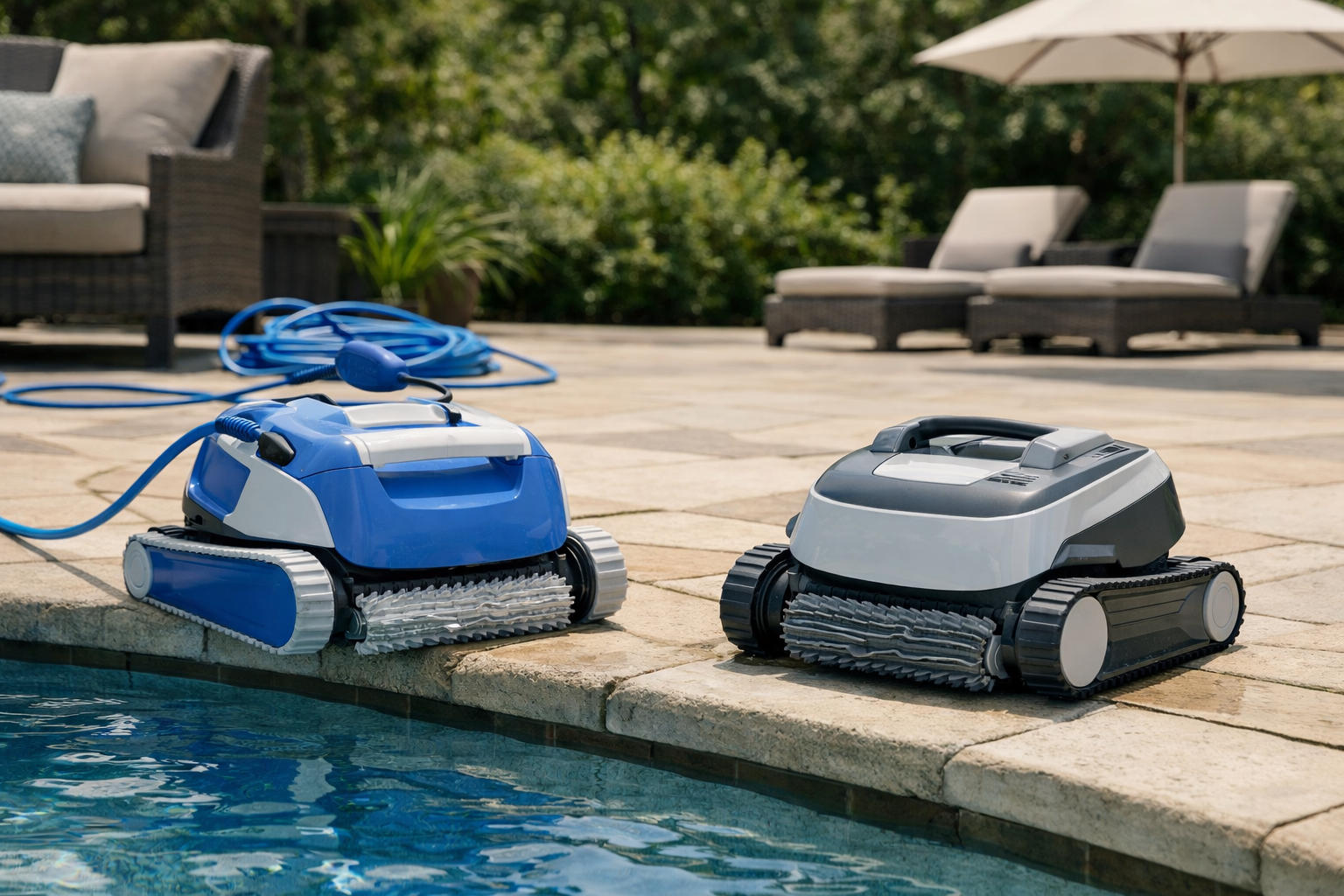
A robotic pool cleaner with app control can be convenient, but app features vary sharply by model. Do not assume that “Wi-Fi” means you can steer the robot anywhere in the pool or change every setting while it is underwater.
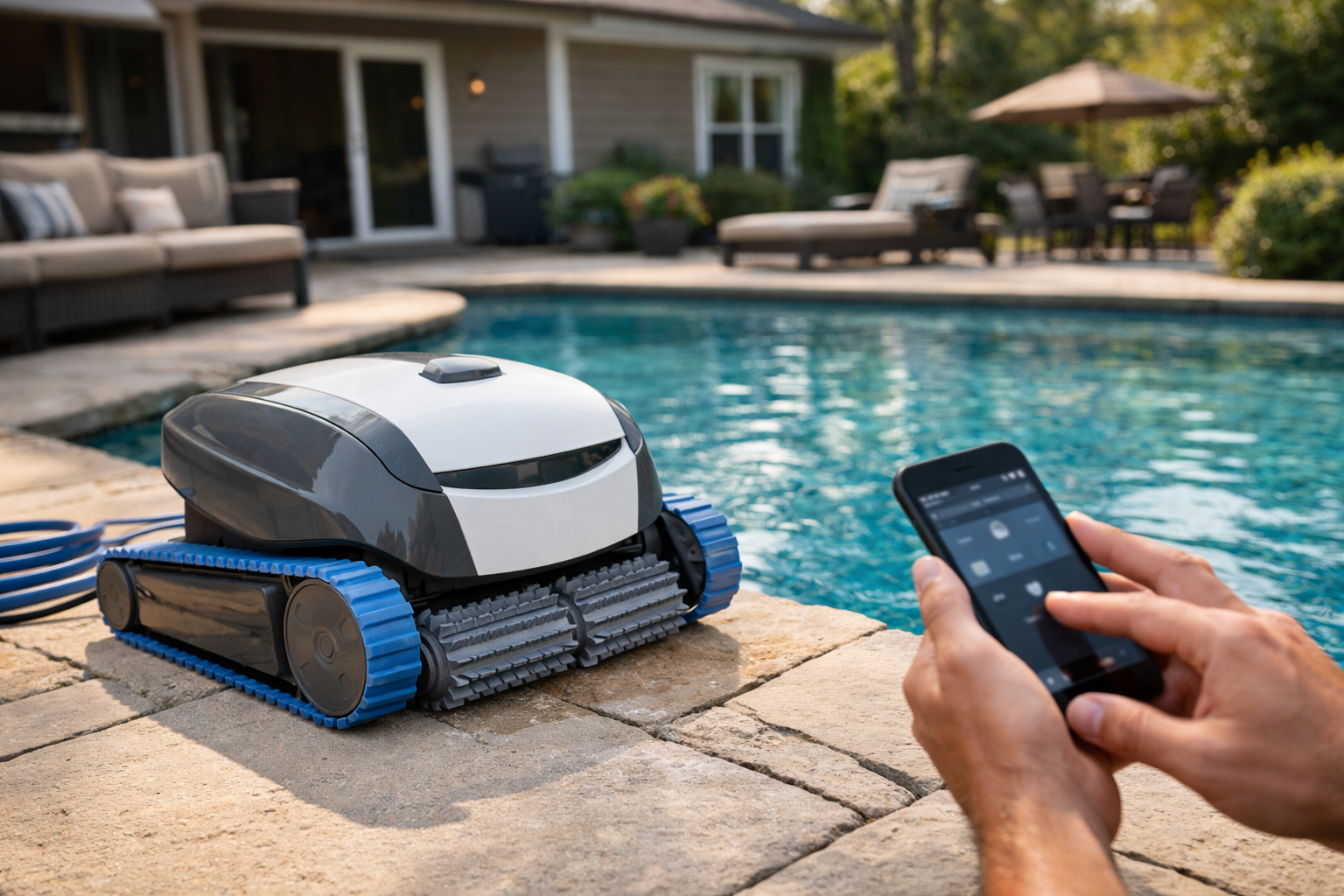
The Dolphin LIBERTY 600 uses the Maytronics One app for items including cleaning programs, Eco Mode, and filter-status monitoring. The Aiper Scuba X1 lists app updates and monitoring, while the Aiper Scuba S1 Pro lists app-selected modes.
Beatbot lists app control for the AquaSense 2 Ultra, but its support information notes an important limitation: remote control and mode switching work while the robot is operating on the water surface. That is a useful reminder to verify whether a model’s app communication works underwater, at the surface, only when docked, or only within Bluetooth range.
Before buying a smart robotic pool cleaner, verify these details:
- Whether the app uses Wi-Fi, Bluetooth, or both.
- Whether your pool area has sufficient Wi-Fi coverage.
- Whether scheduling is available and which cleaning modes it supports.
- Whether the app shows battery level, filter status, cleaning history, or notifications.
- Whether firmware updates are supported and how they are delivered.
- Whether remote control works while the cleaner is submerged.
Cordless versus corded pool cleaners
Cordless models are attractive because there is no cable to unwind, manage, or store. They can be especially convenient for pools where a power-supply location or long floating cable is inconvenient.
The tradeoff is battery management. Every cordless unit needs charging time, and runtime may change by mode. If you have a large pool, heavy debris, or a cleaning routine that calls for frequent full-coverage cycles, a corded robot may be more practical.
The Maytronics Dolphin Nautilus CC Plus is a useful corded comparison. Maytronics specifies floor and wall cleaning in a two-hour cycle for pools up to 40 feet, with Wi-Fi scheduling, start controls, and monitoring through the MyDolphin Plus app. For some owners, predictable plugged-in operation is more valuable than cable-free convenience.
Use a corded model when you want repeatable scheduled cleaning without managing a battery. Choose cordless when easier handling and cable-free retrieval matter more, and when the stated runtime comfortably covers your pool and preferred cleaning program.
What robotic pool cleaners cannot replace
Even the best robotic pool cleaners are not full pool-care systems. They can reduce routine vacuuming, but they do not eliminate the rest of pool maintenance.
- Skimming: A robot may capture some floating debris, but your skimmer remains important for regular surface cleanup.
- Water chemistry: A robot does not test or balance sanitizer, pH, alkalinity, calcium hardness, or stabilizer levels.
- Manual brushing: You may still need to brush tight corners, steps, ladders, fittings, and stubborn algae-prone areas.
- Filter care: Empty and rinse the robot’s basket after cleaning, especially after leaf-heavy cycles. Clean or replace fine filters according to the manufacturer’s instructions.
- Problem diagnosis: Cloudy water, algae, circulation problems, and equipment leaks need separate attention.
A pool robot works best as part of a regular maintenance routine. Use it to handle routine debris and floor coverage, then reserve manual work for the areas your pool’s geometry makes difficult.
Final buying advice
Start with the areas your current pool-cleaning routine misses. If the floor is your only concern, a simpler cordless or corded model may be enough. If you have a visible waterline ring, steep walls, frequent floating debris, or a large in-ground pool, compare the specific cleaning modes and runtime figures more closely.
For a cable-free model with broad listed coverage, the Maytronics Dolphin LIBERTY 600 is a model to investigate. The Aiper Scuba X1 and Aiper Scuba S1 Pro merit comparison for waterline-focused in-ground pools, while the Aiper Scuba S1 may suit simpler above-ground or in-ground setups. The Beatbot AquaSense 2 Ultra offers listed multi-area cleaning and surface parking. If charging sounds like a hassle, the corded Dolphin Nautilus CC Plus is a practical alternative to consider.
Before ordering, read the official Dolphin LIBERTY 600 specifications or compare the listed modes and runtime for the Aiper Scuba X1 against your pool’s dimensions and surface. That final compatibility check is more useful than choosing based on app features or advertised cleaning power alone.
Useful references: Dolphin LIBERTY 600 Remote Pool Cleaner · Scuba X1 Essential In-Ground Pool Cleaner
Related Home Tech Signal guides: Best AI Robot Vacuums for Cluttered Homes and Multi-Level Cleaning