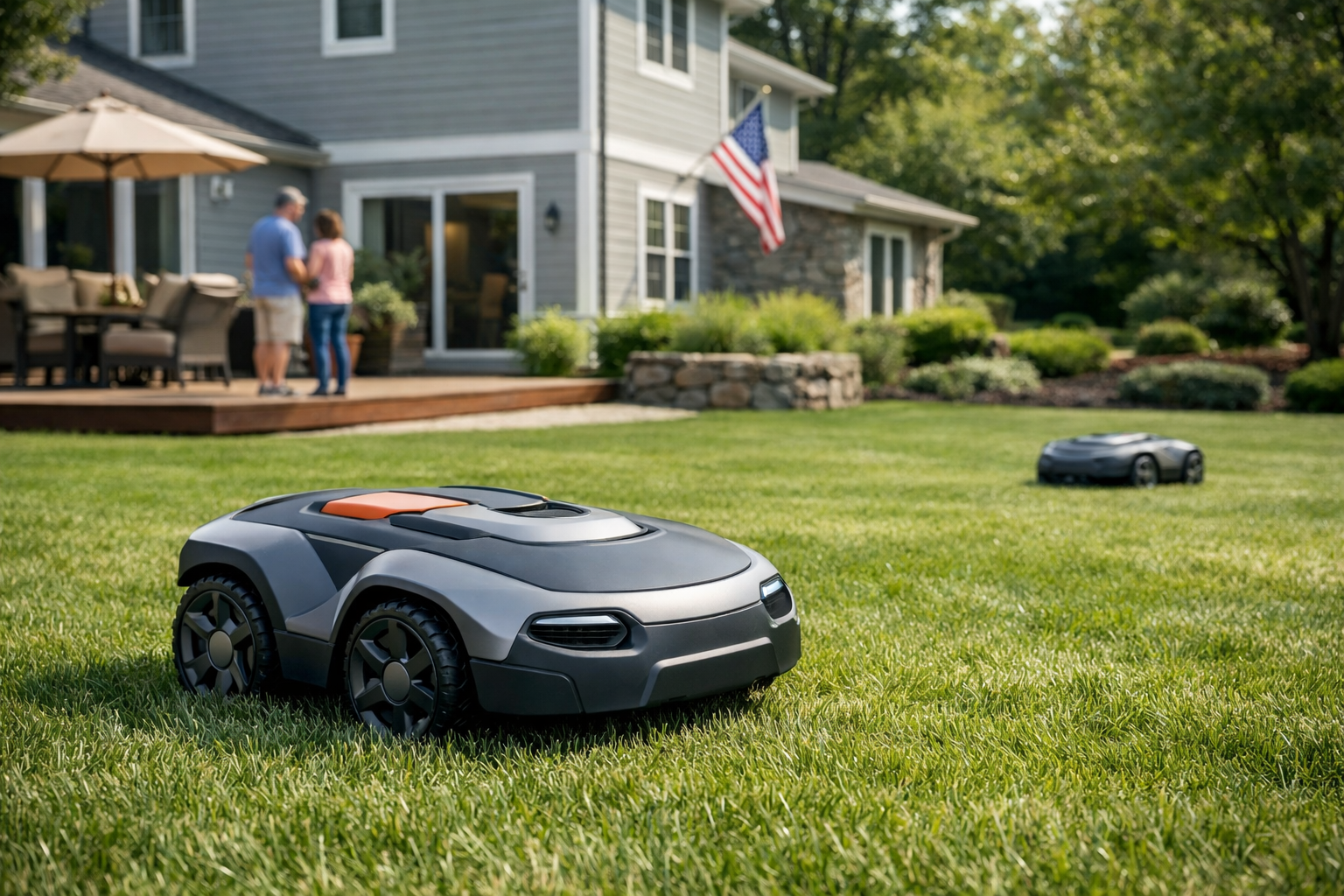
Robot lawn mowers are becoming a more realistic option for U.S. homeowners who want routine mowing without installing a traditional perimeter wire. The catch: a mower described as wire-free or boundary-free still needs the right conditions to navigate reliably.
The best robot lawn mowers for U.S. yards are not necessarily the ones with the largest published acreage rating. Your property’s tree cover, slope, lawn edges, narrow passages, Wi-Fi reach, satellite visibility, and household safety needs matter just as much. A mower that suits an open, flat half-acre lawn may be a poor fit for a heavily shaded yard with retaining walls, play equipment, and several disconnected mowing zones.
This guide compares current boundary-free residential models using manufacturer-published specifications. Those ratings are useful starting points, but they are not independent performance results or guarantees for every yard.
Best Robot Lawn Mowers for U.S. Yards: Quick Picks
- Best for a small, relatively open lawn: Segway Navimow i105. It is rated for about 0.125 acre and combines RTK positioning with vision-based navigation.
- Best for a small-to-medium lawn without an RTK antenna: eufy E18 Robot Lawn Mower. It uses vision-based mapping rather than perimeter wire or RTK hardware and is rated for up to 0.3 acre under specified conditions.
- Best for steep or uneven terrain: Mammotion LUBA mini AWD Robot Lawn Mower. It uses an all-wheel-drive design, and Mammotion lists slopes up to 80%, or about 38 degrees, for LUBA models.
- Best for larger, smart-home-connected lawns: Husqvarna Automower 420 iQ. Husqvarna rates it for up to 1 acre and documents Alexa and Google Home connectivity through Automower features.
Each pick has important installation tradeoffs. Before ordering, verify the current U.S. model configuration, included accessories, service terms, app requirements, warranty, and local dealer or support availability.
How Boundary-Free Robot Mowers Work
A boundary-free robot mower replaces buried perimeter wire with a virtual map. You generally create mowing zones, stay-out areas, and travel routes in the manufacturer’s mobile app. The mower then uses one or more navigation technologies to stay in those mapped areas.
RTK and GNSS positioning
Many wire-free mowers use satellite positioning, often called GNSS, plus RTK corrections for greater location accuracy. RTK systems may receive corrections through a local reference station, a network service, or cloud-based coverage. Husqvarna’s EPOS system, for example, is designed to create virtual boundaries and can use Husqvarna Cloud coverage or an on-site reference station. Husqvarna says its system can provide approximately 2-centimeter accuracy in suitable conditions.
The important limitation is that satellite navigation needs a usable view of the sky. Dense tree canopy, tall buildings, covered patios, and narrow spaces beside a house can reduce signal quality. If a model needs a local reference station, that station also needs broad, unobstructed sky visibility. Review Husqvarna’s EPOS installation guidance before assuming a wire-free system will work in a shaded or enclosed yard.
Vision-based navigation
Some models supplement RTK with cameras and other sensors. Others rely more heavily on vision-based mapping. This can reduce dependence on a separate RTK antenna, but vision has its own limits. Lighting, shadows, grass height, lawn-edge definition, and the size or shape of obstacles can affect what a mower recognizes.
For example, the eufy E18 Robot Lawn Mower is designed to work without perimeter wire or RTK hardware. That may simplify a property where mounting a reference station is impractical, but it also means buyers should carefully assess lawn edges and the mower’s mapping path. Vision systems are not a substitute for a clean, clearly defined mowing area.
Connectivity Is Separate From Navigation
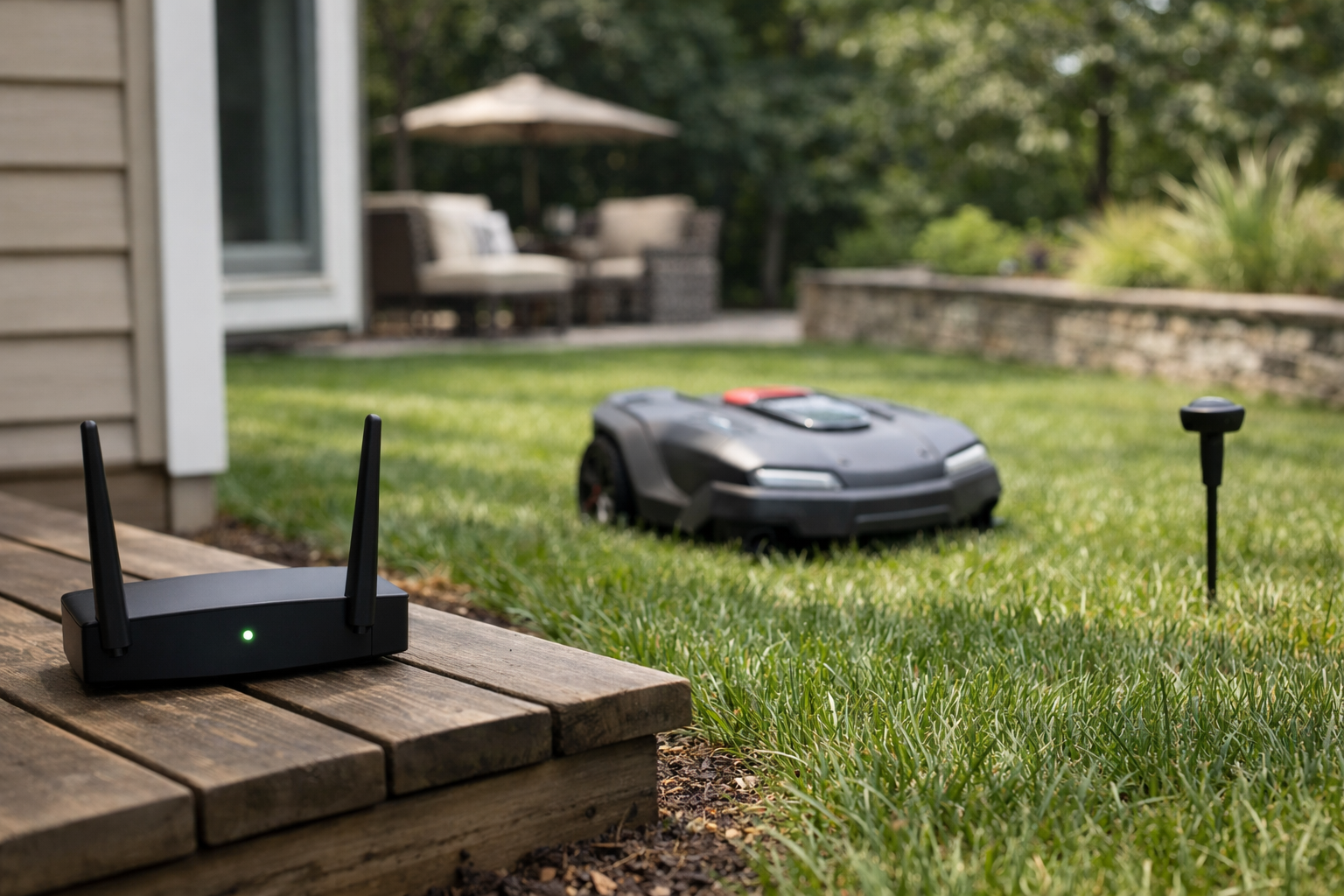
It is easy to treat Wi-Fi, cellular service, and RTK as the same thing. They are not. Wi-Fi may support app control and software updates. Cellular service may support remote status checks, tracking, or cloud-connected functions. RTK corrections may come from a local station, a network, or a cloud service depending on the model and location.
Ask the manufacturer or dealer what happens if your home Wi-Fi drops, cellular coverage is weak, or satellite positioning is interrupted. Also confirm whether a subscription, included cellular-service period, or additional antenna hardware applies to the exact mower package you are considering.
Models Compared
| Model | Published lawn capacity | Navigation approach | Terrain guidance | Smart-home support documented in sources | Key buying consideration |
|---|---|---|---|---|---|
| Segway Navimow i105 | About 0.125 acre | RTK positioning plus vision-based navigation | Up to 30%, or 17 degrees | Alexa and Google Home | Best suited to smaller lawns; confirm antenna, network-RTK, and yard signal conditions. |
| Segway Navimow i110 | About 0.25 acre | RTK positioning plus vision-based navigation | Verify the exact model’s current specifications | Alexa and Google Home | A stronger fit than the i105 when a small yard approaches a quarter acre. |
| eufy E18 Robot Lawn Mower | Up to 0.3 acre under specified conditions | Vision-based mapping without perimeter wire or RTK | Less than 18 degrees | App control documented; voice-platform support not established in reviewed sources | Assess lighting, lawn edges, camera blind spots, and the shape of the mapped area. |
| Mammotion LUBA mini AWD Robot Lawn Mower | Up to about 0.37 acre | Wire-free mapping with NetRTK, 3D vision, and sensors | LUBA models listed up to 80%, or about 38 degrees | App control documented; voice-platform support not established in reviewed sources | Consider it for sloped yards, but check traction, drainage, obstacles, and slope transitions on your property. |
| Husqvarna Automower 410 iQ | Up to 0.5 acre | EPOS virtual boundaries | Check current model-specific slope limit | Alexa and Google Home through Automower connectivity | Confirm whether Husqvarna Cloud coverage or a reference station is needed at your address. |
| Husqvarna Automower 420 iQ | Up to 1 acre | EPOS virtual boundaries | Check current model-specific slope limit | Alexa and Google Home through Automower connectivity | Better matched to larger residential lawns, provided the property supports its positioning setup. |
Published capacity is a planning number, not a promise. A lawn with steep grades, many landscape islands, frequent obstacles, thick grass, or multiple zones can demand more time and navigation work than an open lawn of the same acreage.
Which Robot Mower Fits Your Yard?
Small Lawns: Segway Navimow i105 or eufy E18 Robot Lawn Mower
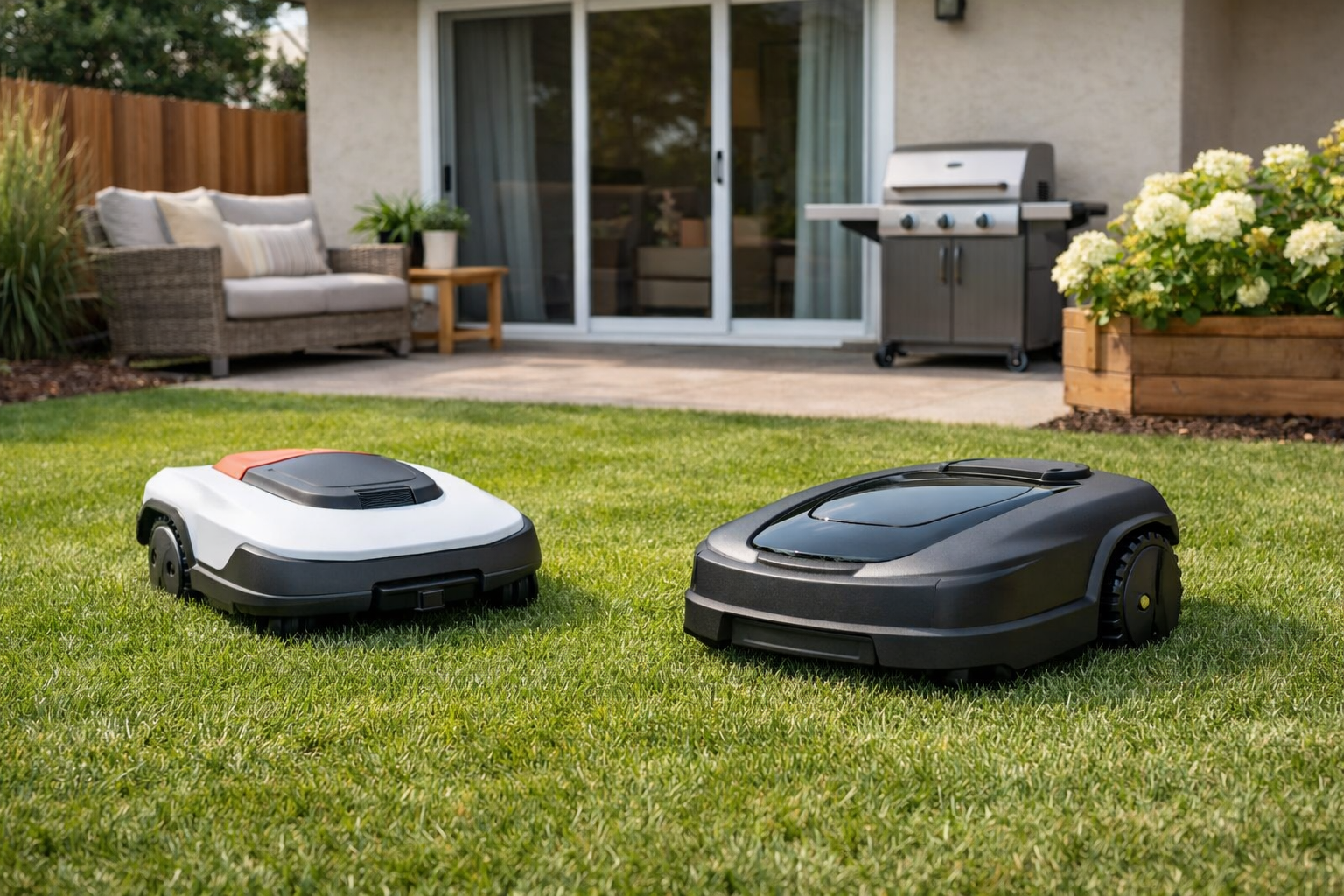
For a compact lawn, the Segway Navimow i105 is worth considering if your yard has reasonable satellite or RTK support and you want documented Alexa and Google Home compatibility. Segway lists lifting and bumper sensors, VisionFence obstacle recognition, child lock features, weather response, and out-of-boundary alerts for this product line.
The eufy E18 Robot Lawn Mower is a different approach for buyers who prefer a mower that does not require RTK hardware. It may be more appealing where a reference-station installation is difficult, but do not assume that means it is ideal under dense trees or in dim, cluttered areas. eufy advises users about camera blind spots and recommends daylight mowing.
Medium Lawns: Segway Navimow i110, Mammotion LUBA mini AWD, or Husqvarna Automower 410 iQ
For lawns roughly in the quarter-acre range, start with the actual mowable turf area rather than lot size. A quarter-acre property may have far less than a quarter acre of grass once the home, driveway, patios, gardens, and planting beds are excluded.
The Navimow i110 provides more published capacity than the i105. The Mammotion LUBA mini AWD Robot Lawn Mower is the more specialized option when slope is a central issue. The Husqvarna Automower 410 iQ may make sense for a yard that needs more capacity and can support Husqvarna’s EPOS positioning requirements.
Larger Lawns: Husqvarna Automower 420 iQ
For an open lawn approaching 1 acre, the Husqvarna Automower 420 iQ is the most clearly sized option in this comparison. Its value depends on whether your property can support consistent virtual-boundary positioning. Verify sky visibility, cloud or reference-station requirements, mowing-zone setup, and whether the mower’s current slope rating matches every area it must cover.
Large-yard owners should also plan for practical details: where the charging station will sit, how the mower reaches separate zones, whether gates must stay open, and whether seasonal leaf fall or storm debris will require more frequent lawn preparation.
Robot Lawn Mower Safety Features That Matter
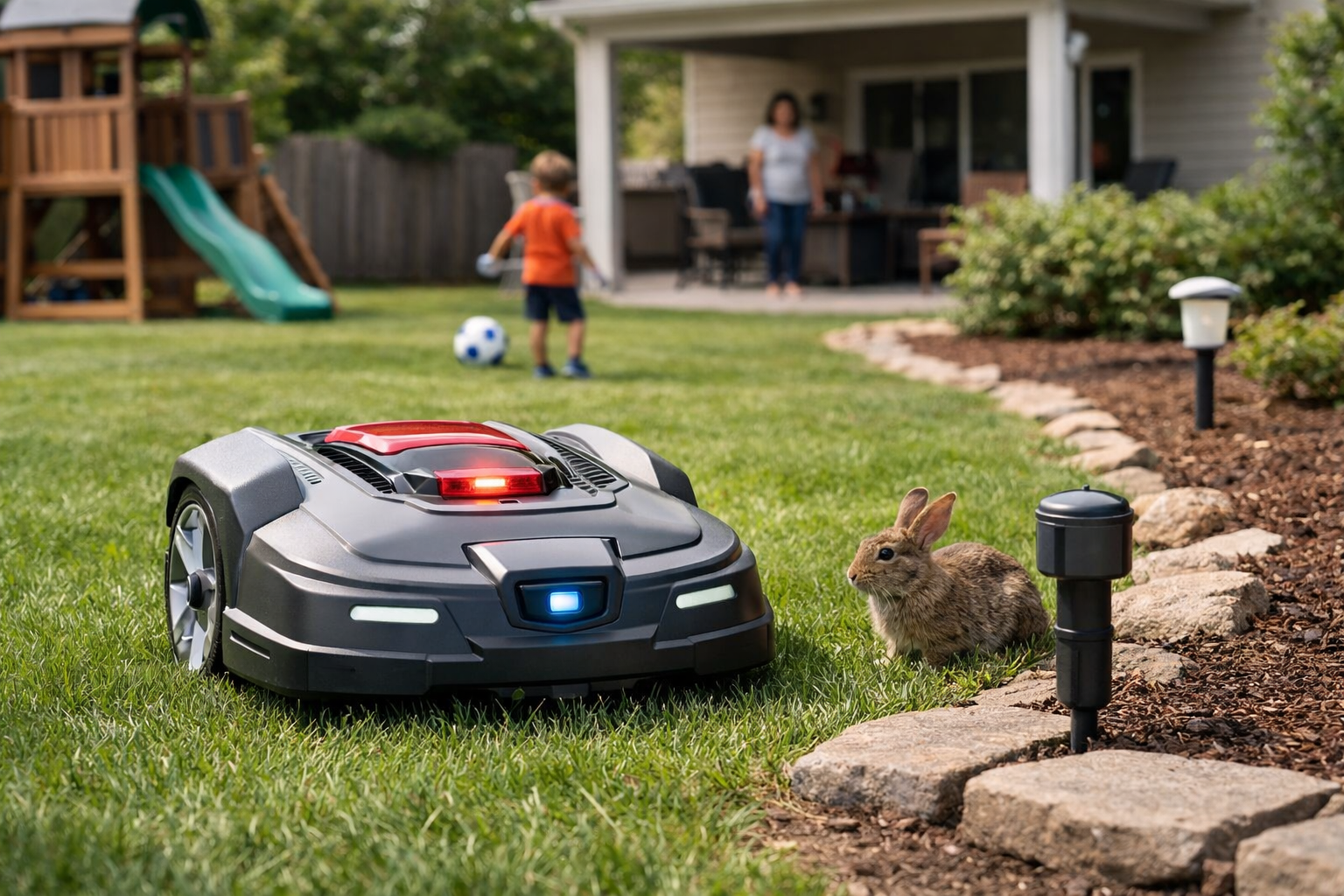
Robot mowers should be treated like powered outdoor equipment, not autonomous household appliances that can operate without preparation or supervision. Obstacle avoidance can reduce some risks, but it cannot reliably account for every child, pet, wildlife encounter, hose, toy, branch, hole, or unexpected object in the mowing path.
Look for the following features, then read the product manual to understand how each one works:
- Lift and tilt detection: Intended to stop or alter blade operation when the mower is picked up or tipped.
- Bumper and obstacle sensing: Can help the mower respond to objects it contacts or identifies, but performance can vary by object size, terrain, lighting, and sensor conditions.
- Child lock and PIN protection: Helps prevent unauthorized operation or settings changes.
- Virtual no-go zones: Useful around ponds, play areas, gardens, drop-offs, and places where obstacles are regularly present.
- Geofencing and theft alerts: Helpful recovery and notification features, though they do not physically prevent theft.
- Rain and weather response: May pause mowing in unfavorable conditions, depending on model settings and product design.
Do not schedule mowing when children, pets, or people are likely to be using the lawn. Bring in toys, hoses, sports equipment, and loose debris first. If your yard attracts hedgehogs, turtles, rabbits, or other wildlife, inspect the grass before starting a mowing cycle and avoid unattended nighttime operation unless the manufacturer specifically documents a safe approach for your circumstances.
For U.S. buyers, formal safety claims deserve a separate check. The U.S. Consumer Product Safety Commission’s mower standards reference identifies ANSI/OPEI 60335-2-107-2020 as a safety specification for consumer turf-care equipment. That page does not certify individual robot mower models, so ask the manufacturer for the current safety listing or conformity documentation for the exact mower sold in the U.S.
Smart-Home Integration: Alexa and Google Home
Smart-home support can be convenient, but it should not be the primary reason to choose a mower. Navigation reliability, capacity, terrain suitability, and safety setup matter more.
Husqvarna documents Amazon Alexa and Google Home support for compatible Automower connectivity features. Segway also lists Alexa and Google Home support for Navimow models. These integrations may allow basic voice commands or status checks, but available commands can change with app versions, regions, account settings, and connected services.
The reviewed Mammotion and eufy product pages emphasize app-based lawn management and control. They do not clearly establish current Alexa, Google Home, Matter, or Home Assistant compatibility. If voice control or automation is essential, verify the manufacturer’s current compatibility documentation before purchase. For broader automation ideas, see our internal guide to How to Create Smart Home Automations for Beginners.
What to Check Before You Buy
Use this checklist before selecting a boundary-free robot mower:
- Measure mowable grass, not property size. Exclude the house, driveway, decks, garden beds, and non-mowable areas.
- Measure your steepest slope. Include transitions at the top and bottom of grades, which can be more difficult than a consistent hill.
- Walk the lawn at the mower’s likely route. Note narrow passages, roots, drainage channels, exposed edging, uneven ground, and low branches.
- Assess sky visibility. Identify dense tree cover, tall fences, nearby structures, and areas beside the home that could interfere with satellite-based navigation.
- Check connectivity where the mower will operate. Test Wi-Fi near the charging station and across the lawn if app control depends on it. Confirm cellular and network-RTK coverage where relevant.
- Plan safety zones. Mark ponds, play areas, garden beds, drop-offs, pet areas, and sections with frequent debris as no-go zones.
- Confirm edge conditions. Vision-based systems especially benefit from visible, well-defined boundaries between grass and hardscape, mulch, or garden beds.
- Review ongoing costs. Ask about replacement blades, reference-station accessories, cellular plans, subscription services, winter storage, repairs, and dealer service.
- Verify the exact U.S. package. Product pages, accessories, coverage terms, pricing, and warranties can change by retailer and season.
Bottom Line
The best robot lawn mowers for U.S. yards match their navigation system to the property—not just their acreage rating. Choose the Segway Navimow i105 for a smaller lawn where RTK and vision navigation are practical and Alexa or Google Home support matters. Consider the eufy E18 Robot Lawn Mower if you want a vision-based, no-RTK approach and can provide clear edges and favorable daylight conditions. Look at the Mammotion LUBA mini AWD Robot Lawn Mower when steep terrain is the defining challenge. For larger lawns, the Husqvarna Automower 420 iQ is a strong specification-based option if EPOS coverage or a correctly installed reference station is feasible.
Whichever model you choose, treat virtual boundaries and obstacle detection as helpful tools rather than guarantees. A careful site survey, realistic safety plan, and confirmation of current connectivity and service requirements will do more for day-to-day satisfaction than a feature list alone.
Useful references: Husqvarna EPOS – Virtual boundaries. Endless possibilities.