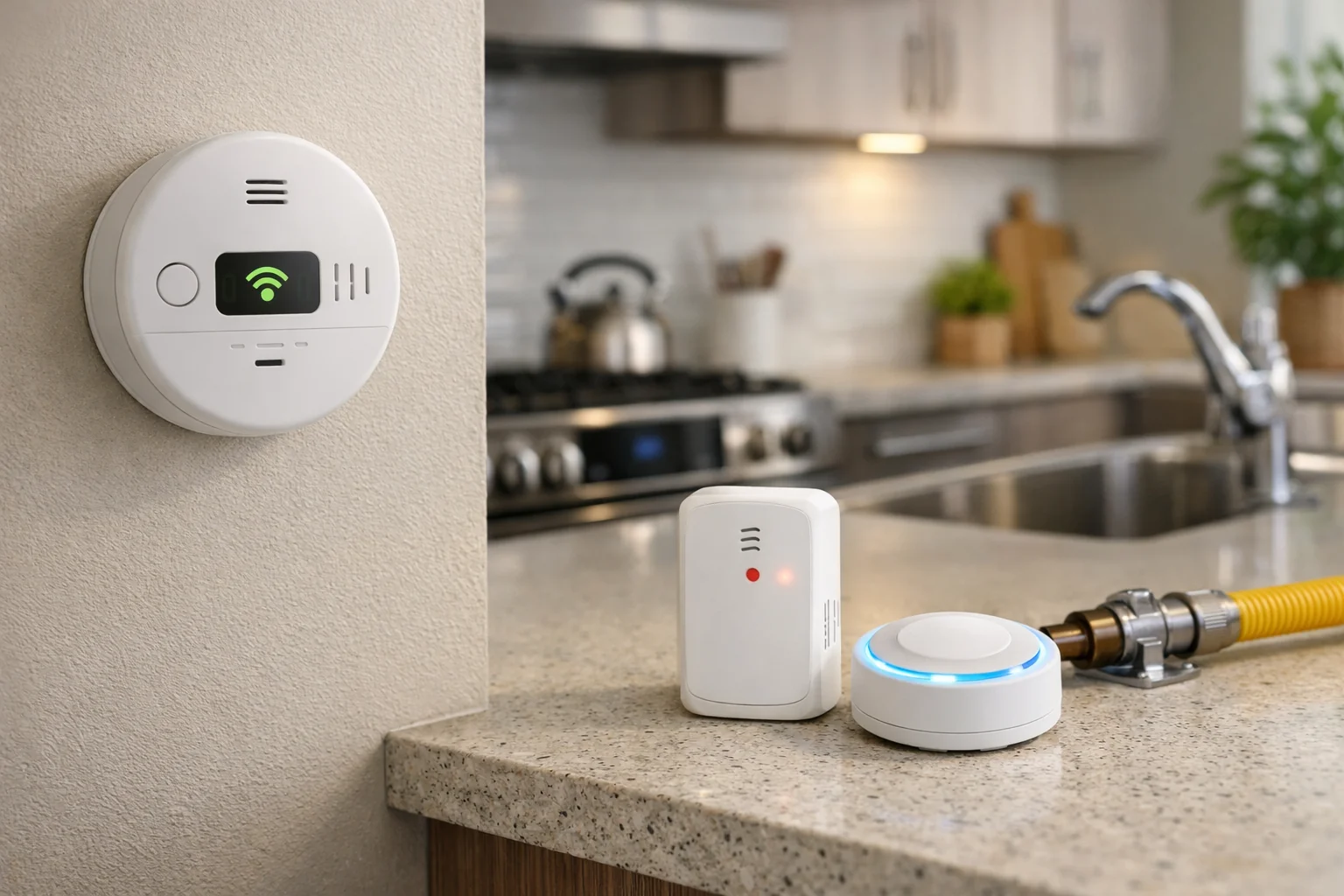
Smart carbon monoxide and gas leak detectors can add a useful second layer of protection: a notification to your phone when you are at work, traveling, or checking on a relative’s home remotely. A loud alarm inside the home, however, remains the most important warning when carbon monoxide or combustible gas is detected.
That extra layer does not make every alarm interchangeable. Carbon monoxide (CO), natural gas, and propane are different hazards that require different types of sensing and, often, different installation locations. Build around properly selected, safety-listed local alarms first, then treat smartphone alerts as an added way to stay informed.
Why connected gas and CO detection matters
Carbon monoxide is a colorless, odorless gas produced when fuel does not burn completely. Potential sources include furnaces, water heaters, fireplaces, vehicles left running in an attached garage, and portable generators. Because people cannot reliably see or smell CO, exposure can cause illness or death before anyone recognizes the problem.
A conventional alarm can wake people who are home. A connected alarm may also tell you which device detected a problem, where it is located, or when its battery needs attention. That can be particularly helpful for people who travel, own a second home, or help manage a parent’s home.
Smart carbon monoxide and gas leak detectors should not be treated as a substitute for a locally audible alarm. If a hazard occurs while the internet is unavailable, occupants still need a loud warning in the home and a clear plan to leave safely.
CO detection and combustible-gas detection are different
The most important shopping rule is simple: a CO-only alarm does not detect a natural-gas leak, propane leak, methane, or other combustible gases. Likewise, a detector intended for natural gas may not be designed to detect propane or carbon monoxide.
CO is a toxic byproduct of combustion. Natural gas is primarily methane, a fuel gas that can create a fire or explosion risk when it accumulates. Propane, sometimes labeled LPG, is also combustible but behaves differently in air. These distinctions affect both the sensor you need and where it should be installed.
If your home has a gas furnace, range, water heater, fireplace, or attached garage, you may need CO alarms regardless of whether you add combustible-gas detection. If you want leak detection for a natural-gas or propane supply, choose a dedicated detector rated for that specific fuel or a combination device that is explicitly evaluated for both hazards.
Look beyond broad marketplace descriptions such as “4-in-1” or “gas and CO detector.” Check the model documentation to confirm exactly which gases it detects and which safety requirements it meets. UL Solutions explains that residential combustible-gas detectors and CO alarms are evaluated under different requirements, including UL 1484 for residential gas detectors and UL 2034 for CO alarms. Smoke/CO combination alarms may also involve UL 217 requirements for smoke detection.
How smart carbon monoxide and gas leak detectors send alerts
Connected alarms commonly use Wi-Fi and a manufacturer app to deliver notifications. Depending on the device, the app may identify the alarm type, name the device or room, show connectivity status, or alert you to a low battery and end-of-life condition. Some systems can also interconnect compatible alarms, so an event detected in one area can trigger alarms elsewhere in the home.
These features can be useful when an alarm would otherwise be heard only by someone standing nearby. A location-specific notification can also help you tell a guest, neighbor, or emergency responder where an alarm originated—after everyone has moved to safety.
Still, connected alerts have limits:
- Wi-Fi and internet are part of the alert path. If either is unavailable, app notifications may not arrive.
- Power loss can affect connectivity. Verify whether a model has battery backup, a sealed battery, or another backup method for local alarm operation.
- Cloud services and apps are not emergency dispatch services. Do not assume an app alert automatically contacts 911, the fire department, or your gas utility unless you have confirmed professionally monitored service terms.
- Notifications can be missed. A muted phone, disabled app permissions, or a household member without app access can prevent a remote warning from reaching the right person.
Google’s Nest Protect support documentation offers a useful example of the distinction: local smoke and CO detection can continue when the device is offline, but app notifications are unavailable. That is why every connected safety plan still needs audible local alarms, proper placement, routine testing, and reliable backup power where the product supports it.
Where to install CO and combustible-gas detectors
For CO alarms, the U.S. Consumer Product Safety Commission recommends alarms on every level of the home and outside sleeping areas. The CDC also advises using battery-operated or battery-backup CO detectors near every sleeping area. Your state, city, landlord, insurer, or adopted building code may require additional locations, especially in homes with fuel-burning equipment or attached garages.
Use those recommendations as a safety baseline, not as a replacement for local code. If you are renting, ask your landlord or property manager about required alarms and who is responsible for replacement. If you are renovating or adding fuel-burning appliances, check with the local building department or fire marshal.
Combustible-gas detector placement is more product- and fuel-specific. Natural gas generally rises, while propane/LPG can collect closer to the floor. That means a detector’s mounting height and recommended distance from appliances can vary. Do not install a gas detector based solely on where a CO alarm is located.
Before mounting a combustible-gas detector, verify:
- Whether it is designed for natural gas/CNG, propane/LPG, or another fuel.
- The manufacturer’s specified mounting height and distance from potential leak sources.
- Whether it must be plugged into a particular outlet or hardwired location.
- Whether it should be kept away from steam, cooking fumes, vents, doors, windows, or areas with unusually strong airflow.
- Whether its instructions identify spaces where it should not be installed.
What to check before buying a connected detector
There is no one best device for every house. Start with the hazards present in your home, then verify the exact model—not just the brand name or retailer listing.
1. Confirm the hazard it detects
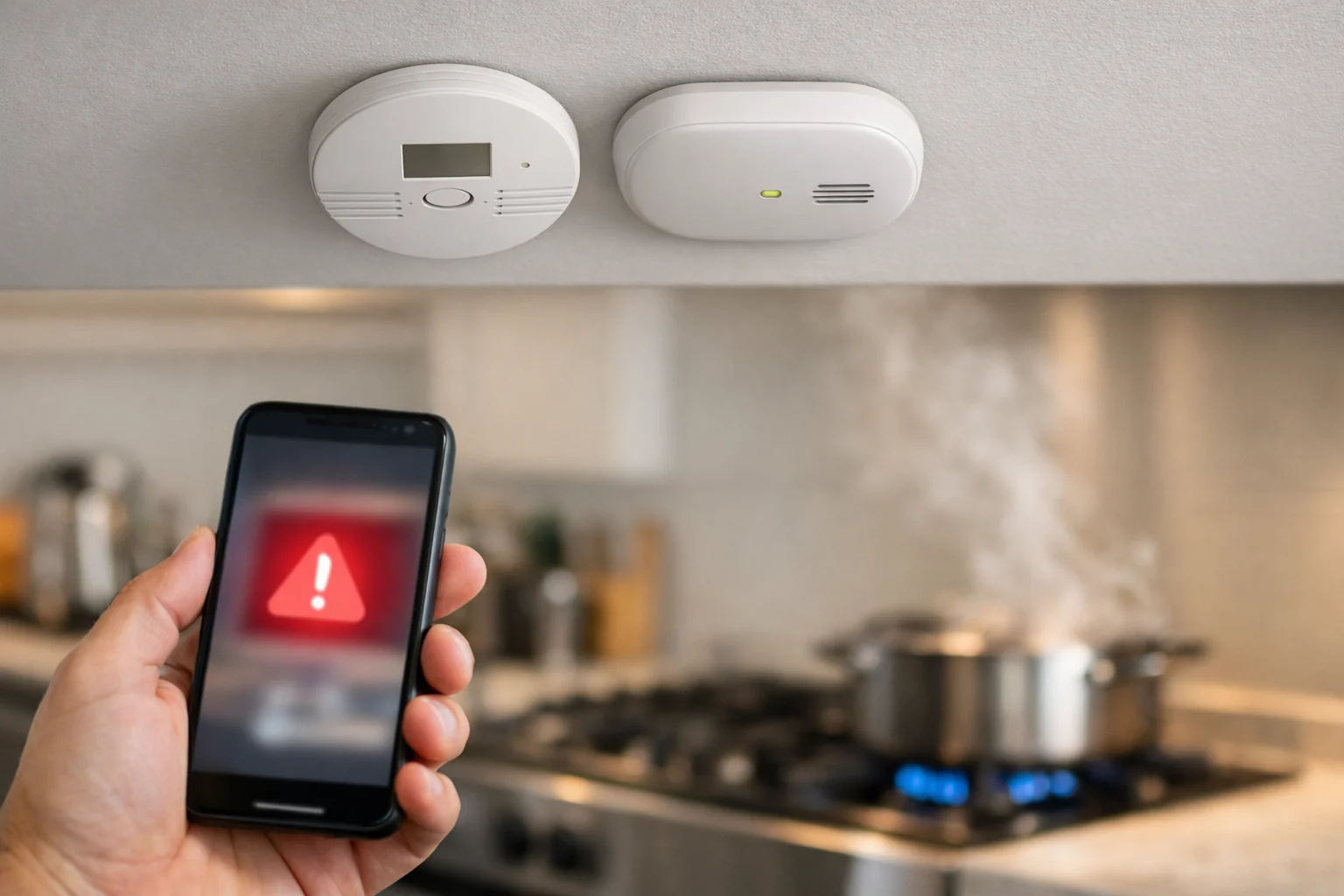
For CO coverage, look for a CO alarm evaluated to UL 2034. For combustible-gas coverage, look for a detector appropriate to the fuel in your home and verify whether it is listed to applicable residential gas-detector requirements, including UL 1484 where applicable. A combination product should clearly identify both capabilities.
Do not assume that a device marketed as a smart CO detector also detects natural gas. Similarly, do not assume a smart natural-gas detector covers propane. Verify supported gases in the manual and product labeling.
2. Put local alarms ahead of app features
A useful connected device should provide a clear local sound alarm and, where applicable, visual indicators. Its phone notification should supplement that warning. Check whether the product can still detect and sound locally during an internet outage, and verify its behavior during a power outage.
3. Understand compatibility and interconnection
Some alarms interconnect only with devices from the same product family. Others require a hub, a particular app, or a compatible smart-home platform. Confirm whether existing alarms can participate before replacing a single device and expecting whole-home warning behavior.
If you want to build routines around safety status or device maintenance, our guide to How to Create Smart Home Automations for Beginners can help with the basics. Do not create an automation that delays evacuation or attempts to diagnose an alarm condition before people leave the building.
4. Check maintenance and end-of-life details
All alarms need testing and eventual replacement. The CPSC recommends testing CO alarms monthly and replacing batteries annually where applicable. Follow the specific model’s instructions for test procedures, cleaning, battery maintenance, and replacement timing. The CDC notes that detectors should be replaced according to manufacturer instructions, generally every five years.
Also verify how the device reports low battery, sensor end of life, disconnection, and failed self-tests. A remote status alert is valuable only if someone acts on it.
5. Research recalls and identify the exact model

Be especially cautious with unfamiliar combination devices sold through online marketplaces. In an August 2026 warning, the CPSC told consumers to stop using several rebranded KH158 4-in-1 plug-in natural-gas and carbon monoxide detectors after reports that they failed to alert consumers to hazardous gas or CO levels. Review the CPSC warning on the affected 4-in-1 detectors before relying on an unverified model.
A low price, an app connection, and a long feature list do not establish that a life-safety device is properly evaluated. Buy identifiable models from established sellers, retain the documentation, and check for recalls before installation.
What to do when a CO or gas alarm sounds
Do not use an app alert to investigate from inside the home. Treat any alarm as a potential emergency.
If a carbon monoxide alarm sounds
Move everyone outside or to fresh air immediately. Call 911, your local emergency number, or the fire department from a safe location, particularly if anyone has symptoms such as headache, dizziness, weakness, nausea, vomiting, chest pain, or confusion. Do not re-enter until emergency personnel say it is safe. Have fuel-burning appliances and other possible sources inspected by a qualified professional before using them again.
If a combustible-gas alarm sounds or you suspect a gas leak
Leave the area immediately. Do not turn lights or appliances on or off, use a phone inside the building, start a vehicle nearby, light a flame, or do anything that could create a spark. From a safe location away from the home, contact 911, the fire department, or your gas utility and follow their instructions.
Do not assume an alarm is false simply because you do not smell gas or feel ill. CO has no odor, and odor intensity is not a dependable way to judge a gas emergency.
The practical bottom line
Smart carbon monoxide and gas leak detectors can improve awareness by extending alerts to your phone and helping you monitor device status. They are most useful when paired with correctly selected, properly placed, locally audible alarms that people can hear while asleep or when the home is offline.
Start by identifying your risks: CO from fuel-burning equipment, natural gas from utility service, propane from tanks or appliances, or some combination. Then verify the exact device’s supported hazards, safety listing, local alarm behavior, backup power, placement instructions, maintenance requirements, and recall status. Connected notifications are valuable—but the immediate response to a real alarm should always be to get people to safety first.
Related Home Tech Signal guides: Best Smart Water Shutoff Valves for Leak Protection